Should Red Dot Align With Front Sight?
You should align your red dot with the front sight to create a clear, consistent aiming point that boosts accuracy and speeds up shot placement. This setup helps you focus precisely on the target while keeping your front sight visible as a backup if the dot falters. It works well for both pistols and rifles but can vary with your shooting scenario. Understanding when and how to adjust this alignment can make a big difference in your performance and confidence.
Key Takeaways
- The red dot should be centered and level over the front sight for a unified aiming reference and precise shot alignment.
- Proper alignment reduces parallax errors, improves shot grouping, and creates a consistent aiming point for quicker target acquisition.
- Firearm type affects alignment; pistols require precise front sight focus, while rifles may need offset or taller sights for red dot placement.
- In rapid-fire or dynamic scenarios, the front sight serves as a crucial backup if the red dot shifts or fails.
- Zeroing involves adjusting red dot windage and elevation to overlap the front sight and confirming impact matches the combined sight picture.
What Does It Mean to Align a Red Dot With the Front Sight?
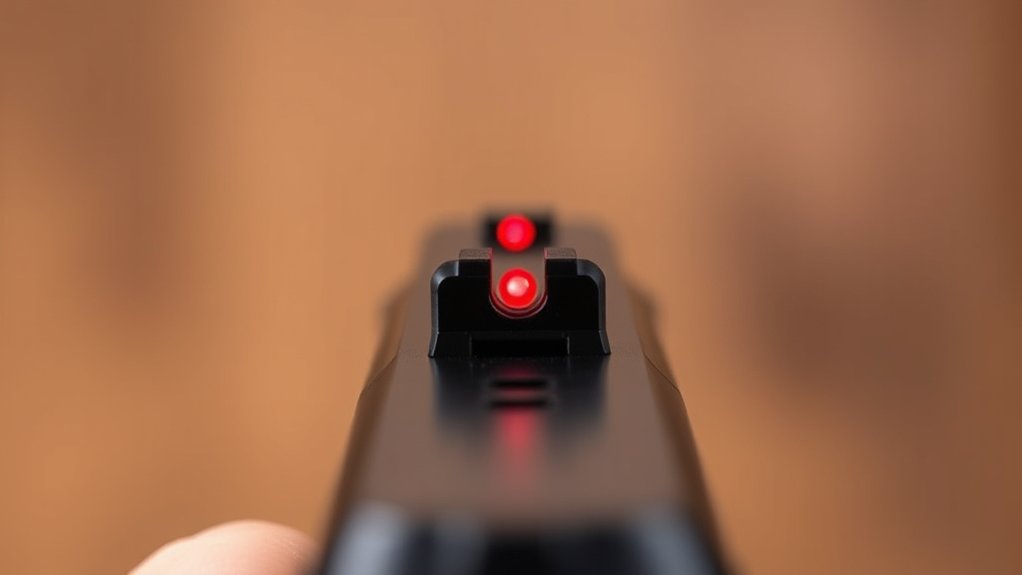
Understanding how to align a red dot with the front sight means combining two aiming points for greater accuracy.
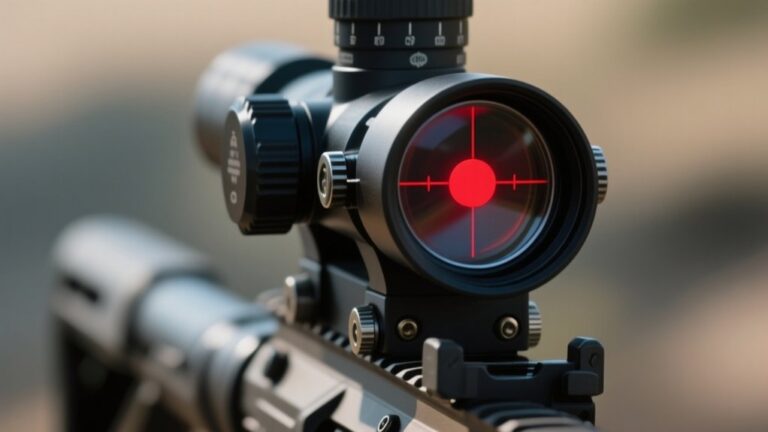
When you look through your optic, you’ll see the red dot superimposed over your target. Aligning it with the front sight involves positioning the dot so it sits directly on top of the front sight post.
This creates a single, unified aiming reference, helping you focus precisely where your bullet will hit. You’ll want to guarantee the red dot and front sight are centered and level, avoiding any offset that could throw off your shot.
How Does Red Dot and Front Sight Alignment Affect Accuracy?
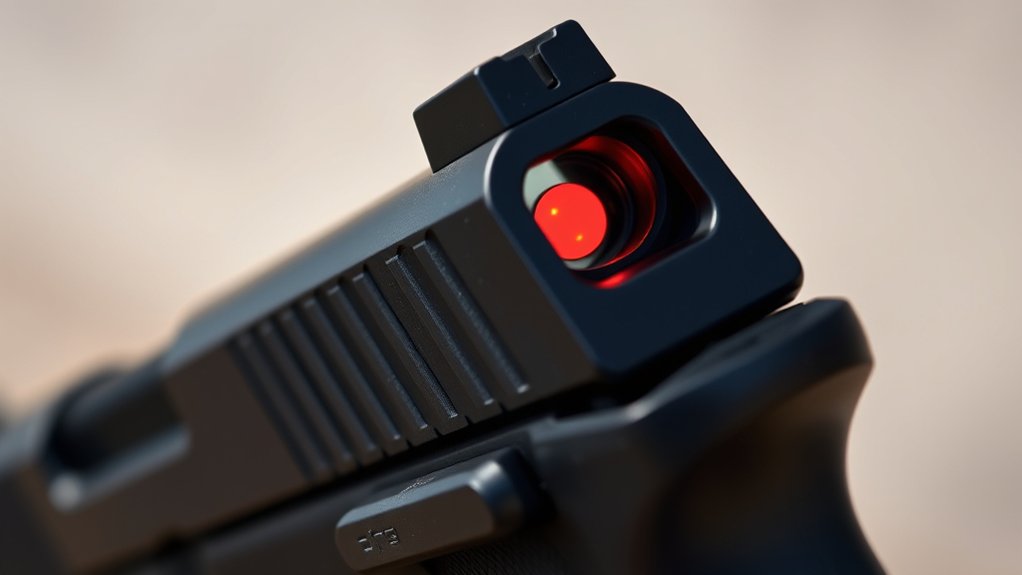
When you align the red dot with the front sight correctly, you considerably improve your shooting accuracy by creating a consistent aiming point. This alignment helps your brain quickly process the target and sight picture, reducing hesitation and aiming errors.
Without proper alignment, you risk aiming off-target, causing shots to stray from your intended point of impact. The red dot serves as a precise reference, while the front sight ensures you maintain proper sight picture, especially in dynamic shooting scenarios.
By consistently aligning both, you minimize parallax errors and improve shot grouping, making every shot more predictable and controlled.
Ultimately, this synergy between red dot and front sight alignment enhances your confidence and performance, letting you focus on trigger control and follow-through.
When Should You Line Up Your Red Dot and Front Sight?
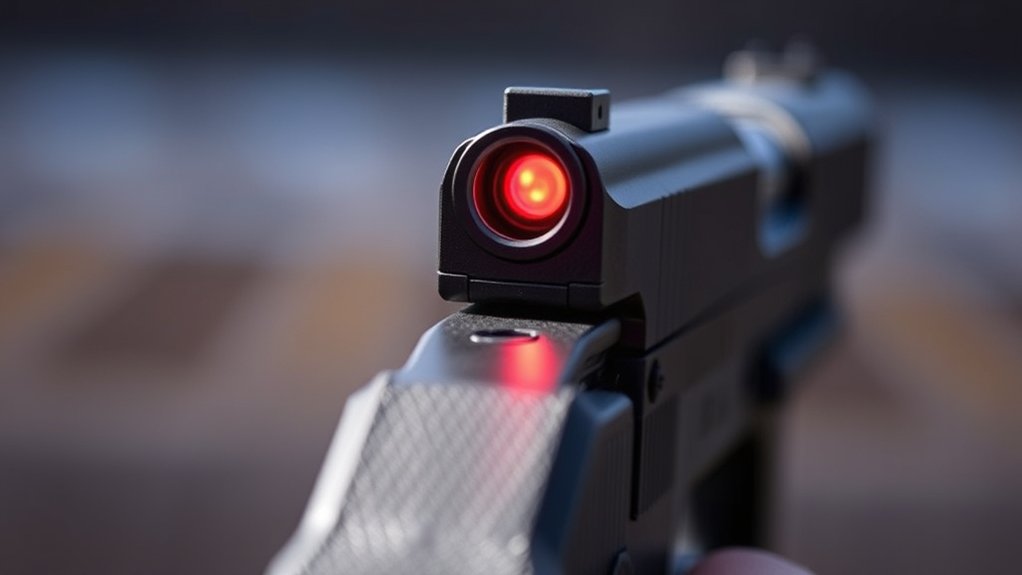
Properly aligning your red dot and front sight improves accuracy, but knowing the right moment to line them up can make all the difference. You should align them when precision matters most—like engaging distant or small targets where every fraction of an inch counts.
During rapid-fire or close-quarters situations, focusing solely on the red dot might be faster and just as effective. However, when taking deliberate shots, especially in competitions or hunting, aligning both sights ensures maximum accuracy.
Also, if your red dot fails or shifts, relying on the front sight alignment keeps you prepared. Ultimately, you control when to line them up based on the shooting context—switching between speed and precision to hit your target confidently.
Pros and Cons of Aligning Red Dot and Front Sight
Although aligning your red dot and front sight can boost accuracy, it’s important to weigh the benefits against potential drawbacks. On the plus side, aligning both helps create a consistent reference point, improving shot precision and reducing aiming errors. It also simplifies target acquisition, especially for beginners who rely on familiar front sight placement.
However, this alignment can slow you down in dynamic shooting scenarios, where quickly switching between the red dot and iron sights matters. It may also clutter your sight picture, causing confusion under stress. Plus, if your red dot is zeroed differently, forcing alignment can lead to inconsistent shots.
Ultimately, consider your shooting style and environment before deciding whether to align your red dot with the front sight.
How Different Firearms Affect Red Dot and Front Sight Setup
When setting up your sights, keep in mind that pistols and rifles handle red dot and front sight alignment differently.
You’ll notice pistols require precise front sight focus, while rifles often integrate optics for quicker target acquisition.
Understanding these differences helps you adjust your setup for each firearm effectively.
Pistol Sight Alignment
How does the type of firearm you use impact the way you align your red dot and front sight?
With pistols, the shorter sight radius means small misalignments become more noticeable, so you need precise alignment between your red dot and front sight. Many pistols allow co-witnessing, where the red dot aligns directly over the front sight, letting you quickly check both at once. This setup helps maintain accuracy and speeds up target acquisition under stress.
However, some pistols have offset or lower-mounted red dots, requiring you to adjust your sight picture accordingly. You must also account for your shooting style and whether you rely primarily on the red dot or front sight as your reference, ensuring a consistent, repeatable sight alignment tailored to the specific pistol you’re using.
Rifle Optic Integration
Since rifles typically have longer sight radii and more mounting options, you’ll need to adjust how you align your red dot and front sight compared to pistols.
On rifles, your red dot often mounts on a flat top rail, which can place it at a different height relative to your front sight. This means you might have to slightly offset your red dot or use a taller front sight post to maintain a clear sight picture.
Also, depending on whether your rifle has backup iron sights, you’ll want to guarantee the red dot doesn’t block your view.
What Shooting Styles Benefit From Aligning Red Dot and Front Sights?
You’ll find that aligning your red dot and front sights really pays off in precision target shooting, where every millimeter counts.
It also gives you an edge in tactical combat scenarios by speeding up your target acquisition.
Plus, competition shooters benefit from the improved accuracy and consistency this alignment offers.
Precision Target Shooting
Why do some shooters prioritize aligning the red dot with the front sight in precision target shooting? Because this alignment enhances accuracy and consistency when you’re aiming at small, distant targets.
In precision shooting, every fraction of an inch counts, and relying solely on the red dot can sometimes lead to subtle aiming errors. By aligning the red dot with the front sight, you create a clear reference point that helps stabilize your aim and confirm that your shot placement is exact.
This technique benefits disciplines like bullseye shooting or long-range pistol competitions, where tight groupings matter most. You’ll find that combining both sights allows you to verify your point of impact with greater confidence, reducing guesswork and improving overall precision.
Tactical Combat Scenarios
While aligning the red dot with the front sight sharpens your precision on the range, this technique also plays a key role in tactical combat scenarios. When every shot counts, combining these sighting methods helps you maintain accuracy under stress.
You benefit from a clear, quick sight picture, which is essential when engaging multiple or moving targets.
Shooting styles that benefit include:
- Close-quarters battle, where speed and accuracy are critical
- Low-light operations, requiring quick target acquisition
- Dynamic movement shooting, demanding reliable sight alignment
- Defensive scenarios, where instinctive shooting meets precision
Competition Shooting Benefits
How does aligning the red dot with the front sight improve your performance in competition shooting? It enhances your aiming speed and accuracy by providing a consistent reference point. This alignment helps you quickly transition between targets while maintaining precision, essential in fast-paced events.
You’ll find this technique especially beneficial in shooting styles like IPSC, 3-Gun, and Steel Challenge, where speed and accuracy matter equally. Aligning both sights reduces the guesswork, letting you focus on your stance and trigger control.
| Shooting Style | Benefit of Alignment | Key Advantage |
|---|---|---|
| IPSC | Faster target acquisition | Improved stage times |
| 3-Gun | Smooth transitions | Enhanced accuracy |
| Steel Challenge | Quick, precise shots | Better overall scores |
How to Zero Your Red Dot Using the Front Sight
Before you start adjusting your red dot sight, you’ll want to align it perfectly with your front sight to guarantee accurate shooting. Begin by mounting your firearm securely on a stable rest to minimize movement.
Start by securely mounting your firearm to ensure stability before aligning your red dot sight with the front sight.
Aim at your target using the front sight and note where the red dot is positioned in relation to it. Adjust the red dot windage and elevation turrets so the dot overlaps the front sight exactly.
To zero your red dot using the front sight, follow these steps:
- Aim at a consistent target point with your front sight centered
- Adjust the red dot until it aligns directly over the front sight
- Fire a group of shots to confirm the point of impact matches your red dot
- Make fine adjustments as needed for precision
This method assures your red dot complements your existing sight picture effectively.
Common Mistakes When Aligning Red Dot and Front Sight
After you’ve aligned your red dot with the front sight and made initial adjustments, it’s easy to overlook common errors that can throw off your accuracy. One mistake is assuming the red dot should perfectly cover the front sight; in reality, the dot and front sight serve different purposes and don’t always overlap.
Another error is inconsistent eye positioning—if your head or eye shifts, the alignment changes, leading to missed shots. Also, neglecting to check the sight’s zero after recoil or rough handling can cause misalignment.
Finally, relying solely on the red dot without verifying the front sight can reduce situational awareness. By avoiding these pitfalls and maintaining consistent sight picture habits, you’ll ensure your red dot and front sight work together effectively.
How Distance and Target Type Affect Red Dot Sight Alignment
Because distance and target type directly influence your shooting strategy, they play an essential role in how you align your red dot sight. When you’re shooting at close range, you might prioritize quick target acquisition over perfect alignment, while longer distances demand more precision. Different targets also require adjustments in your sight picture to guarantee accuracy.
Distance and target type shape your red dot alignment for speed or precision in every shot.
Consider these factors when aligning your red dot:
- For close, fast-moving targets, align the red dot directly on the target without worrying about the front sight.
- At medium distances, use the red dot to center the front sight on the target.
- For long-range shots, focus on precise alignment between the red dot and front sight for accuracy.
- Adjust alignment based on target size and movement speed to optimize hit probability.
How to Use Front Sight Backup With a Red Dot for Faster Target Acquisition
How can using your front sight as a backup improve your speed when acquiring targets with a red dot? When your red dot momentarily disappears—due to lighting or sight picture—you can quickly shift focus to your front sight to maintain alignment.
This backup method prevents hesitation and keeps your shot on target. To use your front sight effectively, practice shifting your eye between the red dot and the front sight smoothly. Keep the front sight in your peripheral vision while tracking the red dot, so if the dot fades, your brain instantly refocuses.
This technique enhances muscle memory, letting you acquire targets faster under stress. By integrating front sight backup into your routine, you minimize downtime and increase accuracy during rapid shooting scenarios.
Adjusting Red Dot and Front Sight Alignment for Defensive vs. Competitive Shooting
When you switch between defensive and competitive shooting, you’ll need to adjust your red dot and front sight alignment to match your priorities.
Defensive shooting favors speed and simplicity, so you might align the red dot slightly above the front sight for quicker target acquisition without overthinking precise alignment.
Competitive shooting demands pinpoint accuracy, requiring you to align the red dot exactly with the front sight for consistent shot placement.
Keep these adjustments in mind:
- Defensive: prioritize fast sight picture acquisition
- Competitive: focus on precise red dot and front sight alignment
- Use consistent sight height for accuracy in competition
- Adjust for low-light or stress scenarios in defense
Why Some Shooters Prefer Not to Align the Red Dot With the Front Sight?
Adjusting your red dot and front sight alignment depends on your shooting goals, but some shooters opt not to align the red dot with the front sight at all.
You might find that relying solely on the red dot speeds up target acquisition, as you don’t have to shift focus between the dot and front sight. This approach suits fast-paced shooting scenarios where every millisecond counts.
Also, if the front sight partially blocks your view or distracts you, ignoring alignment can simplify your sight picture.
Some shooters trust the red dot’s precision enough to disregard the traditional sight picture, especially with well-zeroed optics.
Ultimately, choosing not to align the two can enhance your shooting efficiency, but it requires confidence in your red dot’s calibration and consistent practice.
When Should You Remove or Cover the Front Sight When Using a Red Dot?
You should consider removing or covering the front sight when it interferes with your red dot’s visibility or speed. Covering the front sight can reduce distractions and improve target acquisition.
In tactical situations, adjusting your sights can give you a clearer, faster sight picture when every second counts.
Situations For Sight Removal
Although many shooters prefer keeping the front sight in place, there are specific situations where removing or covering it can improve your use of a red dot sight. You should consider sight removal when:
- You want an unobstructed, clearer sight picture in dynamic shooting scenarios.
- The front sight physically blocks your view of the red dot at certain angles.
- You’re training for fast target acquisition and want to eliminate visual distractions.
- Your red dot is mounted in a way that the front sight misaligns or parallax affects your aim.
In these cases, removing or covering the front sight helps you focus solely on the red dot, enhancing speed and accuracy. However, this choice depends on your shooting style and environment, so test both setups to find what works best for you.
Advantages Of Covering Front
Covering the front sight can offer several key advantages when using a red dot sight, especially in fast-paced or tactical shooting situations. By covering or removing the front sight, you eliminate potential distractions, allowing you to focus solely on the red dot.
This can speed up target acquisition and reduce confusion, especially in low-light or stressful conditions. You also minimize the chance of misaligning your sights, which can happen if the front sight partially overlaps the red dot.
Additionally, covering the front sight can prevent glare or reflections that interfere with your red dot’s visibility. Ultimately, you gain a cleaner sight picture and can react quicker, improving your overall shooting efficiency and accuracy when time is critical.
Tactical Considerations For Use
Removing or covering the front sight isn’t always the best choice—it depends on your shooting context and goals. You should consider tactical factors before deciding.
If you’re engaged in close-quarters combat or rapid target acquisition, covering the front sight can speed up your sight picture. However, in longer-range or precision scenarios, keeping the front sight visible helps with backup aiming if the red dot fails.
Here are key tactical considerations:
- Remove or cover the front sight when speed and simplicity matter most.
- Keep the front sight visible for redundancy and accuracy.
- Consider lighting and environmental conditions that affect dot visibility.
- Evaluate your training and muscle memory with either setup.
Tailor your approach to your mission and environment for supreme performance.
Frequently Asked Questions
Can Red Dot Sights Be Used Effectively in Low-Light Conditions?
Yes, you can use red dot sights effectively in low-light conditions since their illuminated reticle stays visible against dark backgrounds. Just adjust brightness properly, and you’ll quickly acquire targets even when lighting is poor or inconsistent.
How Often Should I Clean and Maintain My Red Dot Sight?
You should clean and maintain your red dot sight regularly, ideally after every few uses or whenever it gets dirty. Wipe lenses gently, check battery contacts, and make sure all screws are tight to keep it functioning properly.
Are There Specific Brands Recommended for Red Dot and Front Sight Setups?
You’ll find quality brands like Trijicon, Aimpoint, and Holosun excel for red dot and front sight setups. They offer reliable durability and clear optics, helping you maintain quick target acquisition and accuracy during your shooting sessions.
Can Red Dot Sights Be Mounted on Rifles as Well as Handguns?
Absolutely, you can mount red dot sights on rifles and handguns—they’re like magic wands for aiming! Whether you’re wielding a tiny pistol or a beastly rifle, red dots boost your accuracy and speed like a pro marksman.
What Batteries Are Best for Long-Lasting Red Dot Sight Performance?
You’ll get the best long-lasting performance from lithium CR2032 batteries. They hold charge well and handle temperature changes. Always carry spares and replace them before your red dot dims to avoid unexpected failures during use.
Conclusion
Think of your red dot and front sight like two dancers on a stage. When they move in harmony—aligned perfectly—they create a seamless performance, guiding your shot with precision. But sometimes, each dancer shines best solo, depending on the rhythm of your shoot. Whether you synchronize them or let one lead, remember: mastering their dance means adapting to your style and situation, ensuring every shot hits the mark like a well-choreographed finale.