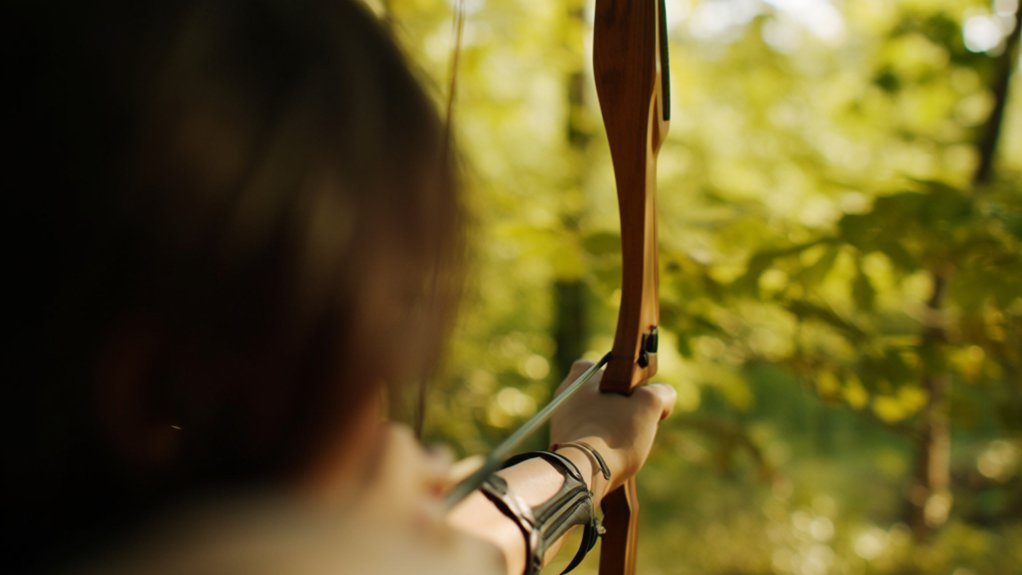
How To Shoot A Recurve Bow Without Sights?
To shoot a recurve bow without sights, focus on consistent stance and a reliable anchor point like the corner of your mouth. Keep your grip relaxed and draw smoothly while maintaining steady posture. Trust your instinct by aiming directly at the target and practicing muscle memory through drills like blank bale shooting. Avoid common errors like varying draw length or shifting your gaze. Master these basics, and you’ll improve accuracy naturally as you explore more advanced techniques.
Key Takeaways
- Develop instinctive shooting by focusing steadily on the target without shifting your gaze.
- Use a consistent anchor point, such as the corner of your mouth or under your chin, for reliable aiming.
- Maintain proper stance with feet shoulder-width apart and relaxed shoulders for stability and balance.
- Practice smooth, controlled draw and release to build muscle memory and shooting confidence.
- Perform drills like blank bale shooting and snap shooting to improve accuracy and natural aim adjustment.
Why Shoot a Recurve Bow Without Sights
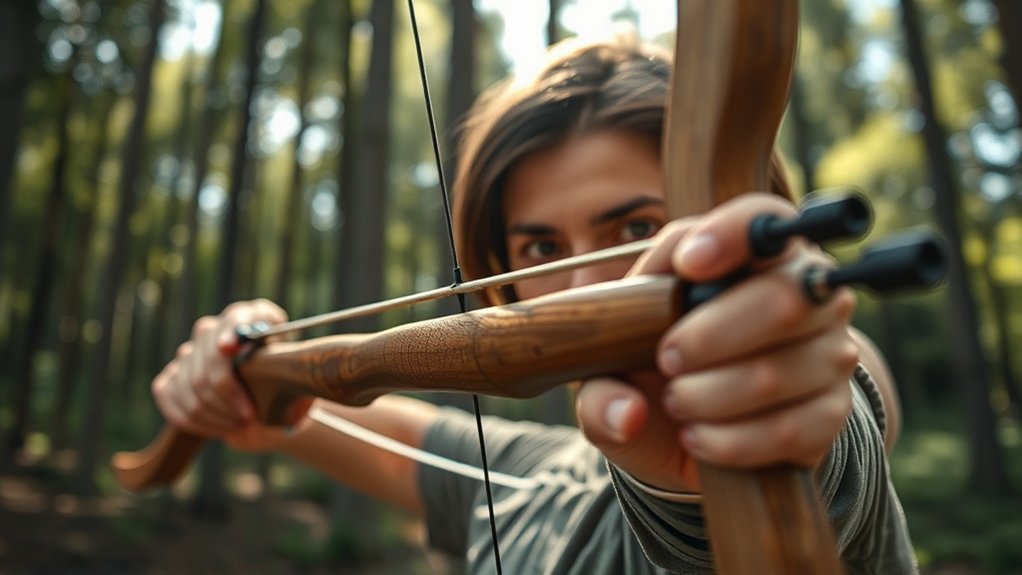
Although using sights can improve accuracy, shooting a recurve bow without them helps you develop a stronger instinctive shooting skill. When you shoot without sights, you rely more on your body’s natural alignment and feel, which builds muscle memory and sharpens your focus.
This method encourages you to trust your instincts and makes you more adaptable in different shooting conditions. Plus, without sights, your setup is simpler and lighter, which can be a big advantage if you’re hunting or shooting in the field.
Shooting without sights also connects you more deeply to traditional archery, letting you experience the sport’s purest form. Ultimately, practicing this way improves your overall archery skills and prepares you for situations where sights aren’t practical.
Instinctive Shooting: Key Principles
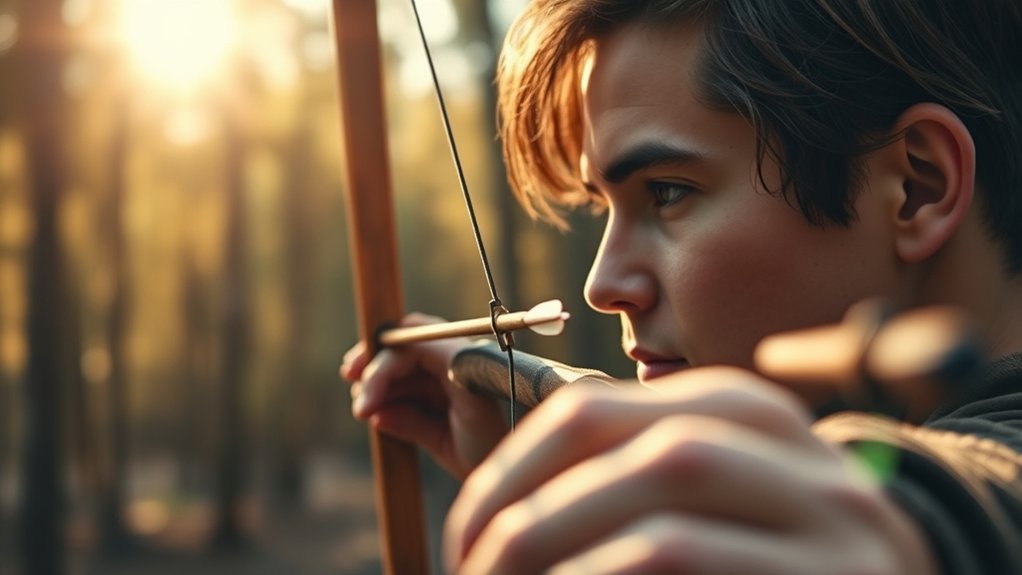
To shoot instinctively, you need to keep your focus firmly on the target.
You also have to find and maintain a consistent anchor point every time you draw the bow.
Finally, mastering a smooth release technique will help your shots stay accurate and controlled.
Focus On Target
When you shoot a recurve bow without sights, your success depends on how well you focus on your target. Instead of relying on equipment, you need to train your eyes and mind to lock onto the target instinctively. Keep your gaze steady and avoid shifting your focus to the arrow or bow.
Trust your instincts and let your body react naturally. Visualize the exact spot where you want the arrow to land, and maintain that mental image throughout your shot. This sharp focus helps improve accuracy and consistency.
Practice regularly to strengthen this skill, as it’s the foundation of instinctive shooting. Remember, your ability to focus directly influences your aim and, ultimately, your performance without sights.
Consistent Anchor Point
Since you don’t have sights to guide your aim, establishing a consistent anchor point becomes essential for accurate shooting. Your anchor point is where your hand, string, or fingers meet your face each time you draw the bow.
By always drawing to the same spot—like the corner of your mouth, your chin, or your cheekbone—you create a reliable reference that helps you aim instinctively. This consistency reduces variables and improves muscle memory, making your shots more predictable.
To find your ideal anchor point, experiment with spots that feel natural and comfortable, then stick with it every time you shoot. Remember, even slight changes in your anchor can throw off your shot, so maintain precision and repeatability to boost your accuracy without relying on sights.
Smooth Release Technique
How exactly do you guarantee your arrow flies true without sights? It all starts with a smooth release technique.
When you draw the bowstring back, avoid any sudden jerks or tension spikes. Instead, focus on a gradual, controlled release that lets the string slip cleanly from your fingers. This prevents the arrow from veering off course due to inconsistent force.
Keep your hand relaxed and follow through naturally, allowing your fingers to unwind gently after the shot. Practicing this smooth release helps build muscle memory, so your shots become instinctive and accurate over time.
Picking the Best Recurve Bow for Shooting Without Sights
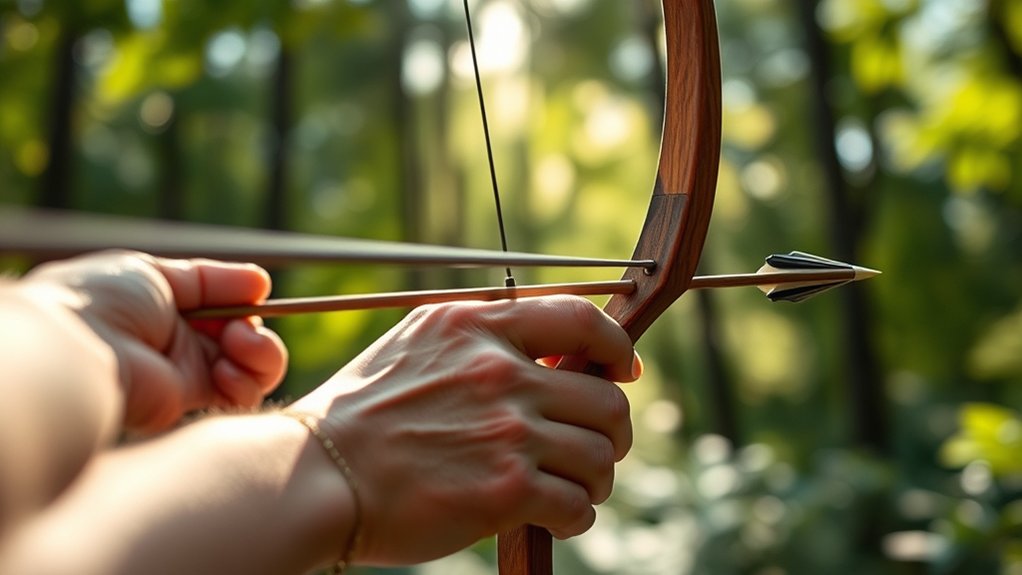
Choosing the right recurve bow can make a huge difference in your accuracy and comfort when shooting without sights. You want a bow that feels natural and responsive to your style. Here’s what to focus on:
- Draw Weight – Pick a draw weight that matches your strength; too heavy will tire you quickly, too light won’t give consistent power.
- Bow Length – A longer bow usually offers better stability and smoother shots, which helps when relying on instinctive aiming.
- Bow Material – Choose a bow made from quality wood or composite materials for durability and a solid feel.
Properly Grip Your Recurve Bow
Although gripping your recurve bow may seem straightforward, the way you hold it directly impacts your aim and shot consistency.
Start by placing the bow’s grip into the webbing between your thumb and index finger, letting it rest naturally. Avoid squeezing the grip tightly; instead, keep your hand relaxed to prevent torque that can pull your shot off target.
Your fingers should curl gently around the grip without gripping too hard, and your knuckles should form about a 45-degree angle.
Keep your wrist straight and avoid bending it inward or outward, as this can affect your release.
A proper grip helps guarantee the bow remains steady during draw and release, making your shots more accurate even without sights.
Find the Right Stance for Stability and Accuracy
Because your stance forms the foundation of every shot, finding the right position is essential for stability and accuracy when shooting a recurve bow without sights. Start by positioning your feet shoulder-width apart to create a solid base.
Next, align your body perpendicular to the target, so your shoulders and hips face the side rather than the target directly.
Finally, keep your weight evenly distributed on both feet, avoiding leaning forward or backward.
Here are three key steps to nail your stance:
- Stand tall with a straight back and relaxed shoulders.
- Position your feet so the toes point slightly outward for balance.
- Keep your knees slightly bent to absorb any movement.
Mastering this stance will boost your control and shot consistency.
Master Your Anchor Point Without Sights
When you shoot without sights, nailing your anchor point becomes essential for consistent accuracy. Your anchor point is a fixed spot on your face where your drawing hand rests every time you draw the bowstring. This consistency helps you aim instinctively. Common anchor points include the corner of your mouth, the tip of your nose, or under your chin. Use your fingers as a tactile guide to find the right spot.
Here’s a simple guide to visualize anchor points:
| Anchor Point | Description | Feel Reference |
|---|---|---|
| Corner of Mouth | String touches cheek | Slight pressure |
| Tip of Nose | String lightly rests | Soft contact |
| Under Chin | Hand presses jawline | Firm but comfortable |
Practice these points until your release feels natural.
Nock Arrows for Consistent Release
To guarantee a smooth and consistent release, you need to nock your arrows properly every time. This step ensures your arrow sits securely on the string, minimizing wobble and improving accuracy. Follow these key points:
Properly nocking your arrows ensures a secure fit, reduces wobble, and enhances shooting accuracy every time.
- Align the Nock Correctly: Place the arrow’s nock so it snaps firmly onto the string’s center serving, usually marked by a small thread. This prevents slipping during your draw.
- Check Arrow Orientation: Make sure the arrow’s index fletching (the odd-colored vane) faces away from the bow to avoid contact with the riser.
- Maintain Consistency: Always nock your arrows at the same spot on the string, maintaining uniformity shot after shot for reliable performance.
Practice Draw Length and Smooth Release Without Sights
Although shooting without sights can feel challenging at first, practicing your draw length and mastering a smooth release will greatly improve your accuracy.
Start by consistently drawing the bow to the same anchor point every time; this builds muscle memory and helps you develop a reliable reference. Pay close attention to your form as you draw, ensuring your shoulders stay relaxed and your grip remains steady.
When releasing, avoid jerking or plucking the string. Instead, let your fingers part naturally, allowing the string to slip off smoothly. Practice this motion slowly at first, focusing on a fluid, controlled release.
Over time, your shots will become more consistent, and your confidence will grow—even without relying on sights.
Gap Shooting for Better Aim
Now that you’ve practiced your draw length and release, it’s time to focus on gap shooting to improve your aim.
You’ll learn how to adjust your aim point by estimating the arrow’s trajectory and keeping a consistent anchor point.
This method helps you hit targets accurately without relying on sights.
Understanding Aim Point Adjustment
When you don’t have sights on your recurve bow, adjusting your aim point becomes essential for hitting your target accurately. You’ll need to learn how to compensate for distance and arrow drop by changing where you aim.
Here’s how you can master aim point adjustment:
- Identify the gap: Understand the space between your arrow’s point and the target at different distances.
- Practice consistent anchor points: Keep your draw and anchor position steady to ensure reliable shot placement.
- Shift your aim point: Instead of aiming directly at the target, aim above or below it depending on the range.
Estimating Arrow Trajectory
Since you don’t have sights to rely on, estimating your arrow’s trajectory becomes essential for accurate shooting. This technique, known as gap shooting, involves learning how much your arrow will drop over certain distances.
Start by shooting at a close, known target and note where your arrow lands relative to your aim point. Then, adjust your aim higher or lower for targets farther away, using the gap between the target and your arrow’s impact as a reference.
Over time, you’ll develop an intuitive sense of how gravity affects your arrow’s flight. Remember, environmental factors like wind can alter the trajectory, so always account for conditions.
Practicing gap shooting consistently sharpens your ability to judge distances and improves overall accuracy without relying on sights.
Practicing Consistent Anchor Points
Understanding how your arrow drops at various distances is only part of the equation. To shoot accurately without sights, you need to practice consistent anchor points. Your anchor point is where your hand or string touches your face at full draw, serving as a reliable reference for each shot. Here’s how to develop it:
- Choose a Clear Anchor Spot: Common spots include the corner of your mouth, chin, or cheekbone. Pick one that feels natural and repeatable.
- Practice Drawing Smoothly: Each time you draw, touch that spot with the same pressure and position.
- Check Your Form Regularly: Use a mirror or record yourself to ensure your anchor point stays consistent.
Using Target Focus Over Sights
Although you won’t have sights to guide your aim, focusing directly on your target sharpens your accuracy and helps you develop instinctive shooting skills. Instead of relying on equipment, lock your eyes on a specific spot, like the center of a bullseye or a distinct feature on your target.
Focusing directly on your target enhances accuracy and builds instinctive shooting skills without relying on sights.
This direct focus trains your mind to judge distance and trajectory naturally. Keep your head steady and avoid shifting your gaze during the shot.
By trusting your visual connection with the target, you enhance hand-eye coordination and build confidence in your shooting ability.
Over time, this approach lets you instinctively adjust for wind or distance without second-guessing, making your archery more fluid and precise.
Drills to Build Muscle Memory and Confidence
To shoot a recurve bow without sights effectively, you need drills that reinforce muscle memory and boost your confidence. Practicing consistently helps your body learn the correct form and builds trust in your instincts.
Here are three essential drills to get you started:
- Blank Bale Shooting: Shoot at a large target without aiming points. Focus on your form and release, not the bullseye.
- Distance Judgment Drill: Place markers at various distances and shoot without aiming. This sharpens your sense of range and arrow drop.
- Snap Shooting: Draw and release quickly on command to develop muscle memory for a smooth, instinctive shot.
These drills train your muscles and mind to work together, making shooting without sights feel natural and accurate.
Mistakes to Avoid When Shooting Without Sights
When shooting without sights, you can’t ignore proper anchor points or expect consistent accuracy.
You’ll also want to maintain the same draw length every time to build reliable muscle memory.
Don’t forget to keep your body aligned, as even small deviations can throw off your shot.
Ignoring Proper Anchor Points
Since you’re shooting without sights, maintaining a consistent anchor point becomes even more essential for accuracy. Ignoring this can throw off your aim and cause inconsistent shots.
To avoid this, focus on:
- Find a Reliable Anchor Spot: Choose a spot on your face or jawline where your hand or string touches every time you draw.
- Stick to It: Make sure you use the same anchor point on every shot to build muscle memory and consistency.
- Check Your Form Regularly: Periodically assess your anchor point to guarantee it hasn’t shifted as you practice.
Overlooking Consistent Draw Length
Maintaining a consistent anchor point sets a solid foundation, but you also need to pay close attention to your draw length. If your draw length varies shot to shot, your arrow’s flight will be unpredictable, making it tough to hit your target accurately without sights.
Each time you draw the bow, pull the string back to the exact same spot, ensuring your muscles and arm position match previous shots. Use a physical reference point, like the corner of your mouth or the tip of your nose, to help lock in that draw length.
Neglecting this consistency throws off your arrow’s trajectory and can lead to frustration. Focus on steady draw length, and you’ll notice improved grouping and confidence in your aim.
Neglecting Body Alignment
Failing to align your body properly can quickly sabotage your accuracy when shooting a recurve bow without sights. Without a clear reference point, your stance and posture become even more critical.
Here are three key alignment tips to keep you on target:
- Square Your Shoulders – Keep your shoulders level and perpendicular to your target. Twisted shoulders throw off your shot angle.
- Position Your Feet Correctly – Your feet should be shoulder-width apart, with the front foot slightly forward for stability and balance.
- Maintain a Straight Spine – Avoid leaning forward or backward. A straight spine guarantees consistent anchor points and release.
Progressing From Practice to Real-World Shooting Without Sights
As you move beyond controlled practice sessions, you’ll need to adapt your skills to unpredictable conditions and varied targets. Start by practicing in different environments—windy fields, wooded areas, or uneven terrain—to challenge your consistency.
Focus on trusting your instinctive shooting rather than overthinking each shot. Pay close attention to your body alignment and anchor points; these remain vital without sights.
Incorporate dynamic shooting drills, like moving targets or timed shots, to simulate real-world scenarios. Review each session honestly, noting what works and where you need improvement.
Frequently Asked Questions
What Maintenance Is Required for a Recurve Bow Without Sights?
You’ll need to regularly check the limbs for cracks, keep the string waxed to prevent fraying, tighten all screws, and store the bow in a cool, dry place. Clean it after every use to maintain performance.
Can I Use Hunting Arrows With a Recurve Bow Without Sights?
You can use hunting arrows with your recurve bow without sights—about 70% of archers prefer them for accuracy and durability. Just guarantee the arrows match your bow’s draw weight and length for safe, effective shooting.
How Do Weather Conditions Affect Shooting Without Sights?
You’ll notice wind can push your arrow off course, and rain may affect your grip and arrow flight. Adjust your aim for these changes, stay steady, and practice in different conditions to improve accuracy without sights.
Are There Specific Safety Tips for Shooting Without Sights?
Yes, you should always make sure your shooting range is clear, wear protective gear, never dry fire your bow, and double-check your stance and aim before releasing. Trust your instincts, but stay cautious to avoid accidents.
What Accessories Can Improve Shooting Accuracy Without Sights?
You can use arrow rest, finger tabs, and a stabilizer to improve accuracy. A clicker helps with consistent draw length, while a bow stringer guarantees safe stringing. These accessories boost your precision even without sights.
Conclusion
So, you’ve decided to ditch the fancy sights and shoot like a true archer of old—blindfolded might even be easier! Just remember, gripping your bow like a limp noodle won’t help, and standing like a flamingo won’t keep you steady. Focus on the target, trust your instincts, and practice until your muscle memory laughs at your mistakes. Soon, you’ll be hitting bullseyes with the confidence of a medieval Robin Hood—minus the tights, hopefully!