How To Measure Sight Height?
To measure sight height, you’ll first find the barrel’s centerline by measuring the bore diameter at several points to locate its midpoint. Then, use a precise ruler or caliper to measure the vertical distance from this centerline straight up to the top of your front sight. Make sure your firearm is stable and use consistent reference points for accuracy. After adjustments or adding accessories, recheck the sight height to maintain precision. Keep going to uncover tips on avoiding common mistakes and maintaining proper sight height over time.
Key Takeaways
- Use a ruler or caliper to measure from the barrel’s centerline (bore axis) to the top of the front sight.
- Find the barrel centerline by measuring the barrel’s diameter at multiple points and locating its midpoint.
- Ensure the firearm is stable and unloaded during measurement to maintain accuracy and safety.
- Take multiple measurements to confirm consistency and record the sight height for reference.
- Recheck sight height after any modifications or accessory installations to maintain precise alignment.
What Is Sight Height and Why It Matters?
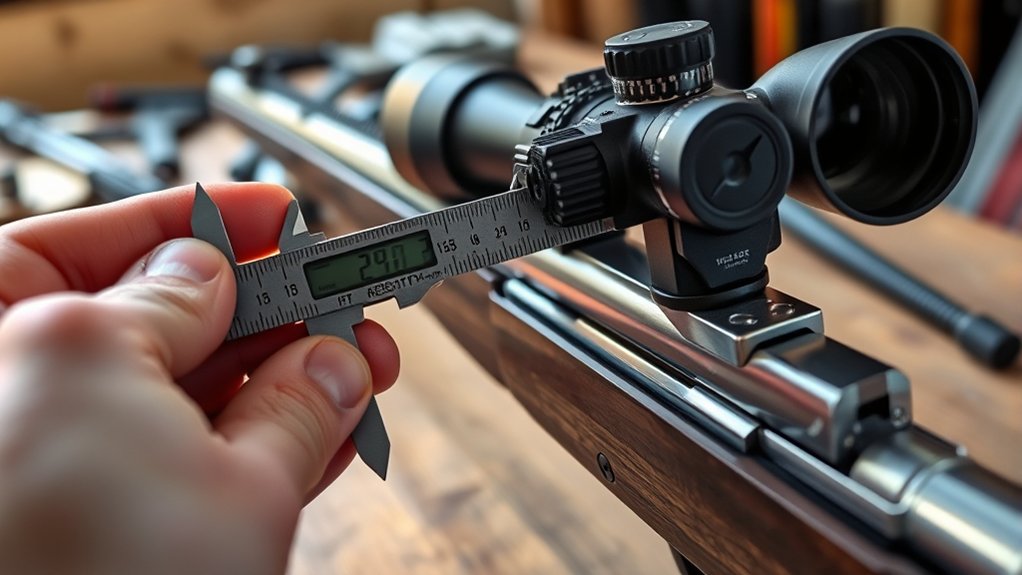
What exactly is sight height, and why should you care about it? Sight height is the distance from the shooter’s eye to the center of the firearm’s sights.
Knowing this measurement matters because it directly affects your point of impact when aiming. If your sight height is off, your shots may land higher or lower than expected, causing frustration and inconsistency.
Sight height impacts your point of impact, so errors can cause shots to land off target, leading to frustration.
By understanding and accurately measuring sight height, you guarantee your firearm is properly zeroed, improving your accuracy and confidence.
Whether you’re sighting in a rifle or adjusting a pistol, sight height plays a vital role in aligning your sights with the target.
Paying attention to this detail helps you make precise adjustments and shoot with greater reliability.
Tools for Measuring Sight Height
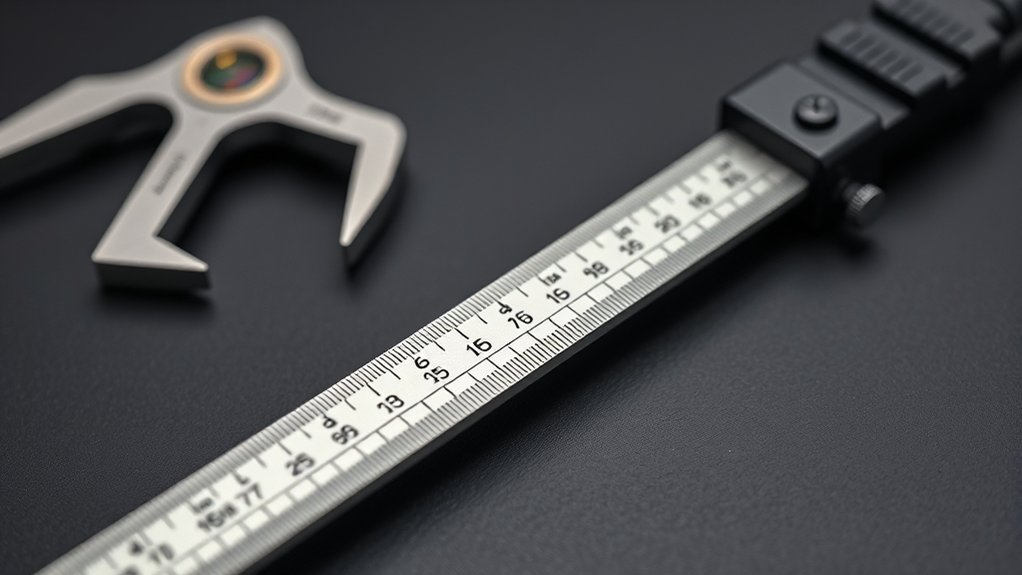
To measure sight height accurately, you’ll need the right tools, from basic rulers to advanced digital devices.
You’ll want to weigh the benefits of digital versus analog options based on your needs.
And don’t forget, proper calibration is key to ensuring your measurements are spot-on.
Essential Measuring Instruments
Although measuring sight height might seem straightforward, using the right instruments guarantees accuracy and consistency. You’ll need a reliable measuring tape or a rigid ruler to get precise vertical measurements.
A spirit level ensures your measuring device stays perfectly vertical, preventing errors caused by tilt. A sturdy tripod or stand can hold your tools steady if you’re measuring from a distance or in awkward positions.
For marking points, a fine-tip pencil or marker helps maintain visibility without obscuring details. Don’t forget a caliper for smaller, detailed measurements when sight components are involved.
These essential instruments, when used correctly, will make your sight height measurements more accurate and repeatable, saving you time and frustration. Always check your tools for damage before use to maintain precision.
Digital Vs. Analog Tools
While both digital and analog tools can measure sight height effectively, choosing the right one depends on your specific needs and preferences.
Digital tools, like laser rangefinders and electronic calipers, offer quick readings and often feature easy-to-read displays. They’re great if you want speed and convenience, especially outdoors or in low light.
Analog tools, such as traditional rulers or mechanical calipers, require manual reading but provide a tactile, reliable experience without batteries or electronic failures. They’re ideal if you prefer simplicity and durability.
Consider your environment, budget, and how frequently you’ll measure sight height when deciding. Both types have their strengths, so pick the one that fits your workflow best.
You can always combine both for versatility in different situations.
Calibration And Accuracy
Ensuring your tools are properly calibrated is essential for getting accurate sight height measurements. Before you start, check your device against a known standard or calibration block.
Digital tools often have built-in calibration settings, so follow the manufacturer’s instructions to reset or adjust them. For analog tools, use a precision ruler or gauge to verify measurements.
If you notice discrepancies, recalibrate immediately to avoid errors. Regular calibration helps maintain consistency and reliability, especially if you use your tools frequently.
Finding the Barrel Centerline for Sight Height
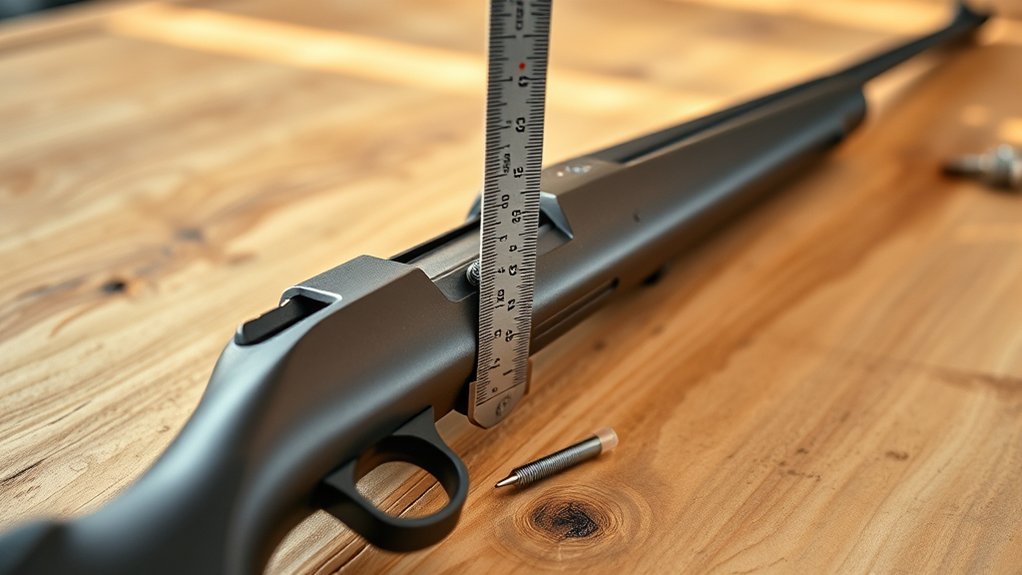
To find the barrel centerline, start by identifying the exact middle of the barrel’s bore.
Measure from the barrel base to guarantee accuracy, using tools like calipers or a ruler designed for small measurements.
This step is vital for getting a precise sight height.
Identifying Barrel Centerline
Before you can accurately measure sight height, you need to identify the barrel centerline since it serves as the primary reference point. To find it, place your firearm on a stable surface and look directly at the barrel from the side.
Visualize an imaginary line running through the exact middle of the barrel’s bore. If possible, use a caliper or ruler to measure the diameter at several points and mark the midpoint.
This centerline runs longitudinally along the barrel, and you’ll use it to measure vertical distances for sight height. Avoid guessing—precision here ensures your sight height measurements are reliable.
Once you’ve identified this centerline clearly, you’ll have a consistent baseline for all subsequent measurements related to your firearm’s sights.
Measuring From Barrel Base
After pinpointing the barrel centerline, you’ll focus on measuring from the barrel base to establish sight height. Start by placing your measuring device at the exact point where the barrel meets the receiver or frame—this is your barrel base.
From here, measure straight up to the centerline you identified earlier. Make certain your measurement is perpendicular to the barrel base, avoiding any angled readings that could skew accuracy.
This vertical distance is your sight height, vital for aligning optics or iron sights properly. Remember, consistency is key; measure from the same barrel base point every time.
This method ensures your sight height reflects the true vertical relationship between the barrel and your sight, helping improve overall aiming precision.
Tools For Accurate Measurement
Although measuring sight height depends on precise data, you’ll need the right tools to find the barrel centerline accurately. Start with a caliper or a ruler that offers fine increments—down to 0.01 inches or millimeters. A caliper helps you measure the barrel’s diameter precisely, which is essential for identifying its centerline.
You’ll also want a flat surface or a vise to stabilize the firearm while measuring. Using a bubble level can verify the barrel is perfectly horizontal, preventing skewed readings.
If you have access to a height gauge or a dial indicator, those tools can enhance accuracy further by allowing you to measure vertical distances without guesswork. With these tools, you’ll confidently pinpoint the barrel centerline, laying a solid foundation for accurate sight height measurement.
Measuring Sight Height: Step-by-Step
When you measure sight height, you’ll guarantee your firearm’s sights are properly aligned for accurate shooting. Start by securing your firearm on a stable surface.
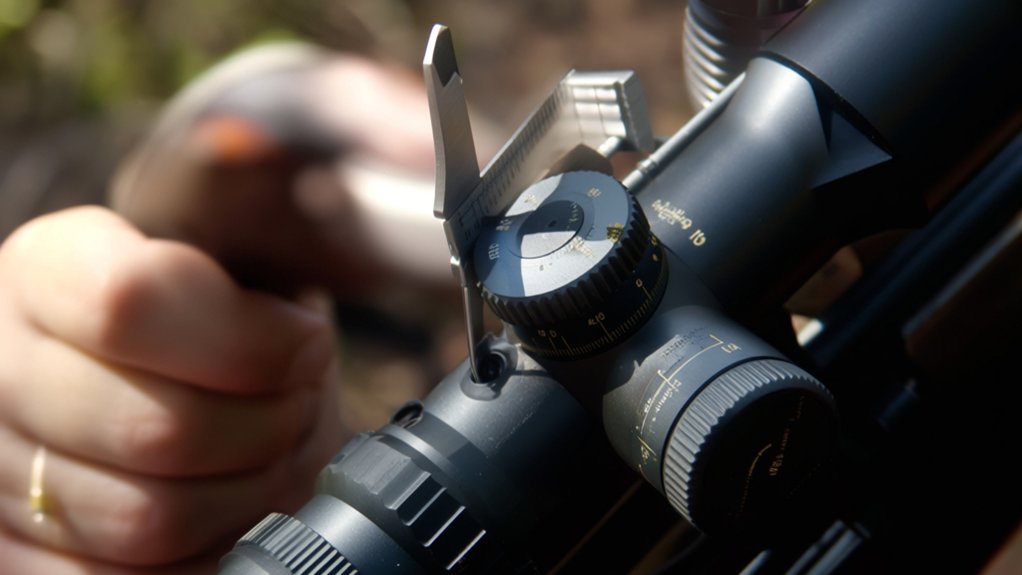
Use a caliper or ruler to measure from the barrel’s centerline to the top of the sight. For iron sights, measure from the bore axis to the front and rear sights separately if needed. Record each measurement carefully.
Confirm the measuring tool is perpendicular to the barrel to avoid errors. Double-check your numbers for consistency.
If you’re working with adjustable sights, note their positions before measuring. These steps help you maintain precise sight alignment, improving your shot accuracy and confidence.
Following this method ensures repeatable and reliable sight height measurements every time you check or adjust your firearm.
Measuring Sight Height on Rifles vs. Handguns
Since rifles and handguns have different designs and purposes, measuring sight height on each requires slightly different approaches.
Rifles and handguns differ in design, so sight height measurement techniques must be tailored accordingly.
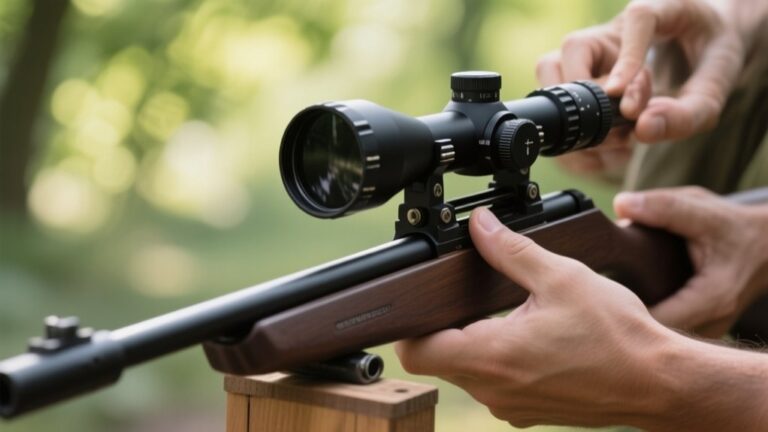
When you measure a rifle, you focus on the distance from the bore axis to the center of the sights, often using calipers for accuracy.
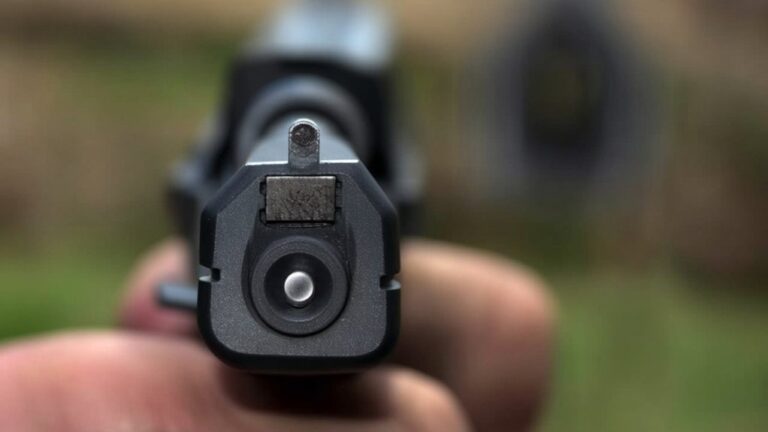
With handguns, you measure from the top of the barrel to the sight’s center, which is usually closer due to the compact design.
Here’s what to keep in mind:
- Rifles often have taller sights to clear scopes or attachments.
- Handgun sights are lower for quicker target acquisition.
- Use a stable platform to avoid measurement errors.
- Double-check measurements for consistency before adjusting sights.
Mastering these differences ensures your shots are true and your confidence grows.
How Sight Height Affects Your Point of Impact
Because sight height determines the vertical alignment between your sights and the barrel, it directly influences where your shots land. If your sight height is off, your point of impact will shift vertically, causing your shots to hit higher or lower than your point of aim.
This is essential when zeroing your firearm—an incorrect sight height means you might need to adjust elevation more than necessary or compensate when aiming. Additionally, changes in sight height can affect your bullet’s trajectory, especially at varying distances.
When you understand how sight height impacts your point of impact, you can better predict where your rounds will land and make accurate adjustments. Ensuring your sight height matches your setup keeps your shots consistent and reliable.
Common Sight Heights for Popular Firearms
Although sight height can vary widely, most popular firearms fall within a few common ranges that help you quickly identify the right setup for your needs. Knowing these typical measurements can save you frustration and improve your accuracy.
Sight height varies, but common ranges simplify choosing the right setup and enhance shooting accuracy.
Here are common sight heights for popular firearms:
- 1911 Pistols: Around 1.35 inches – perfect for classic handguns.
- Glock Pistols: Approximately 1.18 inches – designed for low-profile sight lines.
- AR-15 Rifles: About 2.5 inches – accounts for the flat top rail and optic mounting.
- Shotguns: Varies widely, but often between 2 to 3 inches – depending on barrel and rib height.
Adjusting Your Sights Using Sight Height Measurements
Now that you know how to measure sight height, it’s time to use those numbers to adjust your sights accurately.
You’ll calculate the exact sight height needed and fine-tune your sight alignment for better accuracy.
This process guarantees your shots hit where you expect them to.
Calculating Sight Height
When you calculate sight height, you determine the exact distance between your firearm’s bore axis and the sight plane, which directly affects your point of aim and impact. Getting this measurement right guarantees your shots land where you expect.
Here’s how to approach it:
- Use a precise ruler or caliper to measure from the center of the barrel (bore axis) to the top of the front sight.
- Double-check your measurement to avoid costly errors.
- Record your sight height to compare different sight setups or adjustments.
- Apply this measurement when adjusting sights to maintain consistent accuracy.
Fine-Tuning Sight Alignment
How exactly do you use sight height measurements to fine-tune your sight alignment? Start by comparing your current sight height to the ideal measurement for your specific shooting setup.
If the sight height is off, it affects your point of impact, causing shots to land too high or low. Adjust your sights incrementally—raising or lowering the front sight or adjusting the rear sight—to bring the sight height closer to the target value.
After each adjustment, test your alignment by taking a few shots and observing the impact. Repeat this process until your shots consistently hit your intended point of aim.
Fixing Common Sight Height Measurement Mistakes
Although measuring sight height seems straightforward, you can easily make errors that affect accuracy. To guarantee your measurements are spot-on, watch out for these common mistakes:
Measuring sight height may seem simple, but common errors can easily compromise accuracy.
- Not using a consistent reference point—this throws off your entire measurement.
- Measuring with the firearm unloaded or in an unstable position, leading to inaccurate readings.
- Rushing the process—hasty measurements increase the chance of errors.
- Ignoring environmental factors like uneven surfaces or lighting that can mislead your eye.
When to Recheck Sight Height After Modifications
Mistakes in measuring sight height can lead to inaccurate readings, especially after making changes to your firearm.
Whenever you modify the sights, barrel, or slide, you should recheck the sight height immediately.
Even small adjustments, like swapping out sight inserts or changing the sight post, can affect your point of impact. Rechecking guarantees your shots stay true and helps avoid surprises at the range.
Also, if you add accessories such as optic mounts or suppressors, measure again to confirm the sight height remains consistent.
Don’t wait until your next shooting session—verify sight height right after modifications to maintain accuracy.
Regular rechecks after any change keep you confident that your firearm performs exactly as expected.
Tips to Maintain Consistent Sight Height Over Time
Why does maintaining consistent sight height matter so much? Because even slight changes can throw off your accuracy, making every shot less reliable. To keep your performance sharp, follow these tips:
- Regularly inspect your sights for wear or damage to catch issues early.
- Use proper tools when adjusting sights to avoid unintended shifts.
- Avoid unnecessary adjustments; only tweak sight height when absolutely needed.
- Store your firearm securely to prevent bumps or drops that can alter sight position.
How Sight Height Fits Into Zeroing Your Firearm
Keeping your sight height consistent plays a key role when zeroing your firearm, as it directly affects the point of impact. If your sight height changes between zeroing and shooting, your bullet will hit higher or lower than expected.
When you zero your firearm, you’re aligning the sights so the bullet strikes exactly where you aim at a specific distance. To do this accurately, measure and maintain the same sight height you’ll use in the field.
Any variation can throw off your zero, forcing you to adjust unnecessarily. By understanding how sight height fits into zeroing, you ensure your shots land precisely where intended, boosting accuracy and confidence every time you shoot.
Frequently Asked Questions
Can Sight Height Vary With Different Ammunition Types?
Yes, sight height can vary with different ammunition types because bullet trajectory and velocity change. You’ll need to adjust your sights to maintain accuracy, especially if you switch between lighter or heavier loads frequently.
Does Weather Affect Sight Height Measurements?
Yes, weather does affect sight height measurements; when temperature and humidity shift, materials expand or contract, causing slight variations. So, you’ll want to measure in consistent conditions to guarantee your sight height stays accurate and reliable.
How Does Sight Height Impact Long-Range Shooting?
Sight height impacts your long-range shooting by affecting bullet trajectory and sight alignment. If you don’t account for it, your shots can miss high or low, so you’ll need to adjust your aim accordingly for accuracy.
Can Sight Height Be Measured Without Specialized Tools?
You can measure sight height without specialized tools by using a ruler or tape measure. Notably, even a 0.1-inch difference can affect accuracy, so precise measurement matters when adjusting your sights for better shooting performance.
What Are the Safety Precautions When Measuring Sight Height?
You should always guarantee the firearm is unloaded and pointed in a safe direction. Wear eye protection, keep fingers off the trigger, and work in a well-lit area. Avoid distractions to stay focused and safe during measurement.
Conclusion
Now that you know how to measure sight height, imagine the crisp alignment as your sights perfectly match your target. This simple step sharpens your aim and boosts confidence every time you pull the trigger. Keep your tools handy and double-check after any changes to your firearm. With consistent care, your shots will hit true, turning every range session into a clear, focused experience where precision feels as natural as breathing.