How To Line Up Pistol Sights?
To line up pistol sights, center the front sight perfectly within the rear sight notch, keeping them level and evenly spaced. Focus sharply on the front sight while allowing the target and rear sight to appear slightly blurred. Maintain a consistent eye position at eye level with the sights, and guarantee your stance supports natural alignment. Correct sight alignment improves accuracy and confidence. Keep going to explore how lighting, adjustments, and practice can further refine your shooting skills.
Key Takeaways
- Align the top of the front sight level within the rear sight notch with equal spacing on both sides.
- Focus sharply on the front sight while keeping the target and rear sight slightly blurred.
- Maintain a consistent eye position at eye level with the sights for clear alignment.
- Use proper shooting stance to support natural and steady sight alignment.
- Adjust sights incrementally based on shot placement for improved accuracy and grouping.
Why Sight Alignment Matters for Accurate Shooting
Although it may seem simple, proper sight alignment is essential because it directly affects your shooting accuracy. When you line up the front and rear sights correctly, you create a precise reference point for aiming.
If your sights are off, even by a little, your bullet won’t hit where you intend. You might think you’re aiming right at the target, but misalignment throws off the shot’s trajectory. This means every shot you take depends on how well you align those sights before pulling the trigger.
Consistently practicing proper sight alignment helps you build muscle memory, so your shots become more reliable. Remember, accuracy isn’t just about steady hands—it starts with how you see through your sights.
Understanding the Main Parts of Pistol Sights
Getting your sights properly aligned starts with knowing the basic parts of your pistol’s sight system. You’ll mainly deal with two components: the front sight and the rear sight.
Properly aligning your sights begins with understanding the front and rear sight components of your pistol.
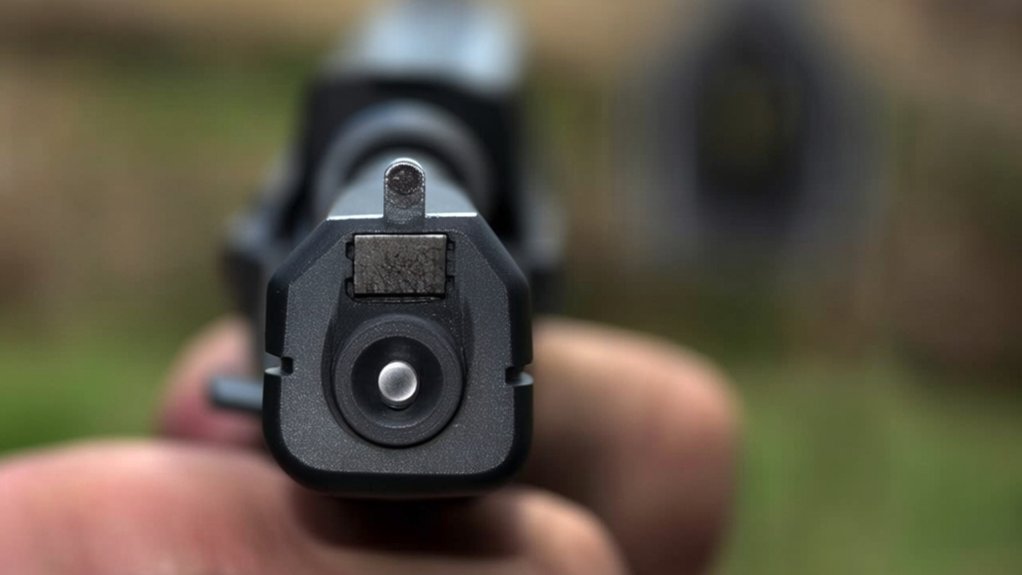
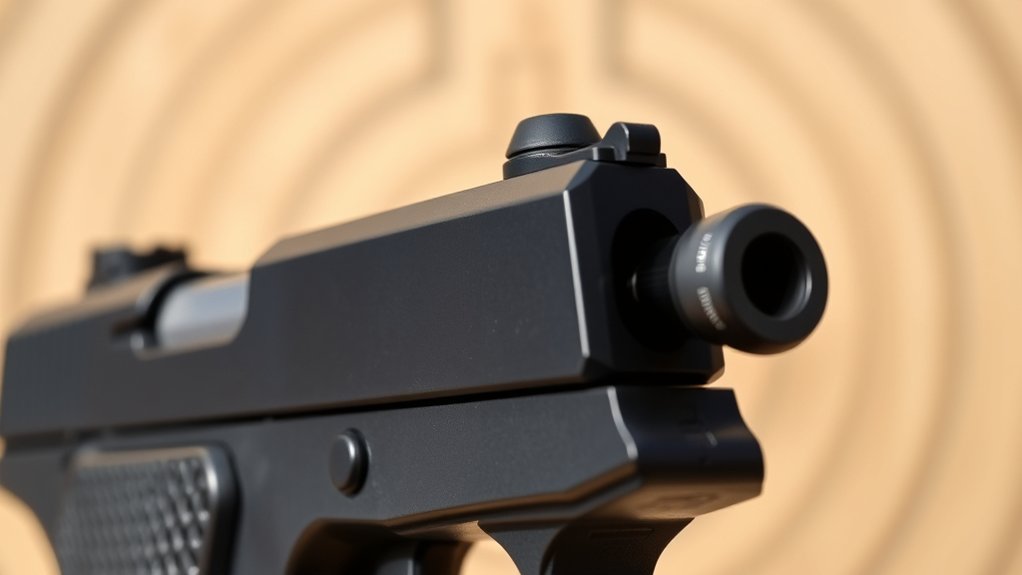
The front sight is usually a single post or dot located near the muzzle. The rear sight sits closer to your eye and often has two notches or dots on either side of a central notch or aperture.
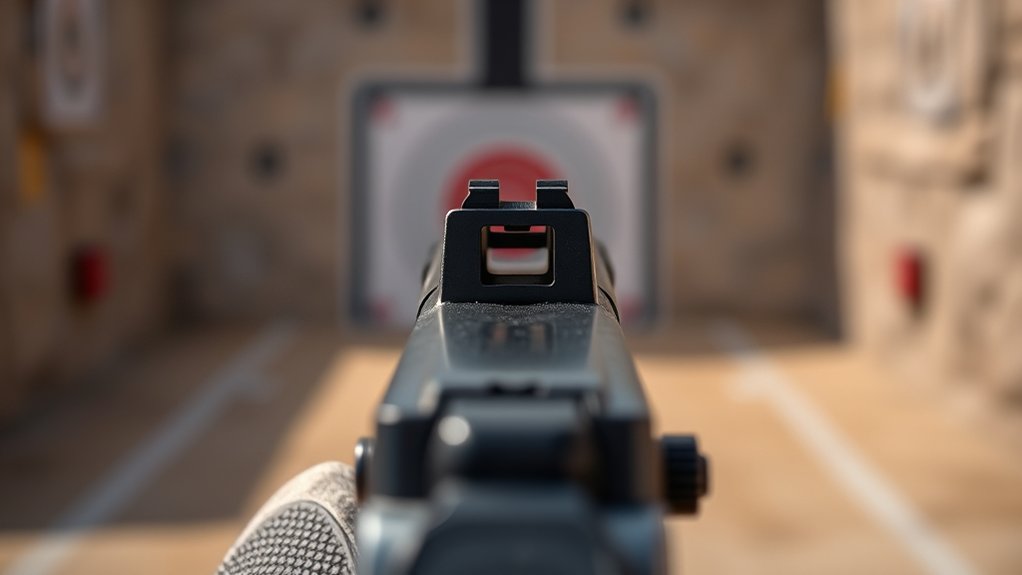
Your goal is to align the top of the front sight evenly within the rear sight’s notch while keeping equal space on both sides.
Some pistols have adjustable rear sights for windage and elevation, letting you fine-tune your aim.
Understanding these parts helps you focus on the alignment, ensuring your shots hit where you intend.
How to Position Your Eye for Clear Sight Alignment
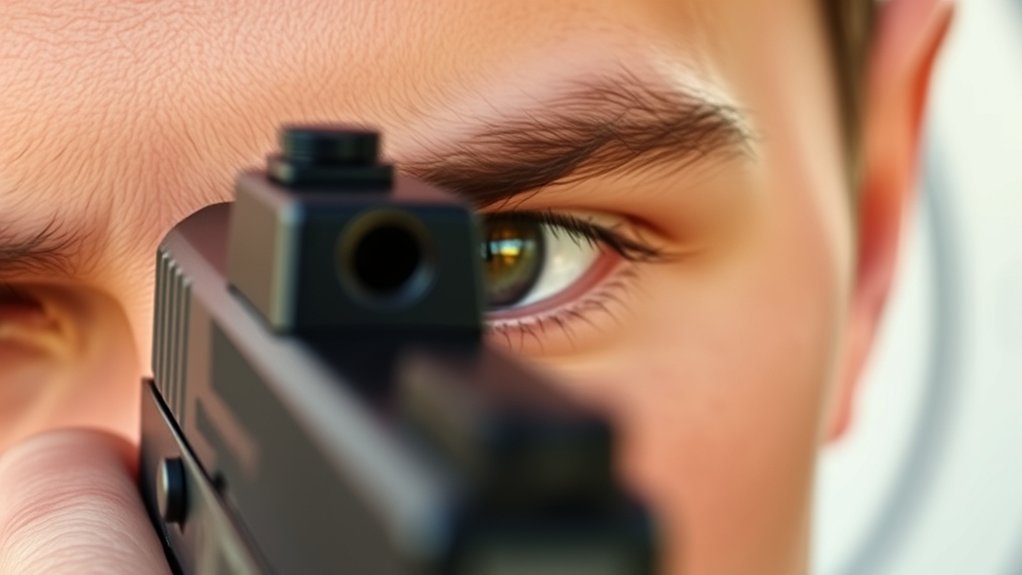
To get a clear sight alignment, keep your eye level consistent with the sights every time you aim.
Focus sharply on the front sight while letting the target and rear sight stay slightly blurred.
Also, maintain the proper distance between your eye and the sights to guarantee a clear, steady view.
Eye Level Consistency
When you position your eye consistently at the same level each time you aim, you guarantee clear and reliable sight alignment. This consistency eliminates variations that can throw off your shot, helping you develop muscle memory for faster, more accurate aiming.
To maintain eye level consistency, establish a natural and comfortable stance first. Then, bring your pistol up to your eye rather than lowering your eye to the sights. Keep your head upright and avoid tilting it, as even slight changes can distort your sight picture.
Practice this position repeatedly to make it second nature. By keeping your eye at a steady height, you’ll assure that the sights line up the same way every time, boosting your overall shooting precision and confidence.
Focus On Front Sight
Although aligning your sights might seem straightforward, focusing your eye sharply on the front sight is essential for clear and accurate aiming.
When you look down the barrel, your eye naturally wants to see the target and rear sight clearly, but that actually blurs the front sight, which is the critical reference point.
Train yourself to lock your focus on the front sight, making it the sharpest image in your vision. The rear sight and target will appear slightly fuzzy, and that’s perfectly normal.
This focus helps guarantee your shots land where you intend. Keep your eye relaxed but attentive, avoiding strain.
Maintain Proper Distance
Since your eye’s position directly affects sight alignment, maintaining the proper distance from your pistol sights is essential. If you’re too close or too far, your sight picture will blur, making accurate aiming difficult. Position your eye at a consistent distance—usually about 12 to 15 inches from the sights—to guarantee clarity.
Here’s how to maintain that distance effectively:
- Hold the pistol steadily at arm’s length, adjusting slightly to find a clear sight picture.
- Keep your head upright and aligned with the sights to avoid parallax errors.
- Practice bringing the pistol up smoothly to your shooting position, maintaining the same eye-to-sight distance.
- Use natural focus on the front sight, allowing the rear sight and target to remain slightly blurred.
This technique ensures precise, repeatable sight alignment every time.
How to Align Front and Rear Sights Correctly
To line up front and rear sights correctly, you need to focus on aligning the top of the front sight with the top of the rear sight while centering it within the rear sight notch. Keep both sights level and avoid tilting your pistol. Your eyes should focus on the front sight, making the rear sight slightly blurry. This alignment ensures accurate aiming.
| Step | What to Do | Common Mistake |
|---|---|---|
| 1 | Raise pistol to eye level | Looking over sights |
| 2 | Center front sight in rear notch | Misaligned sights |
| 3 | Keep sight tops level | Front sight too low |
Following these steps will help you align sights consistently for better shooting accuracy.
How to Recognize the Ideal Sight Picture
You’ll want to keep your focus on the front sight while aligning the top of the front sight evenly with the rear sight notch.
Make certain the sight elements form a straight, level line to create the ideal sight picture.
This precise alignment ensures your shots hit where you aim.
Front Sight Focus
How do you know when your pistol sights are perfectly aligned? The key lies in focusing on the front sight. When you aim, your eyes should lock sharply on the front sight, making it the clearest part of your sight picture.
The target and rear sight will appear slightly blurred—that’s normal and essential for accuracy.
To recognize the ideal front sight focus:
- Ensure the front sight is crisp and clear, standing out against the target.
- Notice the target and rear sight slightly blurred to avoid distraction.
- Keep the front sight centered within the rear sight notch.
- Maintain consistent focus on the front sight during each shot for reliable accuracy.
Mastering front sight focus sharpens your shooting precision instantly.
Aligning Sight Elements
Focusing on the front sight sets the stage for proper alignment of all sight elements. When you look through your pistol sights, verify the front sight is perfectly centered between the rear sight’s two notches.
The top of the front sight should be level with the top of the rear sight. This creates the ideal sight picture, which helps you aim accurately.
Any misalignment—such as the front sight being too high, low, or off to one side—will cause your shot to miss the target.
Keep your eyes trained on the front sight while bringing the aligned sights and the target into one smooth view.
With practice, recognizing this perfect alignment will become second nature, improving your shooting consistency and precision.
How Sight Alignment Improves Shooting Accuracy
Because your shot’s accuracy depends largely on your ability to properly align the pistol sights, mastering this skill is essential. When you consistently align your front and rear sights, you reduce aiming errors and boost precision. Proper sight alignment ensures your bullet hits exactly where you intend.
Here’s how it improves your shooting accuracy:
- Consistent Aim: Aligning sights every time helps maintain a steady point of impact.
- Reduced Parallax Error: Correct alignment minimizes sight picture distortion.
- Faster Target Acquisition: Your eyes quickly lock onto the target with clear sight alignment.
- Improved Focus: Aligning sights sharpens your focus on the front sight, critical for accuracy.
How to Adjust Your Sights for Different Lighting Conditions
Even when your sights are perfectly aligned, varying lighting conditions can affect your ability to see them clearly. You’ll need to adjust your sights or your approach depending on the environment. In low light, use sights with tritium or fiber-optic inserts for better visibility. In bright sunlight, reduce glare by shading the sights with your hand or adjusting brightness settings if available.
| Lighting Condition | Sight Adjustment Tip | Additional Advice |
|---|---|---|
| Low Light | Use tritium or fiber-optic sights | Avoid reflective surfaces |
| Bright Sunlight | Shade sights with your hand | Use matte finish sights |
| Overcast | Increase contrast on sights | Adjust shooting posture |
| Indoor Lighting | Use high-visibility inserts | Avoid harsh shadows |
| Mixed Lighting | Combine fiber-optic and tritium | Practice in varied conditions |
Adjusting Sight Alignment for Different Shooting Stances
Your shooting stance can change how you naturally align your sights, so you’ll need to adjust accordingly. Understanding how different stances affect your sight picture helps you maintain accuracy.
Let’s explore some effective sight adjustment techniques for various shooting positions.
Stance Impact On Alignment
When you change your shooting stance, you’ll need to adjust how you align your pistol sights to maintain accuracy. Each stance shifts your body position and eye level, affecting sight picture and alignment.
To keep your shots on target, consider these key points:
- Isosceles Stance: Both arms extended equally, so align sights straight with your dominant eye.
- Weaver Stance: Slight body angle requires slight sight adjustment to compensate for eye position shift.
- Point Shooting: Focus more on front sight alignment due to quicker target acquisition.
- Kneeling or Prone: Lower eye height means you’ll adjust sight alignment downward to maintain proper sight picture.
Sight Adjustment Techniques
Adjusting your sight alignment is key to adapting your aim across different shooting stances. Each stance shifts your natural point of aim, so you’ll need to tweak your sights accordingly. For example, a strong hand stance might cause shots to hit slightly right, while an unsupported stance might push your shots low. You can compensate by shifting your front sight or adjusting the rear sight to maintain accuracy.
| Stance | Common Sight Shift | Adjustment Technique |
|---|---|---|
| Isosceles | Slightly low | Raise front sight |
| Weaver | Slightly right | Move rear sight left |
| One-handed | Slightly left | Move rear sight right |
| Unsupported | Slightly low-left | Raise front sight, move rear right |
Common Sight Alignment Mistakes and How to Fix Them
Although lining up pistol sights seems straightforward, many shooters struggle with common mistakes that throw off their aim. Recognizing and correcting these errors will improve your accuracy quickly.
- Misaligned Front and Rear Sights – Make certain the top of the front sight is level with the rear sight and centered. Don’t let the front sight dip or rise.
- Ignoring Sight Focus – Keep your eyes focused on the front sight, not the target or rear sight, for precise alignment.
- Uneven Light on Sights – Adjust your grip or angle to avoid shadows or glare that obscure sight clarity.
- Inconsistent Sight Picture – Always align your sights the same way; inconsistency leads to unpredictable shots.
Fixing these mistakes sharpens your shooting and builds confidence.
How to Practice Sight Alignment at the Range
To improve your sight alignment at the range, start by focusing on slow, deliberate practice rather than speed. Take your time to line up the front and rear sights perfectly before each shot. Use a consistent stance and grip to build muscle memory. After every shot, analyze your sight picture and adjust accordingly. Remember, patience pays off.
| Feeling | Action | Result |
|---|---|---|
| Frustration | Slow down, focus | Clearer sight picture |
| Confidence | Consistent grip | Better shot grouping |
| Satisfaction | Adjust and repeat | Improved accuracy |
This method trains your mind and muscle to work in sync, making sight alignment second nature.
Sight Alignment Techniques for Different Pistol Sights
When you’re lining up different types of pistol sights, you’ll need to tailor your technique to the specific design. Each sight requires a unique approach to guarantee accurate alignment and consistent shots.
- Iron Sights: Focus on aligning the front post evenly between the rear notch, keeping the top edges level.
- Fiber Optic Sights: Use the brightly colored front dot as your primary focus, centering it in the rear sight circle.
- Night Sights: Align the luminescent dots similarly to iron sights but in low light; let the glow guide your eye.
- Red Dot Sights: Place the red dot directly on your target, ignoring traditional front and rear sight alignment.
Adjust your technique based on the sight type for improved accuracy.
Adjusting Sights for Better Shot Grouping
Now that you know how to align different pistol sights, the next step is fine-tuning those sights to tighten your shot grouping.
Begin by firing a controlled group of shots at your target. Observe where the bullets cluster in relation to your point of aim.
If your group consistently lands off-center, make small adjustments to the rear sight: move it right to shift shots left, left to move shots right, up to lower the point of impact, and down to raise it.
Always adjust incrementally and re-shoot to confirm changes.
Remember, consistent grip and trigger control are essential; poor technique can mimic sight misalignment.
Frequently Asked Questions
Can Sight Alignment Be Used for Long-Distance Shooting?
Yes, you can use sight alignment for long-distance shooting, but it requires more precision and adjustments. You’ll need to focus on your front sight and compensate for bullet drop and wind to hit distant targets accurately.
How Often Should Pistol Sights Be Professionally Serviced?
You should schedule professional pistol sight servicing every year or after any significant impact. Regular reviews refresh reliable results, reducing risks. Don’t delay—consistent care keeps your sights sharp and your shooting steady.
Are There Specific Sights Recommended for Left-Handed Shooters?
Yes, you should look for pistol sights designed specifically for left-handed shooters, like offset or reversible sights. These guarantee proper alignment and comfort, helping you shoot accurately without awkward positioning or strain on your dominant eye.
Can Environmental Factors Like Wind Affect Sight Alignment?
Yes, wind can affect your sight alignment by pushing your bullet off target. You’ll need to adjust your aim to compensate, especially at longer ranges. Always consider environmental factors to maintain accuracy when shooting.
What Types of Pistol Sights Are Best for Self-Defense?
You’ll want fiber optic or night sights for self-defense—they’re quick to acquire and visible in low light. Tritium night sights especially help in the dark, boosting your accuracy when it counts most.
Conclusion
Now that you know how to line up your pistol sights properly, you’re ready to shoot with confidence and accuracy. Remember, consistent practice is key—just like a knight honing his skills before battle, you’ll improve over time. Keep your eye on the front sight, align it carefully with the rear, and aim for that perfect sight picture. With patience and focus, your shots will group tighter, making every round count. Happy shooting!