How to Read Rifle Scope Magnification Simply
You read rifle scope magnification by looking at numbers like “3-9×40.” The first part, “3-9x,” shows the zoom range—you can adjust magnification from 3 to 9 times. The second number, “40,” tells you the objective lens diameter in millimeters, affecting brightness and clarity. Fixed scopes have just one number, like “4×20,” meaning no zoom. Understanding these helps you pick the right scope for your shooting needs. Keep exploring to find the best match for your setup.
What Is Rifle Scope Magnification?
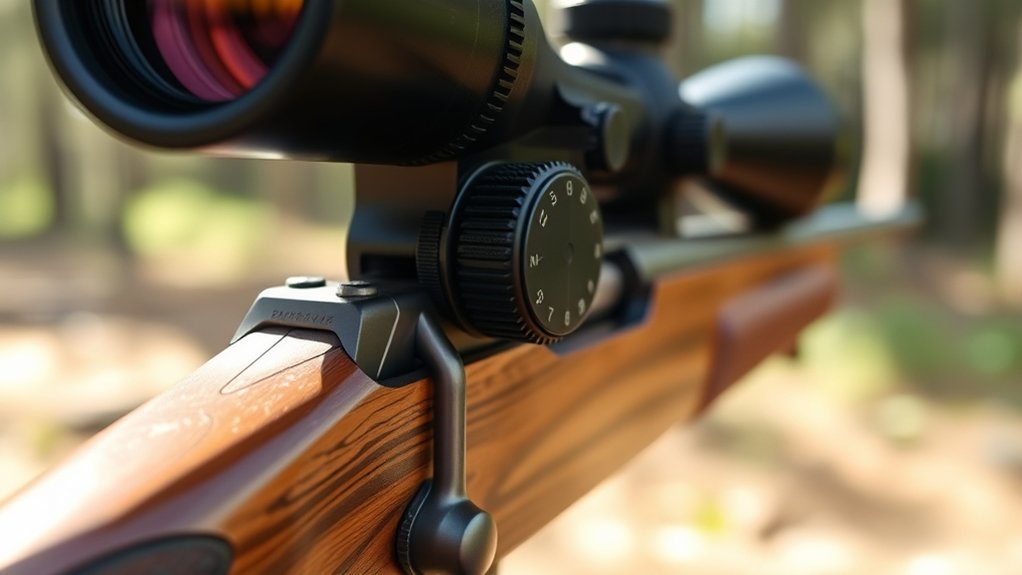
What exactly does rifle scope magnification mean? It refers to how much closer the scope makes your target appear compared to viewing it with the naked eye. For example, a 4x magnification means the target looks four times closer.
When you look through a scope with higher magnification, you can see finer details at a distance, helping you aim more accurately. However, higher magnification also narrows your field of view, which can make tracking moving targets harder.
You’ll find scopes with fixed magnification or variable magnification, allowing you to zoom in or out. Understanding magnification helps you choose the right scope for your shooting needs, whether it’s for hunting, sport shooting, or tactical use, so you can hit your target with confidence.
How to Read the Numbers on a Rifle Scope
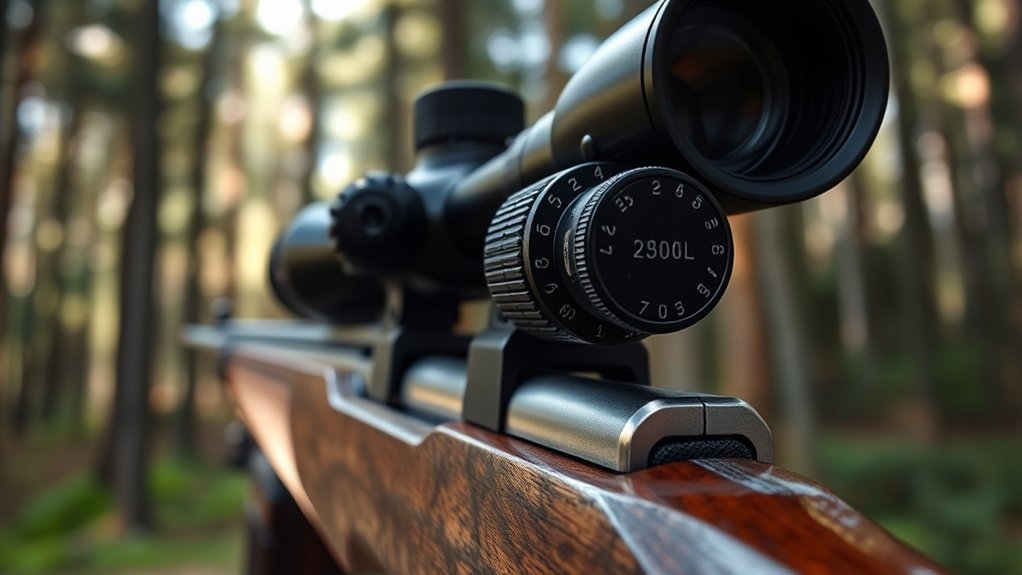
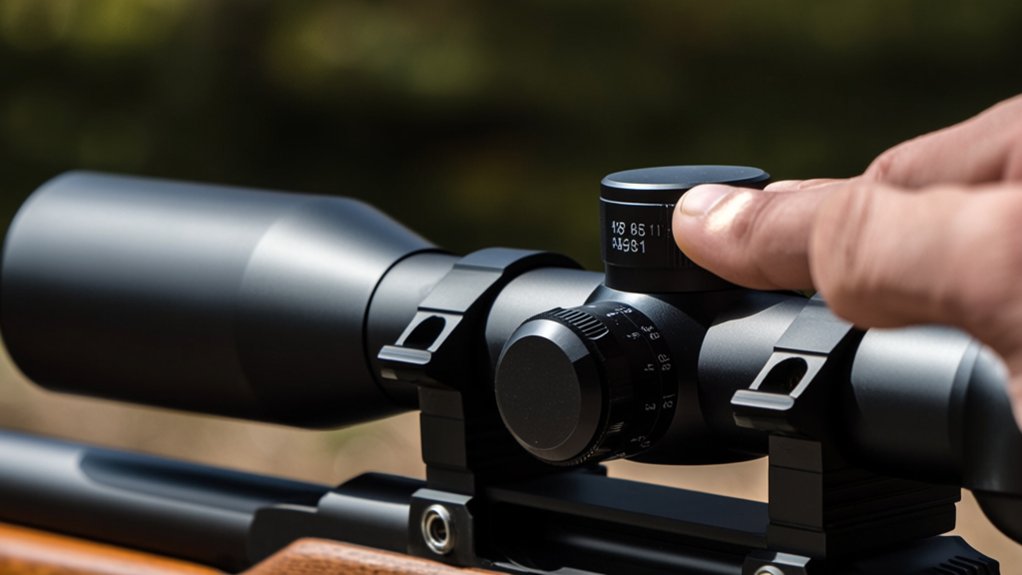
Reading the numbers on a rifle scope is simpler than it might seem at first glance. Typically, you’ll see numbers like “3-9×40” printed on the scope.
The first part, “3-9x,” tells you the magnification range. This means you can zoom in from 3 times up to 9 times closer to your target.
The number after the “x,” in this case, 40, represents the diameter of the objective lens in millimeters. A larger diameter lets in more light, offering a brighter image.
Some scopes just have a single number like “4×20,” meaning fixed 4x magnification with a 20mm objective lens.
Understanding these numbers helps you choose the right scope for your shooting needs without confusion.
Fixed vs. Variable Magnification: Which Is Right for You?
Wondering whether to choose a fixed or variable magnification scope? Fixed magnification scopes offer a single, set level of zoom. They’re simpler, often lighter, and can provide a clearer, brighter image because there are fewer moving parts.
If you mostly shoot at consistent distances, a fixed scope might suit you perfectly.
On the other hand, variable magnification scopes let you adjust zoom levels, giving you flexibility for different ranges and conditions. They’re ideal if you want versatility without swapping scopes.
However, they tend to be bulkier and sometimes less bright at the highest magnifications.
Consider your typical shooting scenarios and preferences. If you value simplicity and sharpness, go fixed. If you want adaptability across various distances, variable magnification will likely serve you better.
Why Magnification Matters for Your Shooting Distance
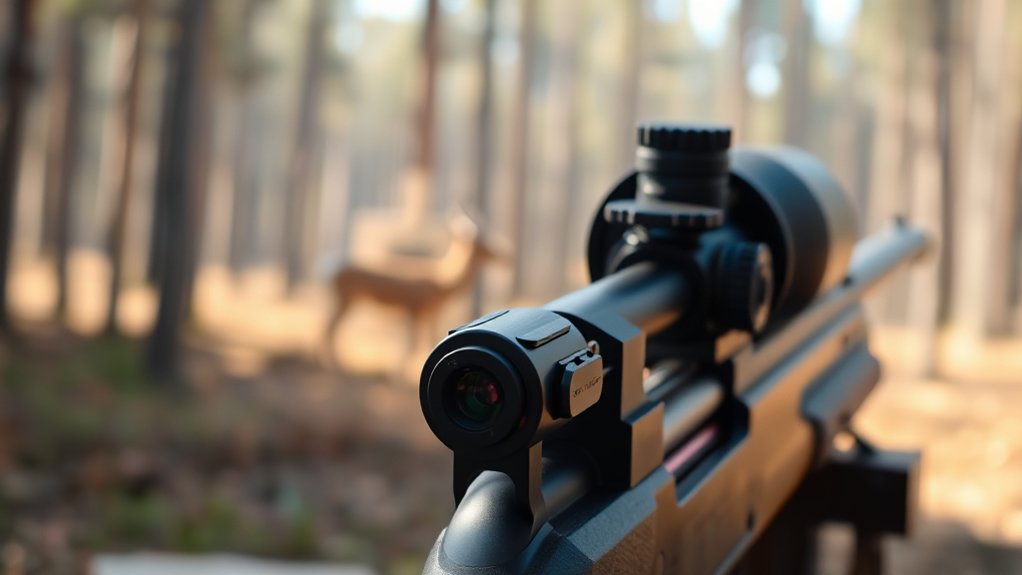
You need the right magnification to see your target clearly, especially at longer distances. Adjusting magnification helps you fine-tune your aim for better accuracy as range changes.
Impact On Target Clarity
Although higher magnification can bring distant targets into clearer view, it also narrows your field of vision and may reduce image brightness. You’ll notice this trade-off especially in low-light conditions or when tracking moving targets.
Choosing the right magnification is about balancing clarity with situational awareness.
Here’s how magnification impacts target clarity:
- Detail visibility: Higher magnification reveals finer target details.
- Image brightness: Increased zoom can make the image dimmer.
- Field of view: Magnification reduces how much area you see at once.
- Stability: Greater zoom amplifies hand movements, affecting clarity.
Keep these factors in mind to select magnification that enhances your shooting experience without compromising your overall view.
Adjusting For Range Accuracy
Balancing magnification for clarity naturally leads to contemplating how it affects your shooting distance. When you adjust magnification, you directly influence how well you see your target at various ranges.
Higher magnification brings distant targets closer, helping you aim with more confidence, especially when the target is small or far away. However, too much magnification can narrow your field of view and make it harder to track moving targets or quickly acquire your aim point.
Lower magnification offers a wider view, suited for closer targets or fast-moving scenarios. By understanding how magnification impacts your perception of distance, you can make smarter choices about scope settings.
This guarantees your shots are more accurate, matching the demands of the shooting range without sacrificing situational awareness.
Enhancing Precision At Distance
When you increase your scope’s magnification, you sharpen your ability to see fine details on distant targets, which directly boosts your shooting precision. Higher magnification lets you spot small movements, assess target features, and make more accurate aiming adjustments.
This is especially critical when shooting at extended ranges where every millimeter counts.
To enhance your precision at distance, consider these key benefits of magnification:
- Improved target identification and clarity
- Better holdover and windage adjustments
- Reduced target size ambiguity for precise shot placement
- Enhanced confidence in shot execution
How to Choose Magnification for Your Shooting Distance
How do you determine the right magnification for your shooting distance? First, consider how far you’ll typically shoot.
For close ranges under 100 yards, lower magnification (1x to 4x) works best, letting you quickly acquire targets without losing sight of your surroundings.
For mid-range shots between 100 and 300 yards, medium magnification (4x to 9x) offers a good balance of clarity and field of view.
If you’re shooting at long distances beyond 300 yards, higher magnification (10x or more) helps you see targets clearly and make precise adjustments.
How Magnification Affects Field of View and Clarity
Although higher magnification lets you see distant targets more clearly, it also narrows your field of view, making it harder to track moving objects or scan your surroundings quickly. When you increase magnification, you zoom in on a smaller area, which limits what you can see around your target. This trade-off impacts both your situational awareness and shooting speed.
Additionally, clarity can change depending on the scope’s quality and your environment. Here’s what to keep in mind:
- Higher magnification reduces the field of view, limiting peripheral vision.
- Lower magnification offers a wider field of view, helping with quick target acquisition.
- Clarity depends on lens quality, light conditions, and magnification level.
- Too much magnification can cause image distortion or shakiness without proper support.
How Magnification Changes Reticle Size
Because magnification changes the size of everything you see through your rifle scope, it also affects how your reticle appears. At higher magnifications, your reticle looks larger and more detailed, making it easier to aim precisely at small targets.
Conversely, at lower magnifications, the reticle appears smaller and less prominent, which can speed up target acquisition but might reduce fine aiming control.
However, keep in mind that the reticle’s actual size inside the scope doesn’t change—only how big it looks in your view. This change in perceived reticle size can influence your shooting accuracy, especially at varying distances.
Understanding this helps you choose the right magnification setting for your shooting situation and improves your overall shooting performance.
How Light Conditions Influence Your Magnification Choice
When light levels drop, you’ll need to adjust your magnification to maintain a clear view through your rifle scope. Lower light reduces the amount of visible detail, so using very high magnification can make the image dimmer and harder to see. You’ll want to balance magnification with available light to keep your target clear.
Consider these points when choosing magnification in different light conditions:
- Lower magnification gathers more light, brightening your view in dawn, dusk, or shaded areas.
- Higher magnification narrows your field of view, which can make spotting targets in low light challenging.
- Scopes with larger objective lenses help gather more light, improving image brightness at higher magnifications.
- Adjust your magnification to keep the reticle visible without straining your eyes in dim conditions.
When to Use Low vs. High Magnification Settings
Choosing between low and high magnification depends largely on your shooting environment and the distance to your target.
Use low magnification when you’re engaging targets at close range or moving quickly. It gives you a wider field of view, making it easier to track moving targets and spot threats around you. Low magnification also works well in dense environments like forests or brush.
High magnification is best when you need precision at longer distances. It lets you see small details clearly, helping you place shots accurately. However, high magnification narrows your field of view and can make tracking moving targets harder.
Matching Rifle Scope Magnification to Your Rifle
To get the most out of your rifle scope, you need to match its magnification to your specific rifle and intended use. Different rifles perform best with certain magnification ranges, so consider these factors:
- Rifle type: A bolt-action hunting rifle often pairs well with higher magnification for long-range shots, while a semi-automatic rifle suits lower magnifications for quick target acquisition.
- Barrel length: Shorter barrels benefit from lower magnification to maintain a wider field of view.
- Caliber: Larger calibers may require less magnification since they’re effective at shorter distances.
- Shooting style: If you prefer rapid shots, a lower magnification helps; for precision, higher magnification is ideal.
Matching your scope’s magnification properly ensures accuracy and enhances your overall shooting experience.
Choosing Magnification for Common Shooting Scenarios
Since different shooting scenarios demand varied levels of precision and speed, you’ll want to select magnification that matches the conditions. For close-range or fast-moving targets, lower magnification helps you acquire targets quickly. Long-range shooting requires higher magnification for accuracy. Here’s a quick guide to help you choose:
| Shooting Scenario | Recommended Magnification |
|---|---|
| Hunting (short range) | 1-4x |
| Hunting (long range) | 5-9x |
| Target shooting | 6-12x |
| Tactical/defense | 1-6x |
| Varmint control | 8-20x |
Choosing the right magnification guarantees you balance field of view and detail, improving your shot success in any situation.
How to Test and Adjust Magnification for Your Needs
Wondering how to find the ideal magnification for your rifle scope? Start by testing different settings in real conditions. Adjust magnification while observing your target to see what offers the clearest view without sacrificing field of view.
Here’s how you can effectively test and adjust:
- Set up a target at various distances to evaluate clarity at each magnification level.
- Note how easily you can acquire and track the target as you change magnification.
- Pay attention to the brightness and image stability; higher magnification can reduce both.
- Adjust magnification in the field instead of just at the range, since lighting and environment affect performance.
Common Mistakes to Avoid When Choosing Magnification
Testing magnification settings helps you find what works best, but many shooters still fall into common traps when choosing magnification. Avoid picking too high magnification for close-range shooting, as it narrows your field of view and makes tracking moving targets harder. Don’t forget to think about the scope’s size and weight, which affect your rifle’s balance. Also, skipping real-world testing and relying solely on specs can lead to disappointment in the field.
| Common Mistake | Why to Avoid It |
|---|---|
| Choosing excessive power | Limits field of view and target tracking |
| Ignoring scope size/weight | Impacts rifle handling and comfort |
| Neglecting practical tests | Specs don’t guarantee real-world fit |
Stay aware of these pitfalls to pick a magnification that truly suits your shooting style.
Tips for Beginners: Selecting the Right Rifle Scope Magnification
When selecting the right rifle scope magnification, you’ll want to take into account the typical distances you plan to shoot and the type of game or target you’re after.
For close-range shooting, lower magnification (1-4x) works best, offering a wider field of view.
For medium distances, moderate magnification (4-9x) balances clarity and range.
Long-range shots demand higher magnification (9x and above) but can reduce your field of view.
Keep these tips in mind:
- Match magnification to your shooting distance
- Consider the size and movement of your target
- Choose variable scopes for versatility
- Avoid overly high magnification if it compromises image brightness or stability
Picking the right magnification helps you shoot accurately and enjoy the experience more.
Frequently Asked Questions
How Does Magnification Impact Battery Life in Illuminated Scopes?
Magnification itself doesn’t directly impact battery life, but higher magnification often means brighter reticle illumination, which drains batteries faster. So, when you increase brightness at higher magnifications, expect shorter battery life in illuminated scopes.
Can Magnification Affect the Durability of a Rifle Scope?
Yes, magnification can affect your rifle scope’s durability. Higher magnification scopes often have more delicate internal parts, making them more prone to damage from shocks or drops. You should handle them carefully to maintain their longevity.
What Maintenance Is Required for Scopes With High Magnification?
You should regularly clean your high-magnification scope’s lenses, yet avoid harsh chemicals that could damage coatings. You’ll also want to check and tighten mounts carefully, contrasting delicate adjustments with rugged durability to keep your scope reliable.
Are There Legal Restrictions on Rifle Scope Magnification?
You generally won’t face legal restrictions on rifle scope magnification, but some states or countries may regulate optics for hunting or firearms. Always check local laws before buying or using high-magnification scopes to stay compliant.
How Does Magnification Influence Scope Weight and Balance?
Higher magnification usually means a heavier scope, which can shift your rifle’s balance forward. For example, upgrading from 3-9x to 6-24x made Sarah’s rifle front-heavy, affecting her steady aim and quick target acquisition.
Conclusion
Understanding rifle scope magnification is so vital, you might think your whole shooting success depends on it—because it kind of does! Picking the right magnification can turn a wild guess into a perfect shot, making every target crystal clear. Don’t settle for guessing games; get your numbers right, test them out, and watch your accuracy skyrocket. Master this, and you’ll feel like you have superhuman vision on the range!