How To Sight In A Gun?
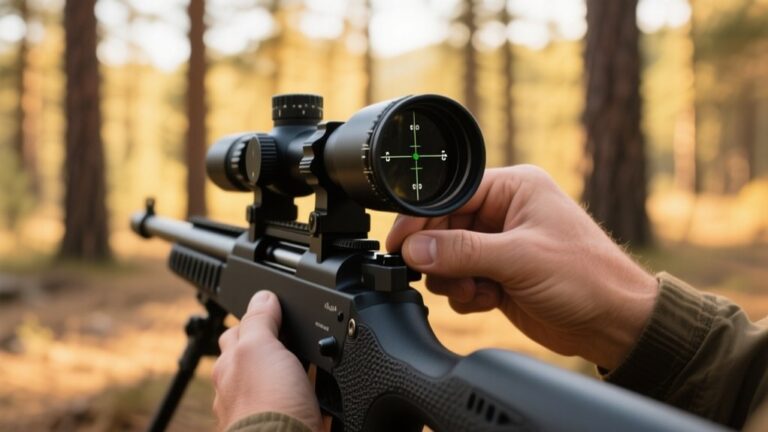
To sight in your gun, start by securely resting it and shooting groups at a target from a close distance like 25 yards. Adjust your sights or scope elevation and windage until shots consistently hit where you aim. Confirm your zero at longer ranges, making small tweaks as needed. Use consistent ammo and consider environmental factors like wind and altitude. With proper setup and maintenance, you’ll improve your accuracy considerably—exploring these steps deeper will sharpen your skills even more.
Key Takeaways
- Begin by confirming your sight zero at a close range, such as 25 yards, before adjusting at your intended shooting distance.
- Use a stable shooting rest and consistent ammunition to achieve accurate and repeatable shot groups for precise sight adjustments.
- Adjust elevation and windage knobs in small increments, firing groups between adjustments to verify changes in bullet impact.
- Test and confirm zero at multiple distances, including long-range, to ensure consistent accuracy across various shooting scenarios.
- Regularly re-sight your firearm after changing ammo, environmental shifts, or physical impacts to maintain reliable accuracy over time.
What Does It Mean to Sight In a Gun?
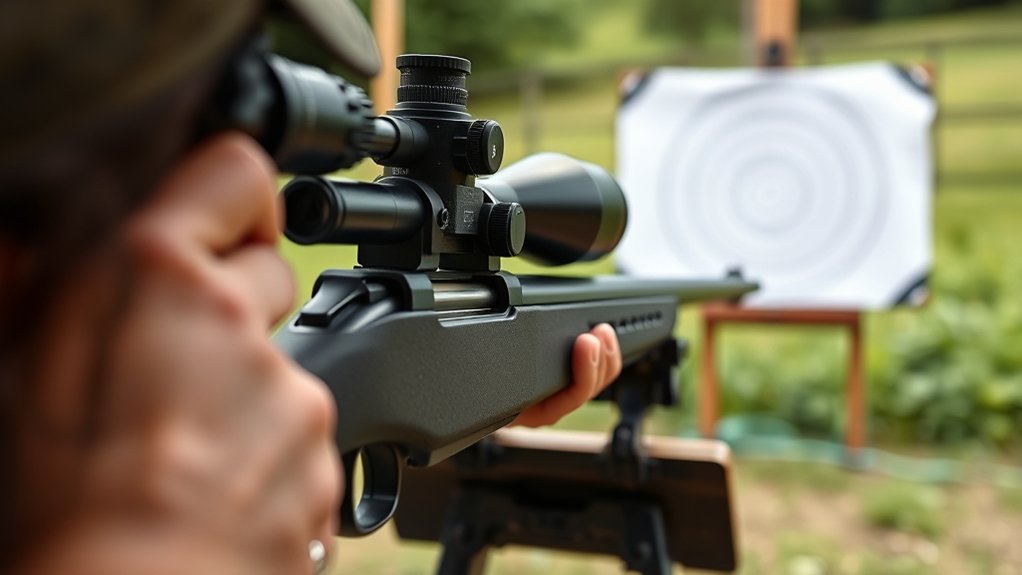
Although it might sound technical, sighting in a gun simply means adjusting your firearm’s sights so your shots hit exactly where you aim. When you sight in, you’re aligning the front and rear sights—or the scope—so the bullet’s point of impact matches the point of aim at a specific distance.
This process guarantees accuracy, whether you’re target shooting or hunting. You’ll start by shooting groups at a target and then fine-tune your sights based on where those shots land.
Each adjustment moves the point of impact left, right, up, or down until your shots consistently align with your intended target. Mastering this lets you trust your aim and improves your shooting confidence every time you pick up your gun.
Why Proper Sight Alignment Is Critical
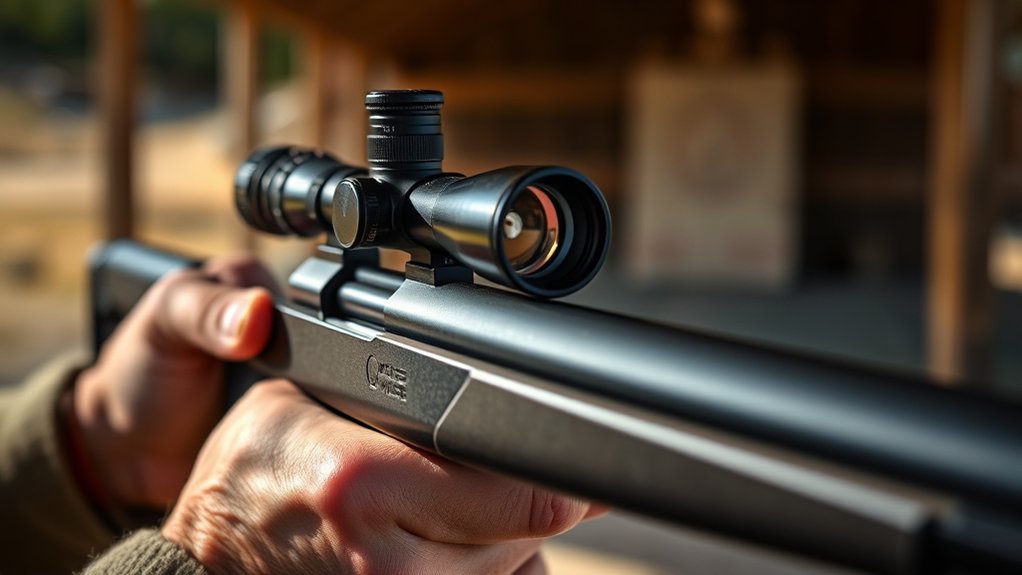
Because your sight alignment directly influences where your bullet lands, getting it right is essential for accuracy. When your front and rear sights don’t line up properly, your shot will consistently miss the intended target, no matter how steady your aim.
Proper sight alignment is crucial; misaligned sights cause shots to miss, regardless of steady aim.
Proper sight alignment guarantees the bullet follows the exact path you expect, increasing your confidence and effectiveness. Without it, you’ll struggle to make precise shots, especially at longer distances or moving targets.
Aligning your sights correctly helps you develop muscle memory and shooting habits that improve over time. Mastering this skill reduces frustration and wasted ammunition, making your practice sessions more productive.
Ultimately, precise sight alignment is the foundation for consistent accuracy and safe shooting.
Essential Tools for Sighting In Your Gun
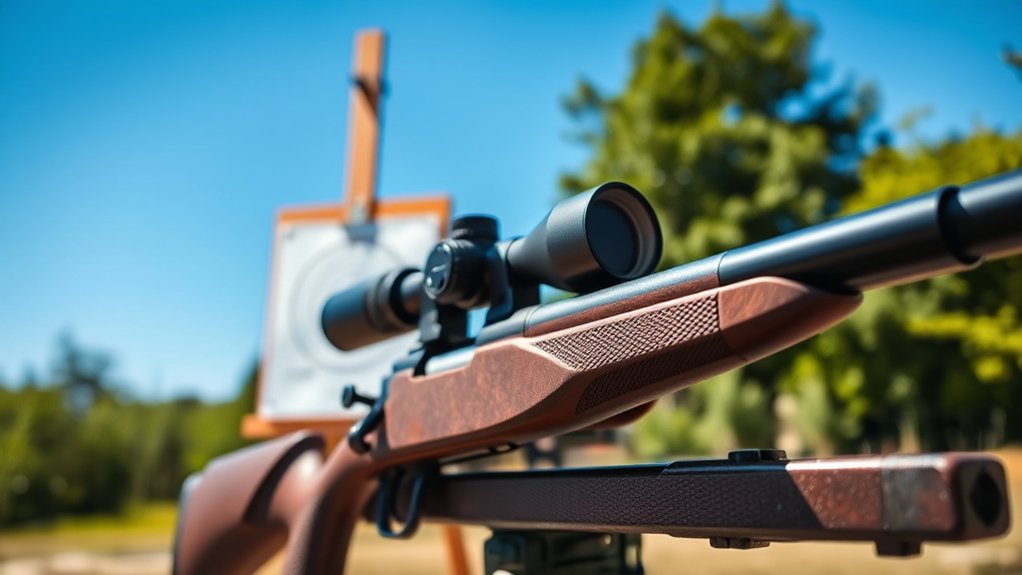
To sight in your gun accurately, you’ll need the right tools, including sight adjustment tools and a stable shooting rest to keep your shots consistent.
Choosing the right ammunition is also vital since different rounds can impact your point of impact.
Let’s explore how these essentials work together to get your gun zeroed in.
Necessary Sight Adjustment Tools
Before you begin sighting in your gun, you’ll need the right tools to make precise adjustments. Having these tools on hand guarantees you can fine-tune your sights accurately and efficiently.
- Sight Adjustment Tool – Often a small screwdriver or specialized tool designed for your gun’s sights to make elevation and windage changes.
- Bore Sight – Helps align your sights roughly before live firing, saving time and ammo.
- Target – A clear, easy-to-see target to evaluate your shot placement and sight adjustments.
- Rest or Shooting Bench – Keeps your gun steady, improving shot consistency and accuracy during adjustments.
These essential tools will help you sight in your gun confidently and quickly, making each shot count.
Choosing The Right Ammunition
How do you know which ammunition will give you the best accuracy when sighting in your gun? Start by selecting consistent, high-quality rounds that match your firearm’s caliber and intended use. Different brands and bullet types can perform very differently, so test several to find what shoots most accurately from your gun.
Keep the ammunition consistent during the sight-in process to avoid discrepancies caused by varying bullet weights or powder charges. Avoid cheap or reloads, as inconsistent velocities can skew your adjustments.
If you plan to hunt or target shoot with a particular ammo, sight in using that exact load. This ensures your point of impact matches your point of aim under real conditions.
Choosing the right ammunition is essential to achieving a precise, reliable sight-in.
Using A Stable Shooting Rest
Although choosing the right ammunition is essential, you won’t get accurate sighting without a stable shooting rest. A solid rest minimizes movement and helps you maintain consistent aim.
When you use a stable rest, your shots will group more tightly, making adjustments easier.
Here’s what you should consider for a good shooting rest:
- Material – Choose sturdy materials like metal or heavy-duty plastic for durability.
- Adjustability – Look for rests with adjustable height and angle to fit your shooting position.
- Portability – Pick a rest that’s easy to transport if you shoot in different locations.
- Surface Grip – Ensure the rest has a non-slip surface to keep your gun steady.
Using a stable rest improves your sight-in process considerably.
Setting Up a Safe Shooting Area
Before you start sighting in your gun, make sure you pick a location that’s safe and legal for shooting. You’ll want to set up clear backstops and keep your surroundings in mind to prevent accidents.
Taking these safety steps seriously will protect you and everyone nearby.
Selecting A Suitable Location
When selecting a location to sight in your gun, you’ll want to prioritize safety above all else. Choose a spot that minimizes risk to people, animals, and property. Look for a backdrop that safely stops your bullets, like a large dirt berm or thick, natural barriers. Guarantee the area is quiet and free from distractions so you can focus on accuracy.
Consider these factors when picking your location:
- Distance – Pick a spot with enough range to test your gun’s accuracy effectively.
- Visibility – Make sure you have a clear line of sight to your target.
- Accessibility – Choose a location that’s easy to reach and set up.
- Legal permissions – Confirm that shooting is allowed in that area to avoid fines or worse.
Implementing Safety Precautions
After choosing the right location, you need to focus on setting up a shooting area that keeps everyone safe. Start by ensuring the backdrop can effectively stop bullets—use a berm, dirt hill, or thick wooden target backer.
Clear the area of any obstacles or debris that could cause accidents. Mark your shooting zone clearly with signs or barriers to keep bystanders at a safe distance.
Always keep your firearm pointed downrange and your finger off the trigger until ready to shoot. Wear appropriate safety gear like eye and ear protection.
Double-check that no one is downrange before firing. Following these steps helps you create a controlled environment, minimizing risks and making your sight-in process safer and smoother.
Safety should always be your top priority.
Choosing the Right Ammunition for Sight-In
How do you pick the right ammunition to guarantee your sight-in is accurate? Start by choosing the ammo you plan to use regularly since different brands or bullet weights can change your point of impact. Consistency matters most during sight-in, so stick to one type.
Here’s how to choose effectively:
- Use factory-loaded rounds for reliability and uniformity.
- Match the bullet weight and type to your typical shooting conditions.
- Avoid experimenting with different ammo brands during sight-in.
- Consider the ballistic performance, such as velocity and drop, to ensure precise adjustments.
How to Zero Your Iron Sights Step-by-Step
Although sighting in a gun may seem intimidating, you can zero your iron sights accurately by following a clear, step-by-step process.
First, set up a target at a known distance, typically 25 yards for initial adjustments. Secure your firearm on a stable rest to minimize movement.
Fire a three-shot group, then examine where the bullets hit relative to the target’s center. Adjust the rear sight horizontally to move the point of impact left or right, and modify the front sight vertically to raise or lower the impact.
Repeat firing and adjusting until your shots consistently hit the bullseye.
Once satisfied at 25 yards, confirm your zero at your intended shooting distance, making fine adjustments as needed.
This method ensures your iron sights align precisely with your point of aim.
Adjusting a Rifle Scope to Sight In Your Gun
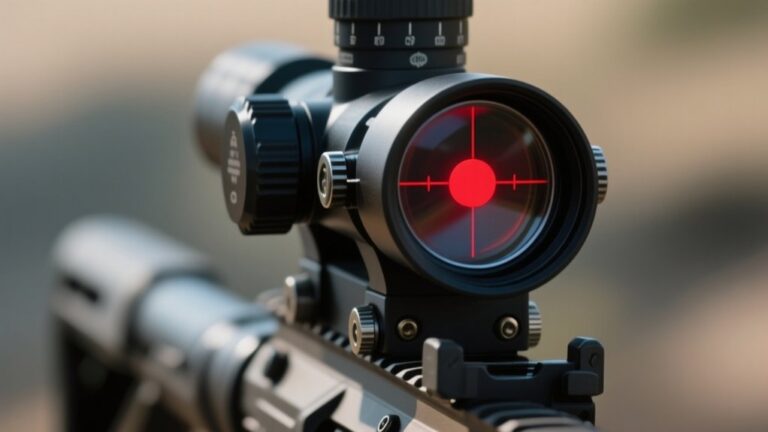
Once you’ve zeroed your iron sights, adjusting a rifle scope follows a similar principle but offers greater precision. You’ll make small adjustments to the windage and elevation turrets to align the reticle with your point of impact. Here’s how to get started:
- Set the scope to its center position by counting clicks from the maximum settings.
- Look through the scope at a target placed at your desired zero distance.
- Turn the elevation turret to move the reticle up or down to match the bullet’s impact.
- Adjust the windage turret left or right until the reticle aligns horizontally with the impact point.
This method guarantees your scope is properly calibrated before you start shooting.
Taking Your First Test Shots
Before you take your first test shots, make certain you choose the right ammunition for your rifle to guarantee accuracy.
Set up a clear, well-marked target at a safe distance where you can easily see your hits.
This preparation will help you make effective adjustments as you begin sighting in your gun.
Choosing Proper Ammunition
How do you choose the right ammunition for sighting in your gun? Picking the proper rounds is crucial for accuracy and consistency. You want ammo that matches your firearm and shooting goals to get reliable results during sighting.
Consider these key points:
- Match the caliber and type – Use the exact caliber your gun is chambered for and choose full metal jacket (FMJ) or target-grade rounds for consistent performance.
- Pick quality brands – Opt for reputable manufacturers to avoid misfires or inconsistencies.
- Stay consistent – Use the same batch or lot number throughout sighting to reduce variation.
- Test multiple loads – Trying different bullet weights or powders can help you find the most accurate ammo for your gun.
Choosing wisely sets you up for a smoother sighting process.
Setting Up Target
After selecting the right ammunition, your next step is to set up a target for your initial test shots. Place the target at a known distance, typically 25 yards for rifles or 10 yards for handguns, depending on your firearm and scope.
Make certain your target is clearly visible and securely mounted to prevent movement. Use a target with distinct markings or a bullseye to help you easily identify shot placement.
Position yourself comfortably and maintain a stable shooting stance to improve accuracy. When taking your first shots, aim carefully and fire a small group of rounds, usually three to five, to gauge your current point of impact.
This initial data will guide your scope or sight adjustments for better precision.
Adjusting Windage and Elevation to Improve Accuracy
When you start adjusting windage and elevation, you’ll directly influence where your bullet hits relative to your target. Windage controls the horizontal alignment, moving the point of impact left or right, while elevation adjusts the vertical alignment, raising or lowering the impact point.
To improve accuracy, follow these steps:
- Identify where your bullet consistently hits on the target.
- Use the windage knob to shift the sight left or right, compensating for horizontal deviation.
- Turn the elevation knob to move the sight up or down, correcting vertical errors.
- Make small, incremental adjustments and fire a few rounds between changes to track progress.
Checking Your Sight Adjustments at Different Ranges
Now that you’ve adjusted windage and elevation, it’s time to check your sights at various distances.
Start by verifying your zero at close range, then move to mid-range to fine-tune your adjustments.
Finally, test your precision at long distances to guarantee your settings hold true.
Verifying Zero at Close
Why should you verify your zero at close range before moving to longer distances? Checking your sight adjustments nearby saves time and ammo. It helps confirm that your initial zero is accurate and your scope or sights function properly. If you skip this step, errors might multiply as you shoot farther.
Here’s how to verify zero at close range effectively:
- Set up a target 10-15 yards away.
- Fire a group of shots, aiming carefully.
- Check where the rounds hit relative to your point of aim.
- Adjust your sights based on the impact location before testing at longer ranges.
This ensures your foundation is solid and prevents frustration during extended-range shooting.
Mid-Range Adjustment Checks
As you move beyond close-range checks, mid-range adjustment verification becomes essential to guarantee your sights hold true over distance. Typically, this means shooting at targets set between 100 and 200 yards.
At these distances, you’ll see how your initial zero holds up when external factors like wind or bullet drop start to matter more. Take careful note of where your shots land relative to the point of aim.
If you notice consistent deviation, modify your sights accordingly, making small, precise changes. Remember to fire groups rather than single shots to get a reliable pattern.
This step ensures your zero isn’t just accurate nearby but remains dependable at practical shooting ranges before you proceed to long-distance precision testing.
Long-Distance Precision Testing
After confirming your sights are accurate at mid-range distances, it’s time to test their performance over longer shots. Long-distance precision testing ensures your adjustments hold up where it really counts.
Here’s how to proceed:
- Choose a safe, open range that allows shooting at extended distances, like 300 yards or more.
- Fire groups of 3-5 shots at each distance to assess consistency and pinpoint any drift.
- Record your point of impact and compare it to your aiming point, noting any vertical or horizontal shifts.
- Make small sight adjustments based on these observations, then repeat testing until your shots consistently hit your target.
This methodical approach helps you achieve reliable accuracy, no matter the range.
Sight-In Tips for Different Types of Firearms
When sighting in different types of firearms, you’ll need to adjust your approach based on the gun’s design and intended use.
For rifles, focus on a stable rest and consistent shooting position to maximize accuracy.
Handguns require shorter distances and steadier grips since they’re less stable by nature.
Shotguns often don’t need precise sighting like rifles, but you should still check bead or optic alignment at typical engagement ranges.
If you’re working with a scoped firearm, zero your scope at the distance you expect to shoot most, then make fine adjustments.
For iron sights, ensure each notch and post is properly aligned and clearly visible.
Tailoring your sight-in process to the firearm type helps ensure your shots land exactly where you want.
Fixing Common Sight-In Issues
Adjusting your sights perfectly can be tricky, even with the best rest and steady grip. If your shots aren’t grouping where you want, check these common issues:
- Incorrect Zero Distance – Confirm you’re sighting in at the range distance you plan to shoot.
- Loose Sights or Mounts – Tighten screws and mounts; even slight movement affects accuracy.
- Inconsistent Shooting Position – Keep the same stance, cheek weld, and grip for every shot.
- Environmental Factors – Wind, lighting, and temperature can shift point of impact; adjust accordingly.
When and How Often to Re-Sight Your Gun
Though you might think once you’ve sighted in your gun, you’re done, regular re-sighting is essential to maintain accuracy. You should re-sight your gun after any significant impact, like dropping it or rough handling, since this can throw off your alignment.
Also, re-check your sights after changing ammunition types or brands because different loads can affect point of impact. It’s a good habit to re-sight before any important shooting session, especially if your gun hasn’t been used for a while.
For frequent shooters, checking your sights every few hundred rounds helps catch any drift early. By maintaining this routine, you guarantee consistent performance and confidence in your shots, so your gun stays true when it counts most.
How Environmental Factors Affect Your Sight-In Accuracy
Maintaining your gun’s sight alignment involves more than just regular checks and re-sighting after handling or ammo changes. Environmental factors can shift your point of impact and affect your sight-in accuracy. You need to take into account these four key factors:
- Wind: It can push your bullet off course, especially at longer ranges, so adjust your aim accordingly.
- Temperature: Changes can affect bullet velocity and barrel pressure, altering your shot placement.
- Humidity: High humidity can slightly reduce bullet velocity, impacting trajectory.
- Altitude: Higher altitudes have thinner air, causing bullets to travel faster and flatter.
Accounting for these elements helps you make precise adjustments, ensuring your sight remains accurate under varying conditions.
Maintaining Your Sights for Long-Term Accuracy
Because consistent accuracy depends on reliable sights, you need to keep them clean, secure, and properly aligned over time. Start by regularly wiping your sights with a soft cloth to remove dirt, oil, and debris that can obscure your view.
Check your mounting screws frequently to verify they’re tight—loose sights can shift and ruin your zero. If your sights are adjustable, confirm they’ve stayed in place after each shooting session.
Avoid harsh chemicals that might damage coatings or lenses. Also, inspect for any physical damage, like dents or scratches, which can affect sight picture.
Frequently Asked Questions
Can Sighting in a Gun Affect Its Resale Value?
Yes, sighting in a gun can affect its resale value. If you do it properly and keep everything in good condition, buyers will appreciate the accuracy. Poor adjustments or damage, however, can lower its worth.
Is Professional Sighting-In Service Worth the Cost?
Yes, professional sighting-in is worth it if you want precise accuracy and save time. You’ll avoid trial-and-error frustrations, ensuring your gun performs reliably, which can be especially valuable if you’re new or need consistent results quickly.
How Do Different Shooting Positions Impact Sight-In Accuracy?
Think of shooting positions like different camera angles—you’ll get varied shots. When you change your stance, your point of aim shifts, so you’ve got to adjust your sights accordingly to keep accuracy sharp and consistent.
Can Sighting in Help With Spotting Hidden Targets?
Yes, sighting in sharpens your focus and improves your ability to spot hidden targets by aligning your aim precisely. It helps you notice subtle movements or shapes, making it easier to detect targets that might otherwise blend in.
Are There Legal Restrictions on Sighting in Firearms at Home?
Yes, you often face legal restrictions when sighting in firearms at home. You shouldn’t shoot in unsafe directions, and many areas prohibit discharging guns indoors. Always check local laws and use proper safety measures before proceeding.
Conclusion
So, you’ve learned how to sight in your gun—because who doesn’t love playing sharpshooter with a tool that demands perfection? Just remember, skipping sight alignment is like trying to hit a bullseye with a blindfold—great for laughs, terrible for accuracy. Keep your sights clean, your ammo right, and your patience intact. Otherwise, you might just miss more than your target—you could miss the whole point of safe, precise shooting. Happy aiming!