How Does A Red Dot Sight Work?
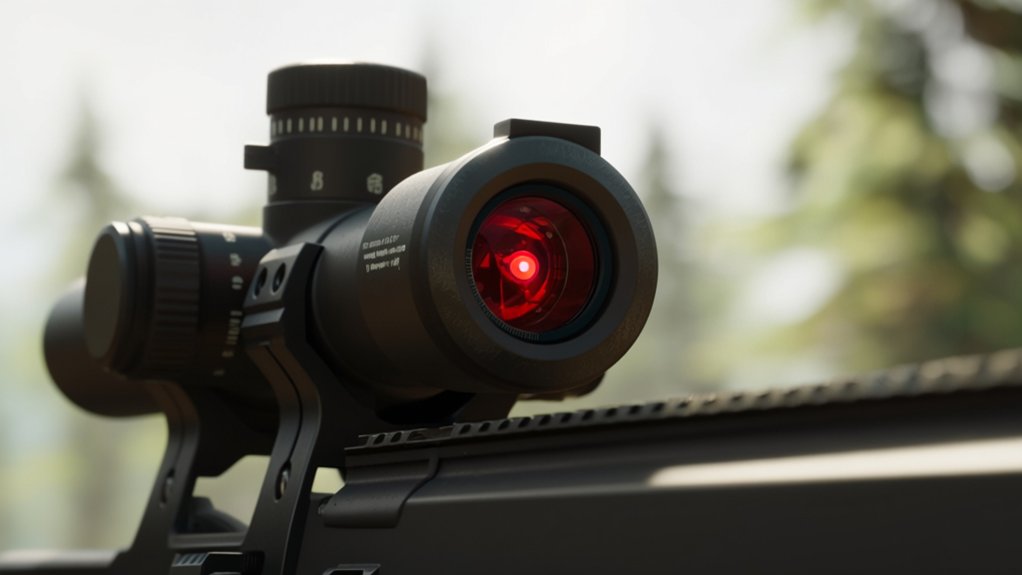
A red dot sight works by projecting a bright red dot reticle onto a specially coated lens, letting you aim quickly without aligning iron sights. You keep both eyes open for better awareness while the LED inside powers the illuminated dot, which stays aligned with your target regardless of your eye’s position. Adjustments help you zero in for accuracy, and proper maintenance keeps it reliable. If you want to optimize your shooting, there’s plenty more to explore.
Key Takeaways
- A red dot sight uses an LED to project a bright red dot reticle reflected on a coated lens for quick aiming.
- The reticle appears superimposed on the target, allowing aiming without aligning traditional iron sights.
- It enables shooting with both eyes open, enhancing situational awareness and fast target acquisition.
- Adjustable brightness ensures visibility in various lighting conditions, powered by batteries or solar energy.
- Quality sights minimize parallax, keeping the dot accurate even if the shooter’s eye moves off-center.
What Is a Red Dot Sight and How Does It Work?
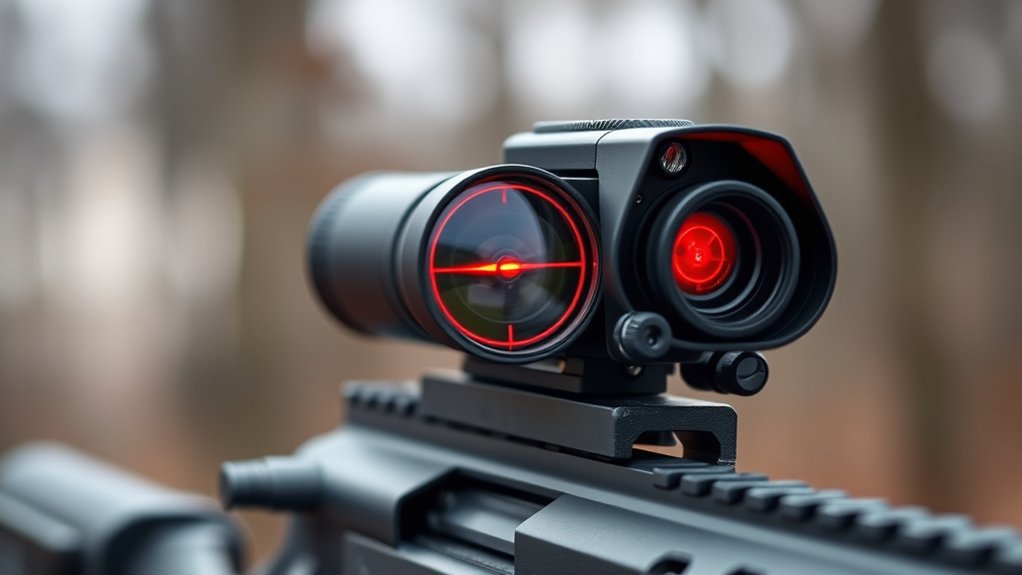
Although red dot sights might seem complex, they’re actually straightforward optical devices designed to help you aim quickly and accurately. When you look through one, you’ll see a bright red dot that acts as your aiming point. This dot allows you to line up your target without needing to align traditional iron sights.
Red dot sights are popular because they let you keep both eyes open, maintaining your peripheral vision and situational awareness. They’re lightweight, compact, and easy to use, making them ideal for various shooting activities, from hunting to tactical situations.
You don’t have to worry about magnification either, as red dot sights usually offer a clear, unobstructed view, helping you stay focused on your target with minimal effort.
How Red Dot Sights Project the Reticle
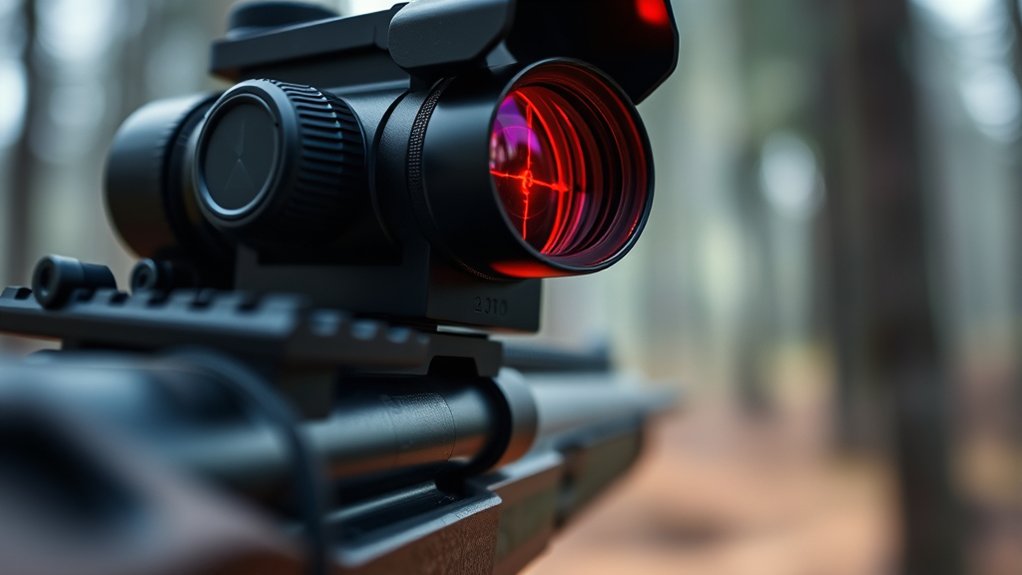
How exactly does a red dot sight create that bright aiming point you see? It projects the reticle by reflecting a tiny illuminated dot onto a specially coated lens.
This lens sits at a precise angle, allowing the dot to appear superimposed on your target without blocking your view. When you look through the sight, your eye aligns the dot with the target, making aiming intuitive and fast.
The reticle itself isn’t physically painted on the glass; instead, it’s a reflection of the projected light source inside the sight.
Because the dot stays aligned with the barrel regardless of your eye position, you don’t have to worry about perfect cheek welds. This setup lets you quickly acquire targets with minimal effort and maximum accuracy.
How LEDs Make the Red Dot Work
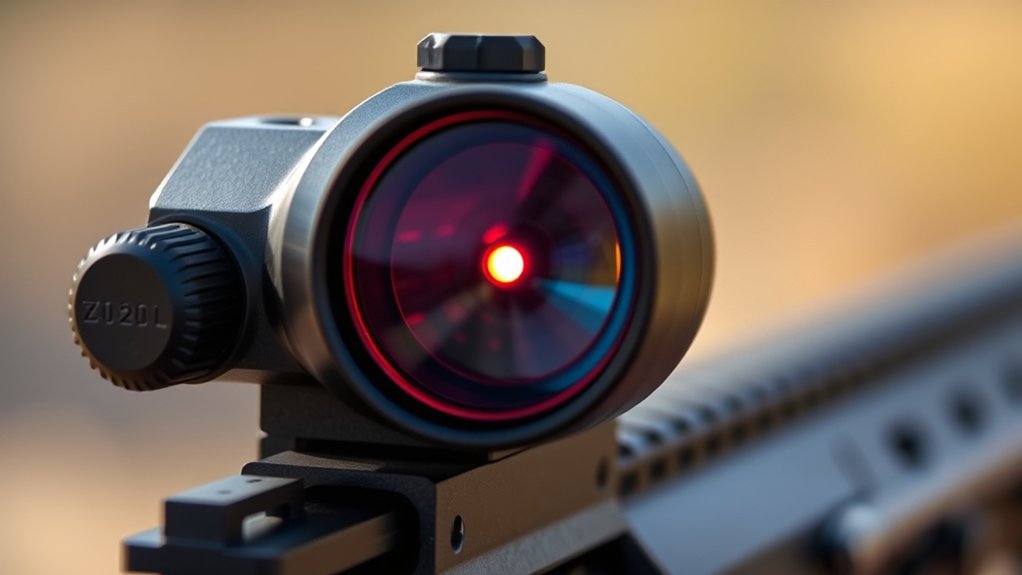
Because the LED inside the red dot sight produces the illuminated dot, it plays an essential role in its operation. You rely on this tiny light source to generate a bright, clear reticle that’s easy to see in various lighting conditions.
The LED emits a precise red light, chosen for its visibility and minimal eye strain. It’s powered by a compact battery, ensuring long-lasting use without adding bulk.
When you activate the sight, the LED lights up, creating the aiming point you use to align your shot. The technology inside controls the LED’s brightness, so you can adjust it to suit bright daylight or low-light environments, making your target acquisition faster and more accurate.
How the Reflective Lens Works
Once the LED creates the red dot, the reflective lens takes over to display it clearly where you need it. This lens isn’t just any glass; it’s specially coated to reflect the red light from the LED back toward your eye while letting other light pass through.
That means you see the dot superimposed on your target without any distortion or loss of brightness. The lens’s angle and coating are carefully designed so the dot appears to float at infinity, allowing you to keep both eyes open and maintain full situational awareness.
Because the lens reflects only the LED’s specific wavelength, you won’t see any distracting reflections, making aiming faster and more intuitive every time.
How Parallax Affects Red Dot Sight Accuracy
Although red dot sights are designed for quick target acquisition, parallax can still influence your shot accuracy if you’re not careful. Parallax occurs when the red dot appears to shift on the lens as you move your eye off-center. This means if your eye isn’t perfectly aligned with the sight, the dot mightn’t be exactly on your target, causing your shot to stray.
Most quality red dot sights minimize parallax at a specific distance, often around 50 yards, but at closer or longer ranges, some parallax error can occur. To maintain accuracy, make sure you consistently position your eye as close to the sight’s optical axis as possible.
Understanding parallax helps you avoid surprises and keeps your shots true to point of aim.
Types of Red Dot Sights Explained
Now that you understand parallax, it’s time to explore the different types of red dot sights. You’ll want to know how reflex and holographic sights compare, as well as the pros and cons of battery-powered versus solar options.
This will help you pick the right sight for your needs.
Reflex Vs. Holographic
Two main types of red dot sights dominate the market: reflex and holographic.
Reflex sights use an LED to project a dot onto a curved lens, reflecting the dot back to your eye while letting you see through the sight clearly. They’re lightweight, simple, and usually more affordable.
Holographic sights, on the other hand, create a 3D holographic reticle using a laser and a diffraction grating, making the dot appear to float on the target. This design offers better accuracy and faster target acquisition, especially in low light or with both eyes open.
Reflex sights rely on a single lens, while holographic sights use more complex optics.
Choosing between them depends on your shooting needs and budget, as each has unique strengths.
Battery-Powered Vs. Solar
Beyond the choice between reflex and holographic red dot sights, you’ll also want to take into account how they’re powered. Battery-powered sights are the most common, offering reliable performance and easy replacement when the battery dies. They’re compact and usually lightweight, but you’ll need to keep spare batteries handy to avoid downtime.
Solar-powered sights, on the other hand, use ambient light to recharge, extending battery life considerably and sometimes eliminating the need for battery changes altogether. They’re ideal if you spend a lot of time outdoors in bright conditions.
However, solar sights can be pricier and mightn’t perform as well in low-light environments. Ultimately, your choice depends on your usage and environment—whether you prioritize convenience or extended runtime without frequent battery swaps.
Advantages of Red Dot Sights Over Iron Sights
While iron sights have served shooters well for generations, red dot sights offer clear advantages that can enhance your shooting experience. With a red dot, you don’t need to align front and rear sights perfectly; simply place the illuminated dot on your target and shoot. This speeds up target acquisition, especially in fast-paced or low-light situations.
Red dots also reduce eye strain because you can keep both eyes open, maintaining better situational awareness. Unlike iron sights, they don’t require you to shift focus between the sights and the target.
Plus, red dots work well with various shooting positions, making them more versatile. Overall, using a red dot sight lets you aim quicker, shoot more accurately, and react faster than relying solely on iron sights.
Mounting Options and Firearm Compatibility
You’ll find red dot sights use several common mounting methods to fit different firearms securely. Understanding which mounts work best helps you match your sight to your specific gun type.
Let’s explore the options and compatibility to get your setup just right.
Common Mounting Methods
Because red dot sights come in various shapes and sizes, choosing the right mounting method is essential for compatibility with your firearm. You want a secure fit that keeps your sight stable during use. Common mounting methods include Picatinny rails, Weaver rails, and proprietary mounts designed for specific models. Each offers different levels of versatility and ease of installation.
| Mounting Method | Key Feature |
|---|---|
| Picatinny Rail | Standardized, versatile |
| Weaver Rail | Similar to Picatinny but less standardized |
| Proprietary Mount | Custom fit for specific sights |
Understanding these options helps you pick a mounting method that matches your firearm’s rail system and your sight’s design, ensuring best performance.
Compatible Firearm Types
Mounting methods like Picatinny and Weaver rails play a big role in determining which firearms can accommodate red dot sights. Most modern rifles, shotguns, and handguns come with these rails or can be easily modified to include them, giving you plenty of mounting options.
If you own an AR-15 or similar tactical rifle, you’ll find it simple to add a red dot sight thanks to standard Picatinny rails.
For handguns, many manufacturers offer models with integrated mounts or adapters specifically designed for red dots.
Even some bolt-action rifles and shotguns can accept red dot sights with the right mount.
Before buying, check your firearm’s compatibility and the red dot’s mounting system to guarantee a secure fit and superior performance.
How to Zero a Red Dot Sight for Precision
Before you start zeroing a red dot sight, make certain your firearm is securely positioned to maintain consistency.
Begin by setting up a target at a known distance, typically 25 yards for pistols or 50-100 yards for rifles.
Aim at the center and fire a three-shot group.
Observe where your shots land relative to the red dot.
Use the sight’s windage and elevation adjustments to move the dot toward the group’s center.
Repeat firing groups and adjusting until the red dot aligns precisely with your point of impact.
Remember to keep your shooting stance and grip steady throughout the process.
Once zeroed, your red dot sight will help you place shots accurately without guessing or compensating.
Adjusting Brightness and Reticle on Red Dot Sights
Once you’ve zeroed your red dot sight, adjusting its brightness and reticle settings guarantees you maintain clear visibility in varying lighting conditions.
Most red dot sights offer multiple brightness levels, so you can increase brightness outdoors or lower it indoors to prevent glare. Use the brightness controls to match your environment—too dim, and you might miss your target; too bright, and you risk losing the reticle’s sharpness.
Adjust brightness to fit your environment—bright outdoors, dim indoors—to keep your reticle clear and visible.
Some models let you change reticle shapes or sizes, helping you choose what feels most comfortable and precise for your shooting style. Don’t hesitate to experiment with these settings during practice sessions to find the best combination.
Properly adjusting brightness and reticle ensures consistent accuracy and quick target acquisition every time you shoot.
Common Uses in Hunting and Shooting Sports
Adjusting brightness and reticle settings helps you stay accurate, but knowing where and how to use your red dot sight reveals its full potential.
In hunting, red dot sights let you quickly acquire targets, especially in close to mid-range scenarios, like tracking fast-moving game or shooting in dense woods. You’ll appreciate the unlimited eye relief and wide field of view, which keep your focus on the environment instead of fiddling with your sight.
In shooting sports, red dot sights excel in dynamic events like 3-gun competitions, where speed and precision matter. You can engage multiple targets swiftly without aligning iron sights.
Whether hunting or competing, a red dot sight enhances your reaction time and accuracy, helping you make every shot count.
Troubleshooting Red Dot Sight Power and Reticle Issues
If your red dot sight isn’t powering on or the reticle looks dim or distorted, you’ll want to troubleshoot these common issues quickly to avoid missing critical shots.
First, check the battery—replace it if it’s dead or improperly seated. Clean the battery contacts to ensure a solid connection.
If the reticle is dim, adjust the brightness settings; sometimes, it’s just set too low.
Inspect the lens for dirt, smudges, or scratches that could distort the reticle image and clean it gently with a microfiber cloth.
Also, verify that the sight’s mounting is secure, as a loose mount can affect alignment and reticle appearance.
If problems persist, consult the manufacturer’s manual or customer support for specific solutions tailored to your model.
Comparing Red Dot Sights to Holographic and Prism Sights
After ensuring your red dot sight functions properly, you might wonder how it stacks up against other optic types like holographic and prism sights.
Red dot sights offer simplicity and speed, projecting a single illuminated dot for quick target acquisition with both eyes open.
Holographic sights use a laser to create a reticle that appears to float on the target, providing greater precision and better performance in low light or complex environments.
Prism sights, meanwhile, incorporate magnification and etched reticles, making them ideal for medium-range engagements where clarity and durability matter.
While red dots excel in speed and ease of use, holographic and prism sights give you added versatility and detail.
Your choice depends on what balance of speed, precision, and range suits your shooting needs best.
Battery Life and Its Impact on Performance
Because your red dot sight relies on a battery to power the illuminated reticle, battery life directly affects its reliability and performance in the field. If the battery dies unexpectedly, you lose your aiming point, which can compromise accuracy and speed.
You’ll want to choose a sight with long battery life, often measured in thousands of hours, to minimize downtime. Many models offer adjustable brightness settings to conserve power when full intensity isn’t needed.
Some even include auto-shutoff features that activate after periods of inactivity, extending battery life further. Always carry spare batteries during critical use, so you’re never caught off guard.
Understanding how battery life impacts your sight helps you plan better and guarantees your red dot performs consistently when you need it most.
Maintaining and Cleaning Your Red Dot Sight
Battery life keeps your red dot sight running, but proper maintenance and cleaning guarantee it stays reliable over time. Regularly wipe the lens with a microfiber cloth to avoid scratches and use lens cleaner for stubborn dirt. Check for loose screws and tighten them to maintain zero. Store your sight in a protective case when not in use to prevent dust buildup and damage.
| Task | Frequency | Tools Needed |
|---|---|---|
| Lens Cleaning | After every use | Microfiber cloth, lens cleaner |
| Screw Tightening | Monthly | Small screwdriver |
| Storage | Always | Protective case |
Frequently Asked Questions
Can Red Dot Sights Be Used Effectively in Low-Light Conditions?
Yes, you can use red dot sights effectively in low-light conditions because their illuminated reticle stands out against dark backgrounds, helping you aim quickly and accurately without needing extra light or adjusting your focus.
Are Red Dot Sights Compatible With Night Vision Devices?
Yes, red dot sights are compatible with night vision devices if they’re designed with adjustable brightness and NV settings. You’ll want to confirm your sight supports low-light modes to avoid overwhelming your night vision gear.
What Materials Are Red Dot Sights Typically Made From?
Red dot sights are typically made from durable materials like aircraft-grade aluminum or lightweight polymers. You’ll find lenses coated with anti-reflective layers to improve clarity and protect the optics from scratches and glare during use.
How Does Temperature Affect Red Dot Sight Performance?
Temperature can affect your red dot sight’s battery life and lens clarity. Extreme cold might shorten battery performance, while heat can cause internal fogging or affect electronics. Always store and use it within recommended temperature ranges.
Can Red Dot Sights Be Used on Pistols or Only Rifles?
You can definitely use red dot sights on pistols, not just rifles. They improve your target acquisition speed and accuracy, especially in close to mid-range shooting. Many pistols are designed or adapted to mount these sights easily.
Conclusion
Think of a red dot sight like a tiny lighthouse guiding your aim through the fog. Just as a lighthouse’s beam cuts through darkness to show the way, the red dot’s illuminated reticle helps you pinpoint your target instantly. With proper care and understanding of its mechanics—like LED projection and parallax—you’ll keep your sight shining bright, ensuring every shot hits where you intend, no matter the conditions.