What Does MOA Mean on a Rifle Scope?
MOA on a rifle scope stands for Minute of Angle, a unit that helps you adjust your aim precisely. It measures an angular change where 1 MOA equals about 1 inch of impact shift at 100 yards. This lets you fine-tune your shot placement by turning scope turrets, often in ¼ MOA increments. Understanding MOA improves your accuracy and helps compensate for distance and bullet drop. Keep exploring, and you’ll master how to zero your scope and make precise corrections.
What Does MOA Mean on a Rifle Scope?
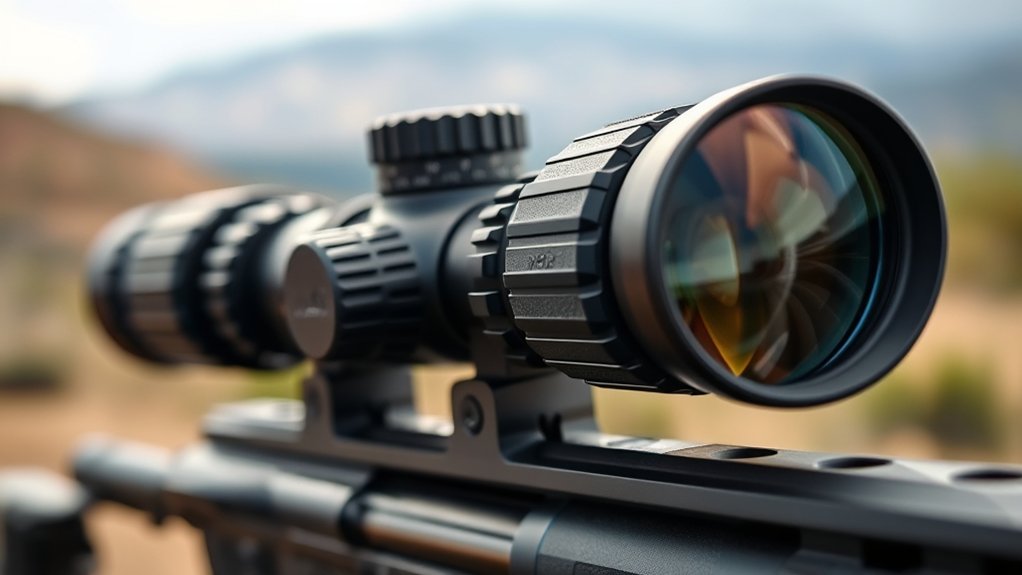
What exactly does MOA mean on a rifle scope? MOA stands for Minute of Angle, a unit used to describe the adjustment increments on your scope. When you adjust your scope using MOA, you’re fine-tuning where your bullet will hit relative to your aim point. Each MOA corresponds to about 1.047 inches at 100 yards, but most shooters round it to 1 inch for simplicity. This means if you dial 1 MOA up, your point of impact moves roughly 1 inch higher at 100 yards. Understanding MOA helps you make precise corrections for wind, elevation, and other factors affecting accuracy. So, when you see MOA markings on your scope, you know exactly how much you’re adjusting your shot for better accuracy.
How MOA Measures Angle and Distance on Rifle Scope Targets
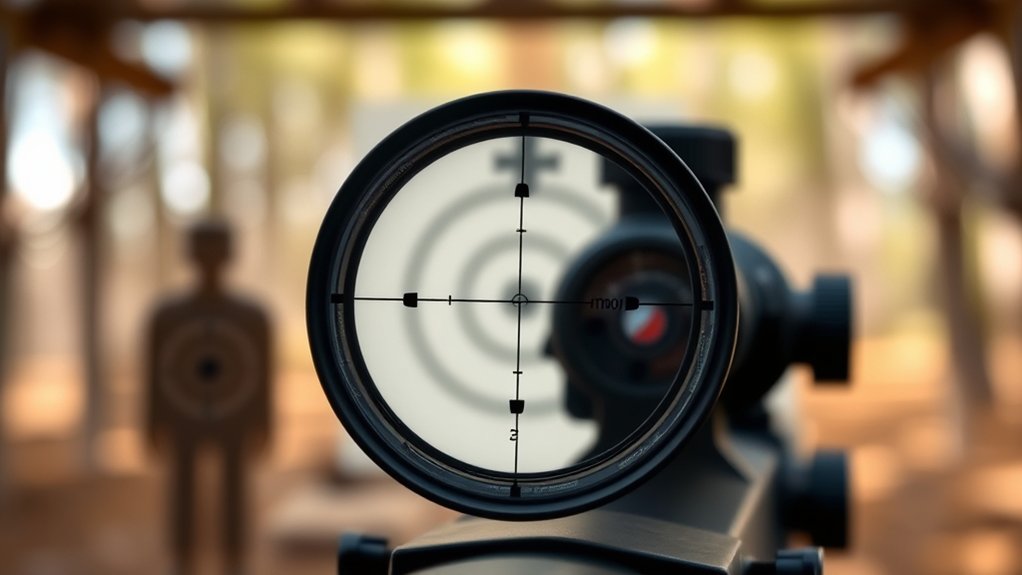
You’ll want to understand how MOA units represent angles to accurately measure distances to your target. Once you grasp this, calculating range and making precise scope adjustments become much simpler.
Let’s explore how MOA helps you dial in your shot and estimate distance effectively.
Understanding MOA Units
How exactly does MOA help you adjust your aim on a rifle scope? MOA, or Minute of Angle, measures angles rather than distances directly. One MOA equals 1/60th of a degree, which translates to about 1.047 inches at 100 yards.
When you turn your scope’s adjustment knob by one MOA, the point of impact shifts roughly one inch at that distance. This angular measurement stays consistent regardless of range, letting you calculate how much to adjust your scope to hit the target accurately.
Calculating Distance With MOA
Wondering how MOA can help you calculate the distance to a target? MOA measures angular size, letting you estimate how far away something is if you know its size. One MOA roughly equals 1 inch at 100 yards, so by measuring how many MOA a target spans in your scope and knowing the target’s actual size, you can calculate distance.
Here’s a simple way to visualize it:
| Target Size (inches) | MOA Measured | Distance (yards) |
|---|---|---|
| 18 | 3 | (18 ÷ 3) × 100 = 600 |
| 12 | 2 | (12 ÷ 2) × 100 = 600 |
| 24 | 4 | (24 ÷ 4) × 100 = 600 |
Use this formula: Distance = (Target Size ÷ MOA) × 100 yards.
Adjusting Scope Using MOA
When you adjust your rifle scope using MOA, you change the point of impact by shifting the reticle in precise angular increments. Each MOA represents 1/60th of a degree, which translates to roughly 1.047 inches at 100 yards.
So, if your shot lands off by 2 inches at 100 yards, you’d adjust your scope by about 2 MOA to correct it. Most scopes allow adjustments in 1/4 or 1/2 MOA clicks, giving you fine control over your aim.
As distance increases, the linear measurement per MOA grows proportionally—meaning 1 MOA equals about 2 inches at 200 yards. Understanding this helps you dial in your scope accurately for various ranges, improving your shot precision and overall shooting effectiveness.
Why MOA Matters When Adjusting Your Scope
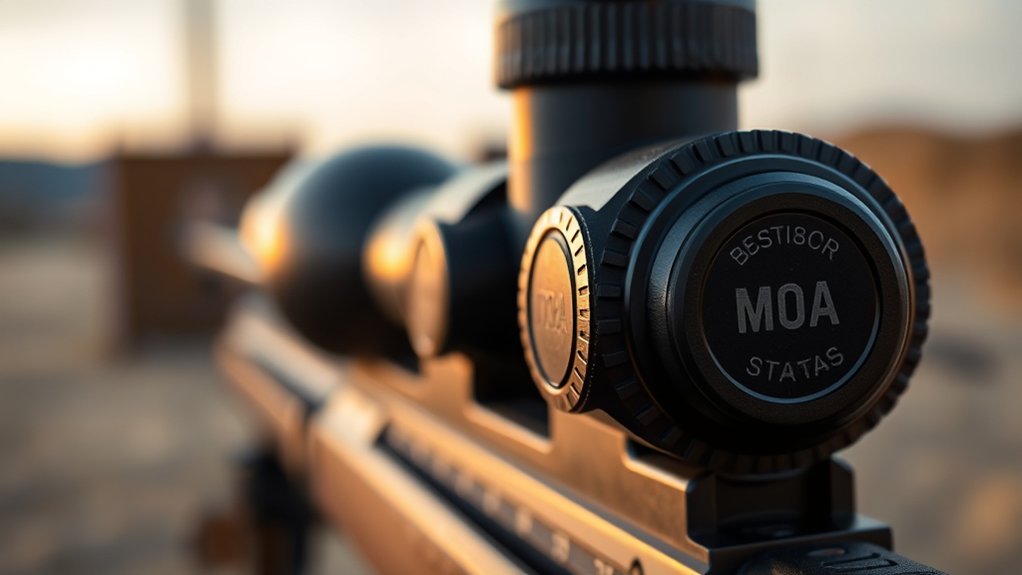
You need to understand MOA because it directly affects how accurate your shots will be.
When you adjust your scope, knowing MOA helps you make precise changes to hit your target exactly where you want.
Without this knowledge, your adjustments could throw off your aim and reduce your shooting effectiveness.
Understanding Minute Of Angle
Three key reasons make understanding Minute of Angle (MOA) essential when adjusting your rifle scope. First, MOA helps you measure the angular distance your bullet travels. Second, it allows precise adjustments in windage and elevation. Third, knowing MOA aids in estimating shot placement at various ranges.
Here’s a quick overview:
| MOA Concept | What It Means |
|---|---|
| 1 MOA | Approximately 1 inch at 100 yards |
| Adjustment Click | Usually ¼ MOA, or ¼ inch at 100 yards |
| Angular Measurement | 1/60th of a degree |
Understanding MOA guarantees you make accurate scope adjustments, matching the bullet’s point of impact with your aiming point. This knowledge directly supports consistent shooting and better target acquisition.
Impact On Accuracy
How does understanding MOA directly influence your shooting accuracy? Knowing MOA lets you make precise adjustments to your rifle scope, ensuring your shots land exactly where you want.
Each MOA click corresponds to a specific shift in your point of impact—usually 1/4 inch at 100 yards—so you can quickly correct for wind, distance, or elevation changes.
Without grasping MOA, your scope adjustments could be guesswork, causing missed targets and wasted ammo.
When you dial your scope using MOA increments, you gain control over subtle shot placement, which is *essential* for consistent accuracy, especially at longer ranges.
Ultimately, understanding MOA empowers you to adapt your aim confidently, turning adjustments into reliable improvements rather than trial and error.
Scope Adjustment Precision
When you adjust your rifle scope, understanding MOA guarantees each click translates into a precise change in your point of impact. This precision matters because:
- Consistency – Every MOA click moves the reticle a predictable distance, letting you replicate exact adjustments.
- Accuracy – Small, measured changes help you zero in on your target without overshooting.
- Distance Compensation – Knowing MOA helps you adjust for bullet drop over various ranges confidently.
- Windage and Elevation Control – You can fine-tune horizontal and vertical corrections accurately to counter environmental factors.
How to Calculate MOA for Rifle Scope Targets at Different Distances
Although MOA is a fixed angular measurement, calculating the actual size of your shot group at different distances requires converting MOA into linear measurements.
One MOA equals approximately 1.047 inches at 100 yards.
To find the size of your group at any distance, multiply the MOA value by the distance (in hundreds of yards) and then by 1.047.
For example, at 200 yards, 1 MOA equals about 2.094 inches (1.047 × 2).
If your group measures 2 MOA at 200 yards, it translates to roughly 4.188 inches.
This method helps you understand how adjustments translate to real-world impacts on your target, allowing you to make precise corrections based on distance rather than angular values alone.
Keep a calculator handy for quick conversions in the field.
How to Use MOA to Zero Your Rifle Scope
To zero your rifle scope using MOA, you’ll need to understand how MOA adjustments move your point of impact.
You’ll also calculate bullet drop compensation to make precise corrections at different distances.
Follow a step-by-step process to guarantee your scope is accurately zeroed for your shooting needs.
Understanding MOA Adjustments
Since you want your shots to hit the target accurately, understanding how to use MOA adjustments is essential for zeroing your rifle scope. MOA lets you fine-tune your point of aim by moving your reticle in precise increments.
Here’s how to use MOA adjustments effectively:
- Identify your scope’s adjustment value, usually 1/4 MOA per click.
- Shoot a group at your zeroing distance and measure how far off the point of impact is from the point of aim.
- Calculate the number of clicks needed to correct the deviation (each click shifts the impact by 1/4 inch at 100 yards).
- Turn the adjustment knobs accordingly—up/down for elevation and left/right for windage—to align your reticle with the actual bullet impact.
Calculating Bullet Drop Compensation
Now that you know how to adjust your scope using MOA clicks, you can apply this knowledge to compensate for bullet drop over longer distances.
Bullet drop means your bullet will hit lower than your aim point as distance increases. To counteract this, first determine how many inches your bullet drops at your target range.
Next, convert that drop into MOA by dividing the drop in inches by the distance in yards and then multiplying by 3.6 (MOA = drop (inches) ÷ distance (yards) × 3.6).
Finally, adjust your scope’s elevation turret up by that MOA value. This way, you’ll raise your point of impact, ensuring your bullet hits where you intend despite gravity’s effect over distance.
Step-by-Step Zeroing Process
How do you zero your rifle scope using MOA adjustments? Start by understanding that each MOA click moves your point of impact roughly 1 inch at 100 yards.
Follow these steps:
- Set up a target at your desired zero distance, typically 100 yards.
- Fire a three-shot group to observe the bullet impact relative to your aiming point.
- Measure the distance from the group’s center to the bullseye, then calculate the needed MOA adjustment (1 MOA ≈ 1 inch at 100 yards).
- Turn the windage and elevation turrets accordingly, using the MOA clicks to shift your point of impact closer to the bullseye.
Repeat this process until your shots consistently hit the target center, ensuring your scope is precisely zeroed.
What MOA Adjustments Look Like on Scope Turrets
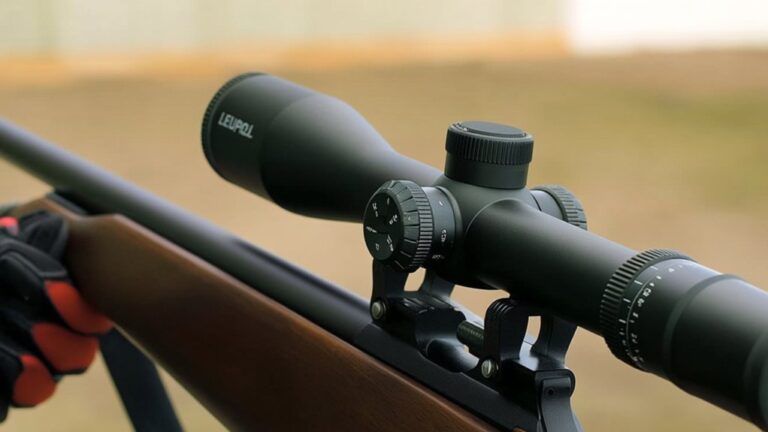
When you look closely at your rifle scope’s turrets, you’ll notice small markings and clicks that represent MOA adjustments. Each click usually moves your point of impact by a fraction of an MOA, commonly 1/4 MOA per click. This allows you to make precise changes to elevation and windage, helping you tighten your groupings on target.
Here’s a quick look at what you’ll find on most turrets:
| Turret Feature | MOA Adjustment Detail |
|---|---|
| Click Value | 1/4 MOA per click |
| Number of Clicks | 20 clicks = 5 MOA total |
| Markings | Numbers indicate MOA |
MOA vs. MIL: What’s the Difference?
Understanding MOA adjustments on your scope’s turrets helps you make precise changes, but you might wonder how MOA compares to another common measurement: MIL. Both measure angular adjustments to improve accuracy, but they do it differently. Here’s what you need to know:
- MOA stands for Minute of Angle, with 1 MOA roughly equaling 1 inch at 100 yards.
- MIL stands for milliradian, where 1 MIL equals 3.6 inches at 100 yards.
- MOA is based on degrees, dividing a circle into 21,600 minutes.
- MIL divides a circle into 6,283 radians.
Many shooters prefer MOA for its simplicity in inches, while MIL is popular in military and long-range shooting for its metric precision.
Knowing these differences helps you choose the right system for your shooting style.
Using MOA to Enhance Long-Range Shooting Accuracy
Why does MOA matter for long-range shooting? Because it gives you a precise way to measure and adjust your shots.
When you understand MOA, you can make small, accurate corrections on your scope to compensate for bullet drop and wind drift. Each MOA click moves your point of impact roughly 1 inch at 100 yards, so at longer distances, you can calculate exactly how many clicks to dial in.
This precision helps you hit targets consistently, even at extreme ranges. By mastering MOA adjustments, you reduce guesswork and improve your shooting confidence.
Common MOA Mistakes When Sighting In
How often do shooters overlook simple MOA errors that can throw off their sight-in process? Avoid these common mistakes to ensure accuracy:
- Misunderstanding MOA increments – Don’t confuse 1/4 MOA clicks with full MOA adjustments; small errors add up quickly.
- Ignoring zero distance – Always confirm your zero range; adjusting MOA without this leads to off-target shots.
- Neglecting consistent shooting position – Changing your stance or rest affects point of impact, skewing MOA calibration.
- Skipping verification shots – After adjustments, take multiple shots to confirm changes; one shot isn’t enough to trust your zero.
How Environmental Factors Affect MOA Adjustments and Accuracy
Once you’ve nailed your MOA adjustments with consistent shooting and verification, it’s important to take into account the environment around you. Wind can push your bullet off course, so you’ll need to adjust your scope or hold accordingly.
Temperature affects air density, which changes bullet trajectory—hot air is less dense, causing less bullet drop, while cold air does the opposite.
Altitude also impacts air pressure, meaning higher elevations require different MOA tweaks.
Humidity plays a smaller role but still influences bullet flight.
By understanding these factors, you can better predict how your bullet will behave beyond basic MOA settings.
Always check conditions before a shot and make small corrections, especially at longer ranges, to maintain accuracy in real-world shooting scenarios.
Choosing a Rifle Scope With the Right MOA Range
Selecting a rifle scope with the right MOA range guarantees you have the flexibility needed for precise adjustments at various distances. To choose effectively, consider these factors:
- Shooting Distance – If you shoot mostly at close to medium ranges, a smaller MOA range is sufficient. For long-range shooting, a broader MOA range helps accommodate greater bullet drop.
- Adjustment Precision – Scopes with smaller MOA increments let you make finer adjustments, ideal for precision shooting.
- Scope Size and Weight – Larger MOA ranges sometimes come with heavier scopes. Balance your need for range with portability.
- Intended Use – Hunting, tactical, or target shooting each demands different MOA ranges. Match your scope to your primary use to maximize effectiveness.
Frequently Asked Questions
What Brands Offer Rifle Scopes With MOA Adjustments?
You’ll find MOA adjustments on brands like Vortex, Leupold, Nikon, Bushnell, and Burris. They make scopes with precise, reliable turrets, helping you fine-tune your aim for better accuracy at various distances.
Can MOA Be Used for Hunting Different Types of Game?
Yes, you can use MOA for hunting different game by adjusting your scope precisely. It helps you compensate for bullet drop and wind, so you’ll make accurate shots whether you’re hunting small varmints or big game.
How Often Should I Recalibrate My Scope’s MOA Settings?
You should recalibrate your scope’s MOA settings regularly, especially after heavy use, changing ammo, or environmental shifts. Checking it before each hunting trip guarantees accuracy and confidence in your shots under varying conditions.
Are MOA Adjustments Compatible With Red Dot Sights?
Think of MOA adjustments like fine-tuning a violin; red dot sights usually don’t use MOA clicks since they rely on different systems. Still, some advanced models let you tweak MOA for precise aiming.
Does MOA Affect Bullet Trajectory or Just Aiming Precision?
MOA mainly affects your aiming precision, letting you adjust your point of impact. It doesn’t change bullet trajectory itself, but by fine-tuning your scope, you align your shots more accurately with where the bullet lands.
Conclusion
Now that you know MOA is basically your rifle scope’s secret weapon for pinpoint accuracy, you’re unstoppable! Forget guessing—MOA lets you dial in shots like a sniper from miles away (almost). Mastering it means you’ll never miss that impossible shot, even if the wind’s howling like a hurricane. So get out there, adjust with confidence, and watch your shooting skills level up to legendary status!