What Does AO Mean on a Rifle Scope?
AO on a rifle scope means Adjustable Objective, a feature that lets you fine-tune the focus of the scope’s objective lens for sharper images at varying distances. It helps you eliminate parallax, keeping the reticle aligned with your target even during minor head movements, which signifies more precise shots. By turning the objective ring, you guarantee crisp clarity and accurate aiming whether you’re close or far away. Keep going to discover how to use AO effectively and avoid common mistakes.
What Does AO Mean on a Rifle Scope?
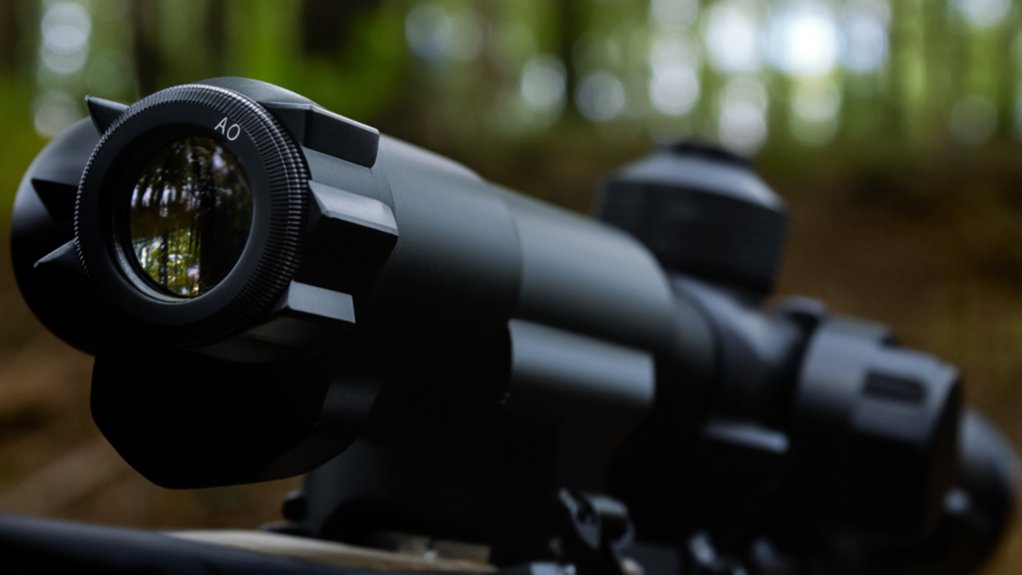
Although many scopes look similar, AO on a rifle scope stands for Adjustable Objective. When you see AO, it means you can fine-tune the focus of the scope’s objective lens to match the distance to your target. This adjustment helps you get a sharper, clearer sight picture.
Unlike fixed objective lenses, an AO lets you dial in the focus for different ranges, which is especially useful in varying shooting conditions. You simply rotate the objective bell until the target image becomes crisp.
This feature is valuable whether you’re shooting at close or longer distances because it helps eliminate blurriness caused by uncorrected focus. Basically, AO gives you more control over clarity, enhancing your overall shooting experience.
Why Parallax Matters for Shooting Accuracy
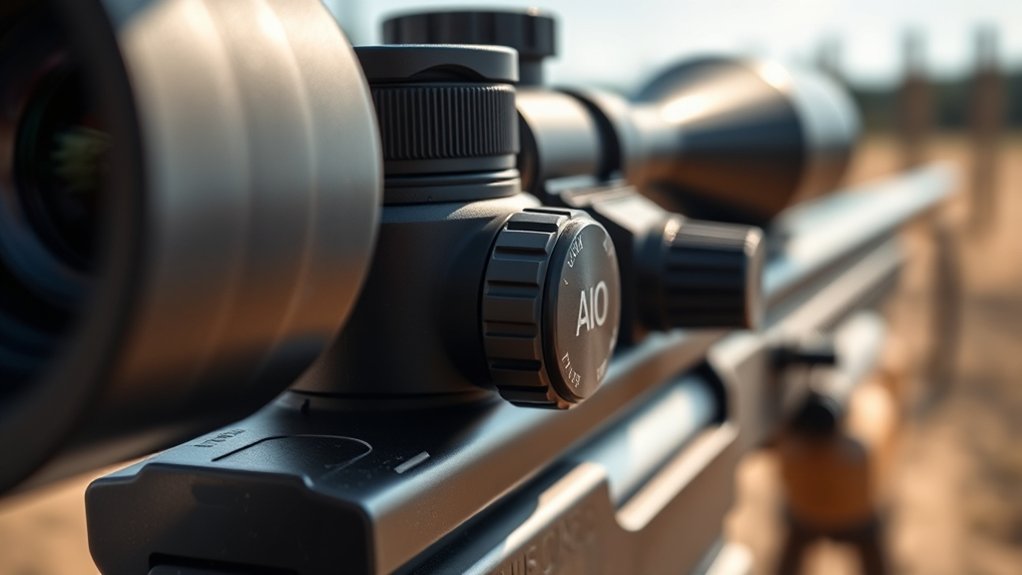
Because parallax affects how your eye aligns with the scope, it plays a crucial role in shooting accuracy. When parallax error occurs, the reticle appears to shift relative to the target as you move your head, causing inconsistent shot placement.
Even a slight misalignment can throw off your aim, especially at longer distances. If you don’t account for parallax, you might think you’re on target when you’re actually off, leading to missed shots.
Understanding parallax helps you maintain a consistent sight picture, ensuring your point of aim matches your point of impact. By being aware of this issue, you can adjust your shooting position or equipment to minimize error and improve precision every time you take a shot.
How an Adjustable Objective Reduces Parallax
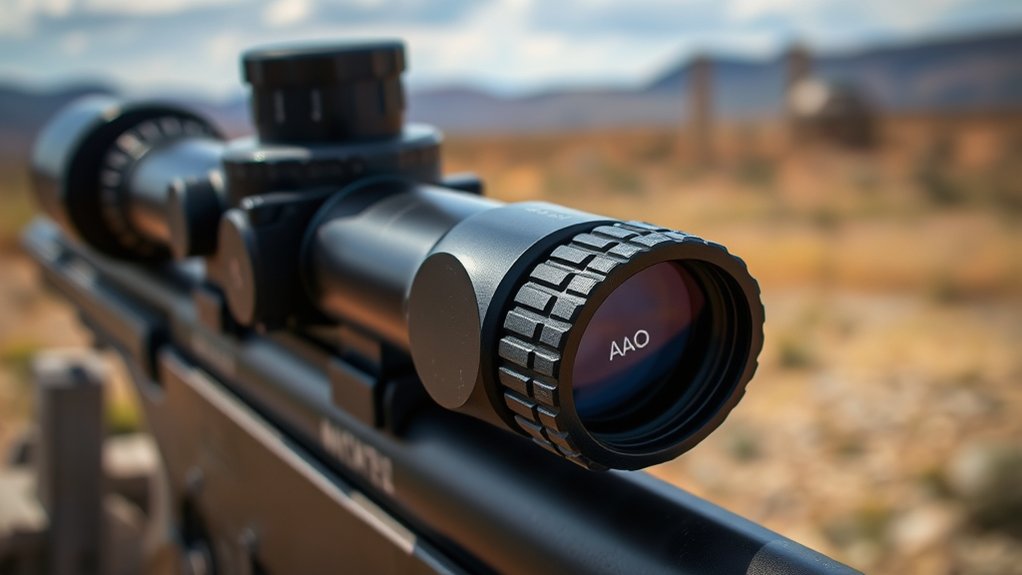
To reduce parallax, your scope uses an adjustable objective that shifts to align the reticle and target on the same focal plane.
By turning the AO ring, you fine-tune the focus based on your target’s distance, eliminating image shifts.
This mechanism helps you shoot more accurately, especially at varying ranges.
Parallax Explained Simply
When you look through a rifle scope, parallax can cause the reticle to shift against the target if your eye moves slightly off-center. This happens because the image of the target and the reticle aren’t perfectly aligned on the same focal plane.
An Adjustable Objective (AO) helps fix this by letting you change the focus distance, ensuring the target image and reticle align correctly. This way, your point of aim stays consistent, even if your head moves a bit.
Here’s why understanding parallax matters to you:
- Keeps your shot accurate at varying distances
- Prevents aiming errors caused by eye position
- Enhances confidence in long-range shooting
- Reduces target image blur
- Allows quick adjustments in the field
With AO, you control parallax for sharp, reliable aiming.
Adjustable Objective Mechanism
Understanding how an Adjustable Objective (AO) works helps you see exactly how it eliminates parallax errors.
The AO mechanism lets you adjust the front lens of your rifle scope, aligning the reticle and target perfectly at varying distances. By rotating the objective lens, you change the focus plane so your eye stays on the same optical path, no matter where the target sits.
This adjustment removes the chance of the reticle shifting against the target when you move your head slightly. Without this, you’d risk aiming errors caused by parallax.
Essentially, the AO lets you fine-tune your scope’s focus to match the target range, keeping your shot precise and your sight picture consistent, especially at longer or variable distances.
Benefits Of AO Scopes
Although parallax errors can be subtle, AO scopes give you the confidence that your reticle stays perfectly aligned with your target at any distance.
By adjusting the objective lens, you eliminate parallax, ensuring accuracy and a clear sight picture. This feature helps you make precise shots without second-guessing your aim.
With an AO scope, you’ll benefit from:
- Enhanced target clarity at varying distances
- Reduced eye strain during prolonged use
- Improved shot accuracy by eliminating parallax error
- Versatility for hunting or tactical shooting scenarios
- Faster target acquisition with consistent reticle alignment
Using an adjustable objective means you adapt quickly to different ranges, making your shooting experience more reliable and enjoyable.
How to Adjust the AO on Different Rifle Scopes
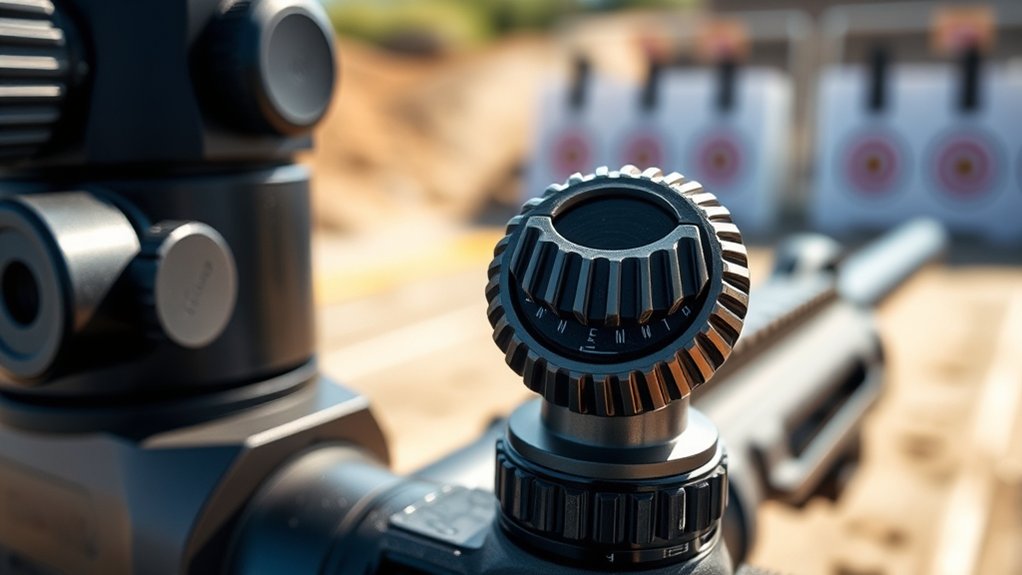
Since each rifle scope model handles adjustable objective (AO) differently, you’ll need to familiarize yourself with the specific mechanism on your scope before making adjustments.
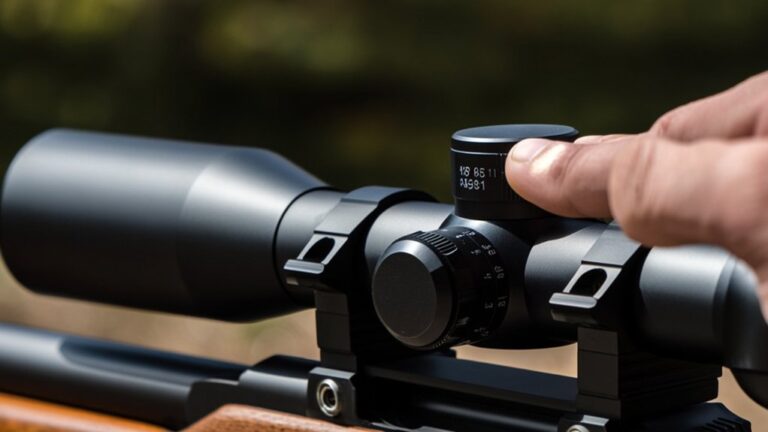
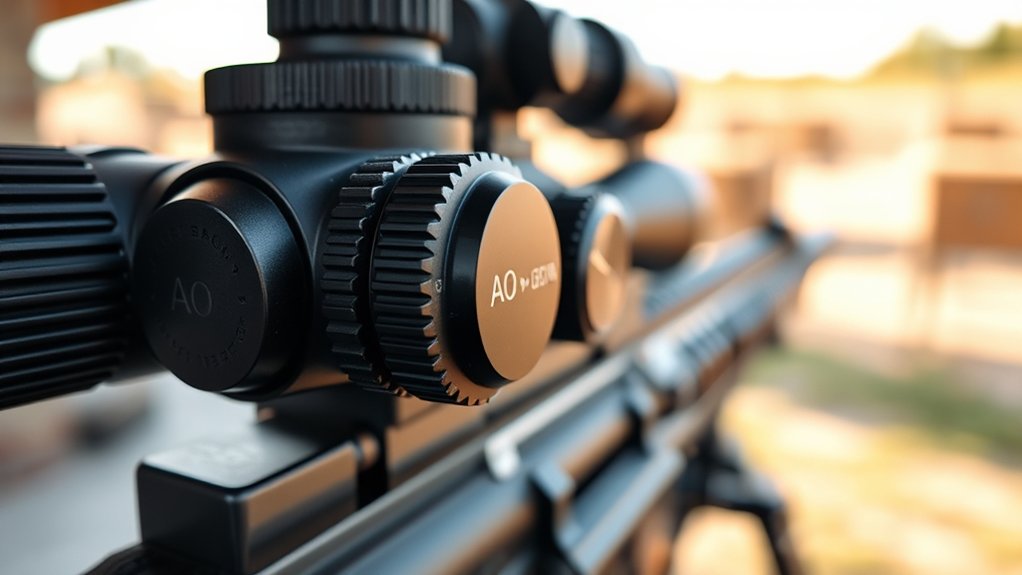
Typically, the AO is controlled by a rotating ring located on the objective bell at the front of the scope. To adjust it, look through the scope at your target and slowly turn the AO ring until the target image becomes sharp and clear.
Some scopes feature marked distances on the AO ring, letting you dial in the focus based on estimated range. Others may require trial and error, especially if no markings are present.
Always make small, precise turns rather than large adjustments to avoid overshooting the correct focus.
If your scope has a locking mechanism, verify you secure the AO after adjusting.
When and How to Use the AO Feature Effectively
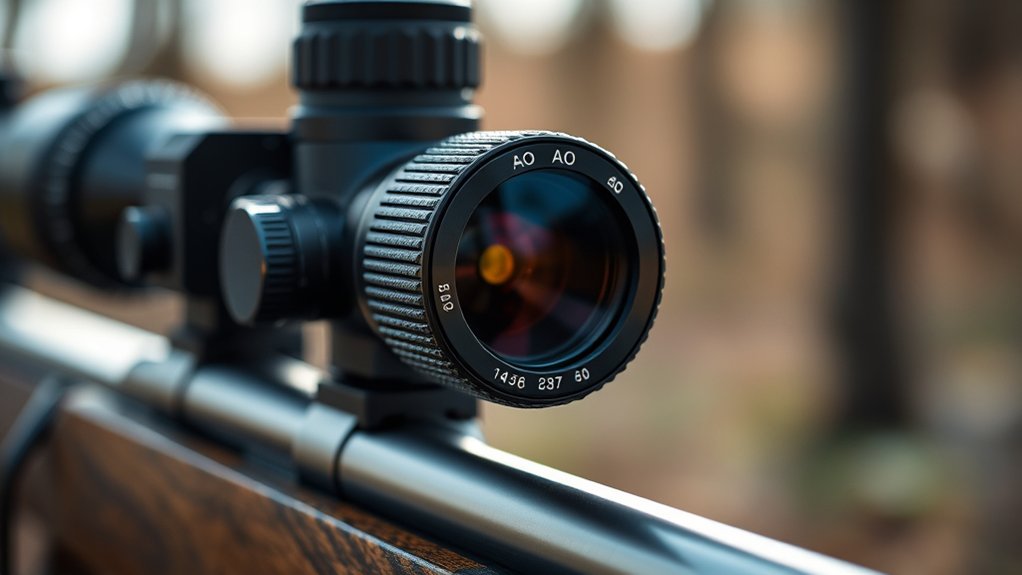
You’ll want to adjust the AO feature depending on your target’s distance to keep your focus sharp. Using it effectively can enhance target clarity, especially when details matter most.
It also helps optimize visibility in low light, giving you a clearer sight picture when conditions aren’t ideal.
Adjusting Focus for Distance
How do you guarantee a crisp, clear sight picture at varying distances? You adjust the AO (Adjustable Objective) on your rifle scope. This feature helps you fine-tune the focus, eliminating parallax error and ensuring your reticle aligns perfectly with the target image.
Here’s how to use it effectively:
- Identify your target’s distance before aiming
- Rotate the AO ring until the target image and reticle are sharp
- Use the distance markings on the AO for quick adjustments
- Re-check focus when switching between close and long-range targets
- Avoid forcing the AO ring past its limits to prevent damage
Enhancing Target Clarity
Whenever you need to enhance target clarity, knowing when and how to use the AO feature can make all the difference. The Adjustable Objective (AO) lets you fine-tune the focus on your target, eliminating parallax error and sharpening the image.
Use the AO when your target is at varying distances—especially beyond the scope’s fixed parallax setting. Turn the AO dial until the reticle and target align perfectly in focus. This guarantees your shot placement is accurate without distortion.
Avoid over-adjusting; subtle movements often yield the best clarity. Remember, the AO is most effective in daylight conditions when you can clearly see the target.
Mastering this feature improves your precision, making every shot count by delivering a crisp, clear view tailored to your shooting distance.
Optimizing Low Light Visibility
While the AO feature sharpens your view in daylight, its benefits extend into low light conditions as well. Using the adjustable objective helps reduce blur and halo effects caused by low light, improving target visibility when light is scarce.
To use AO effectively at dawn or dusk, adjust it slowly until the target edges become crisp. You’ll notice less eye strain and clearer focus, making shots more accurate. Remember, the AO setting changes as light conditions shift, so fine-tune it regularly.
Consider these tips for optimizing low light visibility with AO:
- Adjust AO to minimize glare and reflections
- Use it to clarify targets in fog or mist
- Combine AO with proper reticle illumination
- Avoid over-adjusting, which can blur the image
- Practice adjustments before actual low light shooting scenarios
Comparing AO Scopes With Fixed Objective Scopes
Because adjustable objective (AO) scopes and fixed objective scopes serve different purposes, choosing between them depends on your specific shooting needs.
AO scopes let you fine-tune the focus to eliminate parallax errors at various distances, giving you sharper accuracy whether you’re targeting close or far.
On the other hand, fixed objective scopes have a set parallax correction optimized for a particular distance, usually 100 yards, which means less adjustment but limited versatility.
If you often shoot at varying ranges or need pinpoint precision, an AO scope is your best bet.
However, if you mostly hunt or shoot at consistent distances, a fixed objective scope offers simplicity and durability without extra adjustments.
Understanding these differences helps you pick the right scope for your shooting style.
Common AO Rifle Scope Mistakes to Avoid
You might be making common mistakes with your AO rifle scope without realizing it. Misunderstanding how AO works, not adjusting the focus correctly, and ignoring parallax settings can all affect your accuracy.
Let’s look at how to avoid these pitfalls.
Misunderstanding AO Functionality
How often do shooters confuse the purpose of adjustable objective (AO) scopes? Many assume AO adjusts magnification or reticle focus, but it actually corrects parallax error by aligning the scope’s objective lens with the target’s distance.
Misunderstanding this leads to common mistakes you should avoid:
- Thinking AO changes zoom level
- Using AO to sharpen the reticle instead of the target
- Ignoring parallax adjustment, causing off-target shots
- Believing AO is unnecessary for close-range shooting
- Over-torquing AO rings, risking damage
Understanding AO’s true function helps you make precise adjustments and improves your shooting accuracy. Don’t let misconceptions about AO limit your scope’s potential or your performance in the field.
Incorrect Focus Adjustment
Why does incorrect focus adjustment on an AO rifle scope often lead to frustratingly off-target shots?
When you don’t set the focus properly, the target image appears blurry, making it tough to aim accurately.
AO, or Adjustable Objective, helps you fine-tune the focus to match the target distance, but if you skip this step or adjust it incorrectly, your reticle won’t align sharply with the target.
This mismatch causes aiming errors, especially at varying distances.
To avoid this, take the time to rotate the AO dial until the target is crisp and clear before taking your shot.
Neglecting this simple step can ruin your accuracy, wasting valuable shots and messing with your confidence in the field.
Get the focus right, and your shots will improve instantly.
Ignoring Parallax Settings
Getting the focus right with your AO rifle scope sets the foundation, but ignoring parallax settings can still throw off your shots. Parallax occurs when the reticle appears to shift on the target if your eye isn’t perfectly aligned.
If you don’t adjust the parallax correctly, your point of impact will be inconsistent, especially at varying distances. Many shooters overlook this essential step, assuming focus alone is enough.
To avoid this mistake, make sure you:
- Understand your scope’s parallax adjustment range
- Adjust parallax for the specific target distance
- Keep your eye centered behind the scope
- Recheck parallax after changing shooting positions
- Practice regularly to build muscle memory for adjustments
Ignoring parallax compromises accuracy, so don’t skip this critical step when using your AO scope.
Key Benefits of AO for Long-Range and Target Shooting
Although long-range and target shooting demand precision, AO (Adjustable Objective) scopes give you the edge by allowing quick and accurate focus adjustments. This feature eliminates parallax error, ensuring your reticle stays perfectly aligned with the target at varying distances. You can trust your shot placement, even under changing conditions.
Here’s how AO benefits your shooting experience:
| Benefit | Description |
|---|---|
| Parallax Correction | Removes image shift for precise aiming |
| Faster Target Acquisition | Lets you adjust focus swiftly |
| Enhanced Image Clarity | Sharpens target view at all distances |
| Increased Confidence | Reliable adjustments improve shot accuracy |
With AO, you maintain clarity and precision, vital for hitting targets consistently at long range.
Maintaining Your AO Rifle Scope for Peak Performance
To keep your AO rifle scope delivering sharp focus and accurate adjustments, regular maintenance is key. You want to guarantee each component functions smoothly, especially the adjustable objective, which can accumulate dirt or debris.
Clean it gently and check for any mechanical issues to avoid performance dips.
Here’s how you can maintain your AO rifle scope effectively:
- Use a soft brush or air blower to remove dust from lenses.
- Wipe lenses with a microfiber cloth and lens cleaner.
- Check and tighten mounting screws regularly.
- Inspect the adjustable objective for smooth rotation.
- Store the scope in a protective case when not in use.
Choosing the Right AO Rifle Scope for Your Shooting Style
When selecting an AO rifle scope, you’ll want to take into account how your shooting style impacts your needs.
If you prefer close-range shooting or hunting in dense environments, choose a scope with a strong adjustable objective to quickly sharpen image clarity at shorter distances.
For long-range precision shooting, look for scopes offering fine AO adjustments that let you eliminate parallax for pinpoint accuracy.
Consider the magnification range too—higher magnification benefits target shooters, while hunters may favor versatile, lower settings.
Also, think about the scope’s durability and ease of adjustment, especially if you’re in rugged conditions or need quick changes on the fly.
Matching your AO scope’s features to your specific shooting habits guarantees you get clear, sharp views and improved accuracy every time.
Frequently Asked Questions
Can AO Scopes Be Used for Hunting Moving Targets?
Yes, you can use AO scopes for hunting moving targets. They help you adjust focus for clear images at different distances, but you’ll still need good tracking skills and quick adjustments to hit moving game accurately.
Does AO Adjustment Affect Night Vision Performance?
You won’t suddenly see like a hawk in the dark just by tweaking AO, but yes, adjusting it can slightly impact night vision clarity. It mainly fine-tunes focus, so don’t expect magic under low light.
Are AO Scopes Compatible With All Rifle Calibers?
You’ll find AO scopes compatible with most rifle calibers, but always check specific model specs. Some high-recoil calibers might need scopes built to handle extra force, so don’t assume universal compatibility without confirming.
How Does AO Impact the Weight of the Rifle Scope?
AO adds a slight weight to your scope, like a pebble in your pocket. You won’t notice much difference, but that extra adjustment mechanism means a bit more metal, so your rifle feels just a tad heavier.
Can AO Scopes Be Mounted on Air Rifles?
Yes, you can mount AO scopes on air rifles. Just make sure the scope’s adjustment range fits your air rifle’s pellet trajectory, and secure the mounting rings properly to handle recoil and maintain accuracy during shooting sessions.
Conclusion
Understanding AO on your rifle scope can boost your shooting accuracy considerably. Did you know that parallax errors can cause shots to miss by over an inch at 100 yards? By mastering your scope’s Adjustable Objective, you reduce these errors and improve precision. Whether you’re target shooting or hunting, using the AO feature correctly makes a real difference. Keep your scope well-maintained and choose one that fits your style to get the most out of every shot.