How To Sight In Air Rifle?
To sight in your air rifle, start by setting up a safe shooting area with a solid backstop and use a stable rest to hold the rifle steady. Fire groups at a close distance, then adjust your iron sights or scope’s windage and elevation based on where the pellets hit. Make small, precise tweaks while considering weather and lighting effects. Regularly check and maintain your sights to keep accuracy consistent. Keep going to uncover tips on fine-tuning and troubleshooting for better shooting results.
Key Takeaways
- Stabilize the rifle using a rest or sandbags to ensure consistent shooting during sighting.
- Start sighting at 10 yards, shoot groups, and adjust windage and elevation accordingly.
- Use quality pellets specific to your rifle for consistent shot placement.
- Choose a safe shooting area with a solid backstop and ensure no one is in the line of fire.
- Fine-tune adjustments in small increments, considering external factors like wind and lighting for accuracy.
Why You Should Properly Sight Your Air Rifle
Although you might be enthusiastic to start shooting, properly sighting your air rifle guarantees your shots hit the target accurately. When your rifle is sighted in, you don’t waste pellets guessing where they’ll land. This saves you time, ammo, and frustration.
Accurate shots also improve your confidence and enjoyment, whether you’re plinking, hunting, or target shooting. Plus, properly sighting your air rifle helps you develop better shooting skills by reinforcing good habits like consistent aim and trigger control.
If your rifle isn’t sighted in, you risk missing your target entirely or causing unintended damage. Taking the time to properly sight your air rifle ensures every shot counts and helps you become a more responsible and effective shooter.
How to Choose Tools to Sight In Your Air Rifle
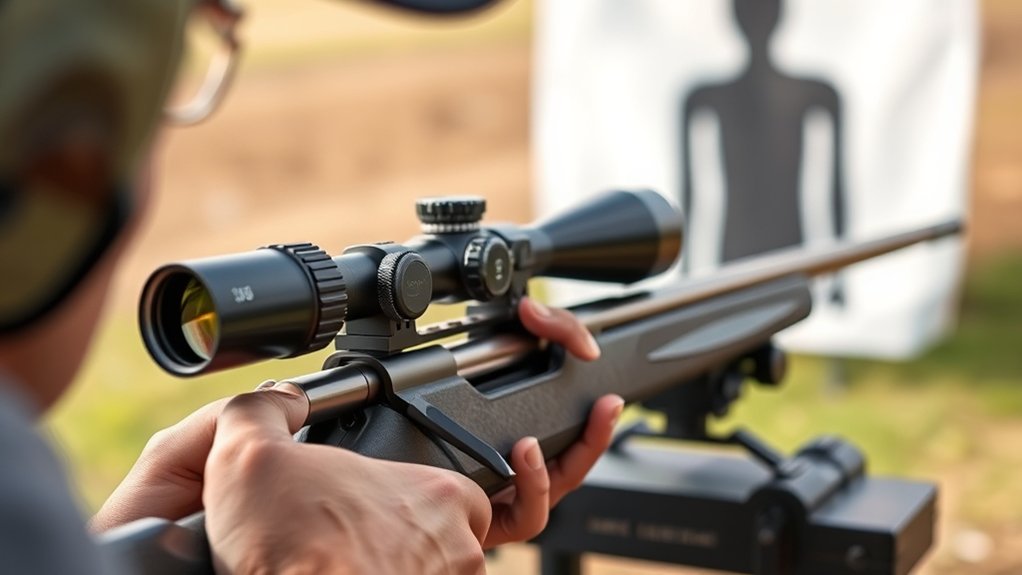
To sight in your air rifle accurately, you’ll need the right tools that match your setup. Choosing a quality scope and a stable rest is vital for consistent shots.
Let’s look at the essential gear that will make your sighting process easier and more precise.
Essential Sight-In Tools
When you’re ready to sight in your air rifle, choosing the right tools can make the process smoother and more accurate.
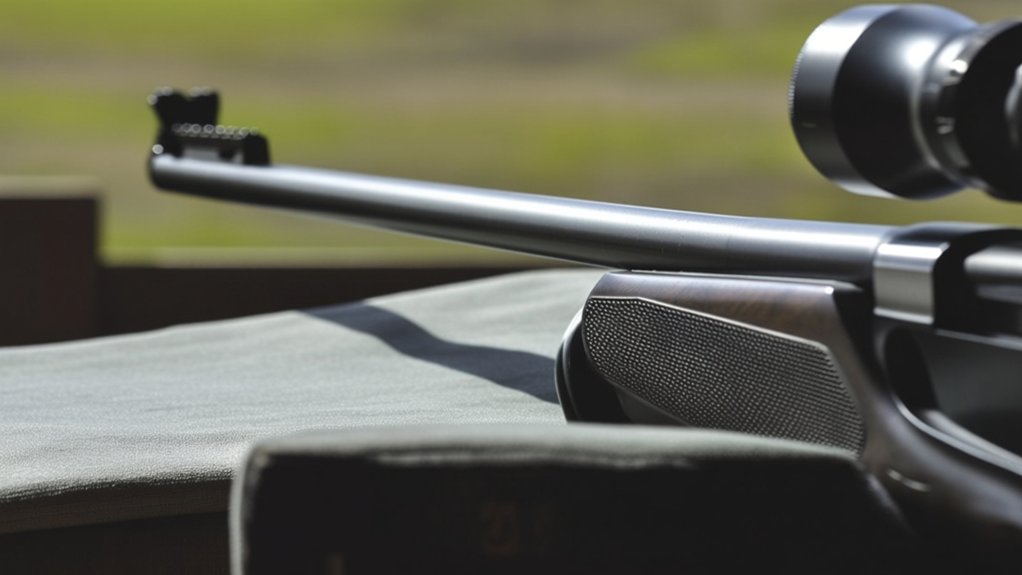
Start with a sturdy shooting rest or sandbags to stabilize your rifle, minimizing movement and helping you get consistent shots.
Use quality pellets specifically designed for your rifle to guarantee reliable performance.
A target with clear, contrasting markings is essential for spotting your shot placement quickly.
To measure groupings precisely, a caliper or ruler comes in handy.
Don’t forget a reliable spotting scope or binoculars to see your shots clearly at a distance without repeatedly walking to the target.
Ultimately, a chronograph can be helpful if you want to check pellet velocity, but it’s optional for basic sighting-in.
Having these essentials will set you up for success.
Choosing The Right Scope
Stabilizing your rifle and using quality pellets set a solid foundation for sighting in, but choosing the right scope will greatly enhance your accuracy and shooting experience.
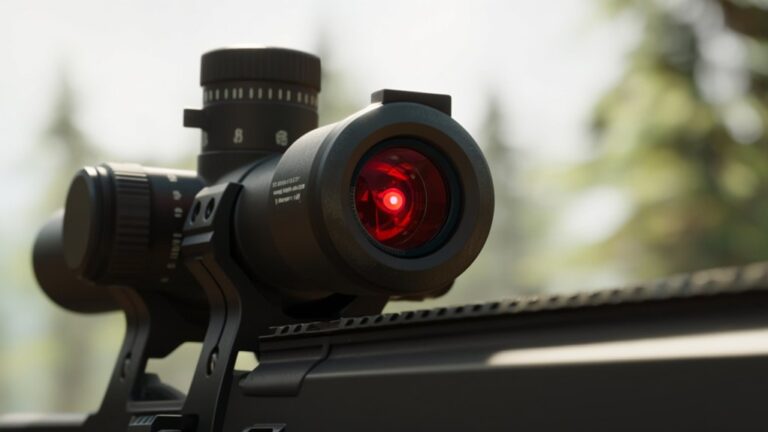
First, pick a scope designed specifically for air rifles, as they can handle the unique recoil and trajectory. Look for a scope with variable magnification, typically between 3x and 9x, to adjust for different shooting distances.
Confirm it has clear, sharp optics and a reticle that suits your shooting style—simple crosshairs often work best.
Consider scopes with adjustable parallax to keep your target in focus at varying ranges.
Finally, choose a durable, waterproof, and fog-proof model to withstand outdoor conditions.
The right scope makes sighting in easier and improves your overall performance.
Importance of Stable Rest
Although choosing the right scope is essential, you won’t achieve consistent accuracy without a stable rest to support your air rifle. A steady rest minimizes movement, letting you focus on fine-tuning your aim.
Without stability, even the best scope can’t compensate for shaky hands or uneven surfaces. When selecting a rest, look for one that offers solid support and adjustability to suit your shooting position.
Bipods, sandbags, or shooting rests provide varying levels of stability—choose what fits your style and environment. Remember, a stable rest reduces recoil impact and helps maintain sight alignment shot after shot.
Investing time in setting up a reliable rest pays off by making your sighting process smoother and more precise, ultimately improving your shooting performance.
Setting Up a Safe Shooting Area
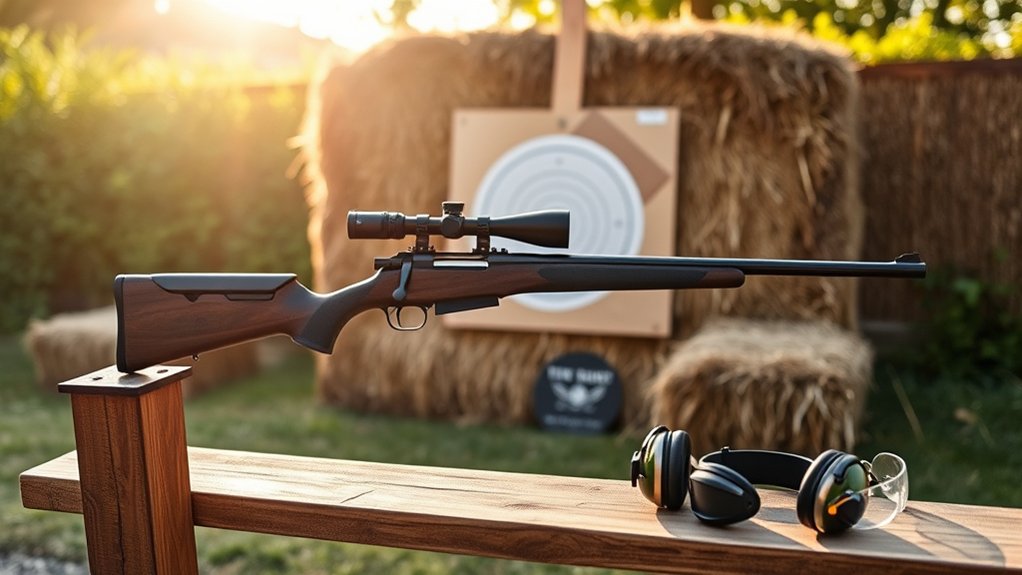
Before you start sighting in your air rifle, make certain your shooting area is secure and well-prepared. Safety is key to avoid accidents and ensure accurate practice. Follow these steps to set up your area:
Ensure your shooting area is secure and well-prepared to prioritize safety and accuracy before sighting in your air rifle.
- Choose a clear, open space with a solid backstop like a thick wooden board or a commercial pellet trap to safely catch pellets.
- Confirm no people, pets, or valuable property are within the shooting or pellet path. Establish a clear safety perimeter.
- Set up a stable shooting rest or bench to maintain consistency and prevent accidental misfires.
How to Adjust Iron Sights When Sighting In Your Air Rifle
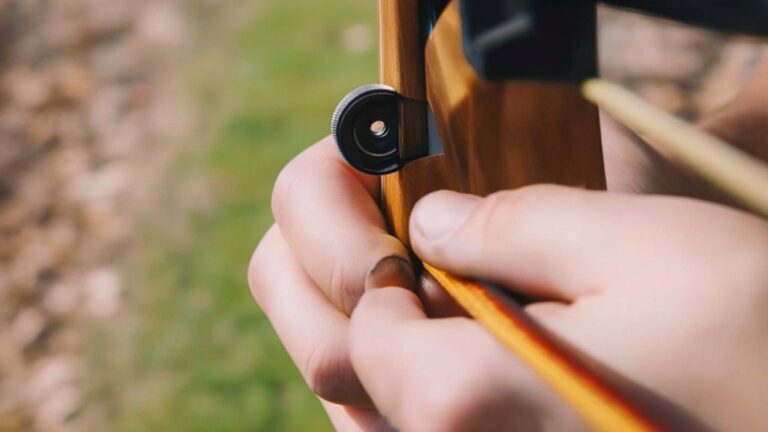
Once your shooting area is set up safely, you can focus on adjusting the iron sights of your air rifle. Start by firing a group of shots at your target from a consistent distance, usually 10 to 20 yards.
Observe where the pellets hit compared to your aim point. If the shots are off-center, adjust the rear sight to move the point of impact.
Move the rear sight left or right to correct horizontal deviation, and up or down for vertical correction. Some iron sights require turning screws, while others need you to slide the sight.
Make small adjustments, then shoot another group to check changes. Repeat this process until your shots consistently hit your desired target spot, ensuring your air rifle is accurately sighted in.
How to Sight In Your Air Rifle With a Rifle Scope
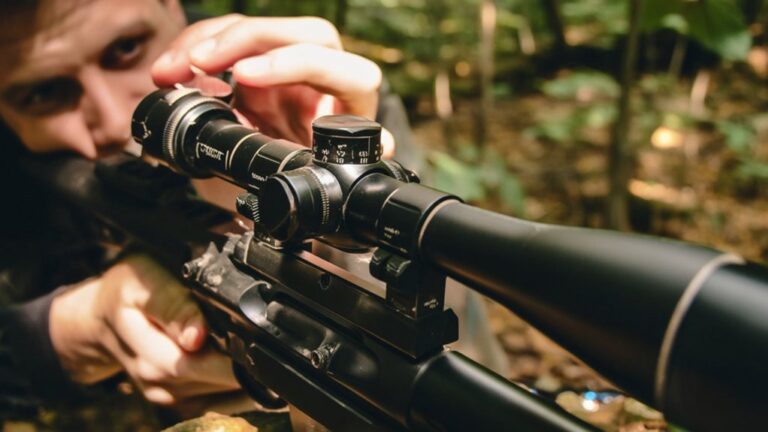
When you mount a rifle scope on your air rifle, you’ll need to carefully align it to guarantee your shots hit their mark. Start by securing your rifle on a stable rest to avoid movement.
Then, follow these steps:
- Set a target about 10 yards away and fire a few shots to see where they land.
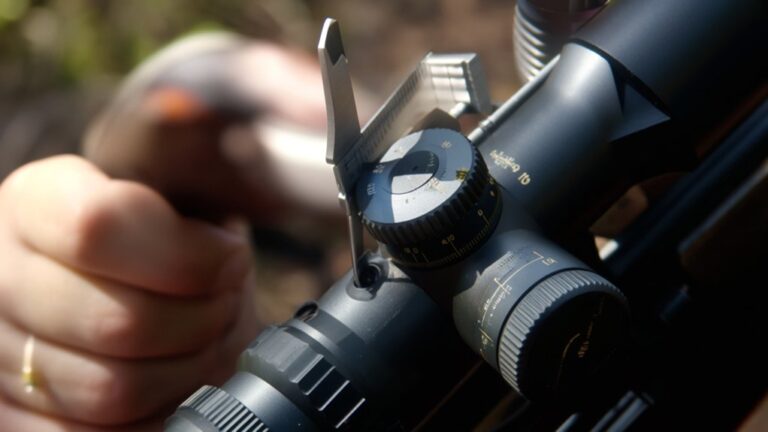
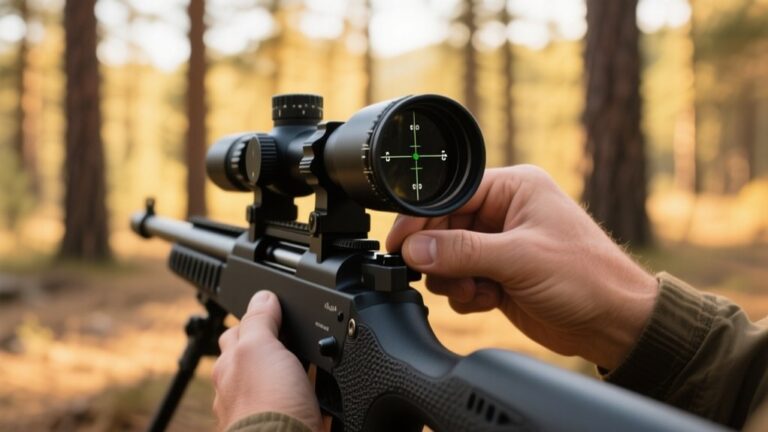
- Adjust the scope’s windage and elevation knobs to move the reticle toward the point of impact.
- Move back gradually, repeating the shooting and adjusting process at 20, then 30 yards, fine-tuning until your shots consistently hit the bullseye.
Patience and small adjustments are key. This process ensures your scope matches your rifle’s trajectory for accurate shooting.
Using a Bore Sighter to Sight In Your Air Rifle Faster
Adjusting your rifle scope by trial and error can take time, but using a bore sighter speeds up the process considerably. A bore sighter aligns your scope with the barrel’s bore, giving you a close initial zero before live firing.
To use one, remove the pellet or BB and insert the bore sighter into the barrel or chamber. Look through your scope and adjust the windage and elevation turrets until the reticle matches the bore sighter’s dot or alignment marks.
This guarantees your scope starts off pointing near the point of impact. Once aligned, you’ll spend less time making big adjustments on the range, saving you pellets and frustration.
It’s a smart step for faster, more accurate sighting in.
How to Zero Your Air Rifle for Best Distance
To zero your air rifle for the best distance, you need to understand how pellet trajectory and scope adjustments work together. When you shoot, pellets follow a curved path, so your aim must compensate for drop over distance.
Zeroing your air rifle requires mastering pellet trajectory and scope adjustments to compensate for drop over distance.
Here’s how to zero in effectively:
- Set a target at your preferred distance—commonly 25 or 30 yards—and shoot a group to see where pellets land.
- Adjust your scope’s elevation and windage to move the point of impact closer to the bullseye, accounting for pellet drop and wind.
- Repeat shooting and adjusting until your pellets consistently hit the target center at that distance.
This approach guarantees your rifle is accurately zeroed for peak performance at your chosen range.
Fine-Tuning Your Air Rifle Sights for Maximum Accuracy
After zeroing your air rifle at your preferred distance, you’ll want to fine-tune your sights to squeeze out every bit of accuracy. Start by shooting small groups and carefully observing where your pellets cluster.
Adjust your windage and elevation knobs in tiny increments—usually one click at a time—to shift the point of impact closer to your bullseye. Consistency is key, so maintain the same shooting position and hold each shot steady.
Take your time between shots to analyze results, then repeat adjustments as needed. Remember, fine-tuning isn’t about dramatic shifts but subtle tweaks that improve precision.
This process helps you tailor your sights perfectly to your rifle’s unique characteristics, ensuring tighter groups and more reliable accuracy every time you shoot.
How Weather and Lighting Affect Air Rifle Sighting
Though you’ve perfectly sighted your air rifle, weather and lighting conditions can still affect your shot’s accuracy. You need to adapt to these external factors to maintain precision.
- Wind: Even a light breeze can push your pellet off course. Always check wind speed and direction before shooting and adjust your aim accordingly.
- Lighting: Bright sunlight can create glare or cast shadows on your target, making it hard to see your sights or the target clearly. Use a sunshade or adjust your shooting angle to reduce glare.
- Temperature: Cold weather can affect pellet velocity and air pressure inside the rifle, causing subtle shifts in point of impact. Allow your rifle to acclimate to the environment before shooting.
Being mindful of these factors helps you stay accurate in varying conditions.
Troubleshooting Common Air Rifle Sighting Problems
If your shots aren’t hitting the mark, start by adjusting your sight alignment carefully.
You’ll also need to correct the pellet trajectory to match your target distance.
Let’s tackle these common sighting issues step by step.
Adjusting Sight Alignment
When your shots consistently miss the target, adjusting your sight alignment becomes essential to improve accuracy. You want to verify the front and rear sights line up perfectly with your target. Even a slight misalignment can throw off your aim. Here’s how to adjust it effectively:
- Check your position: Make sure you’re holding the rifle steady and your eye is aligned with the sights.
- Adjust the rear sight: Move it left or right, up or down, depending on whether your shots land off to the side or too high/low.
- Fine-tune the front sight: Some rifles allow minor adjustments here; use it to center your point of impact exactly.
Correcting Pellet Trajectory
Because pellet trajectory can vary due to factors like pellet weight, velocity, and environmental conditions, you’ll need to troubleshoot common sighting problems to keep your shots on target.
Start by confirming you’re using consistent pellets; even slight weight differences affect drop and accuracy.
Next, adjust your sights to compensate for pellet drop at different distances—raise the front sight or lower the rear sight if your shots hit low.
Wind can push pellets off course, so factor in wind direction and speed when shooting outdoors.
If your pellet consistently veers left or right, fine-tune your horizontal sight adjustment.
Regularly check your rifle’s velocity with a chronograph, as changes can affect trajectory.
How Often to Check and Re-Sight Your Air Rifle
How often should you check and re-sight your air rifle to maintain accuracy? Regular checks ensure your shots stay true, especially after changes or rough handling. You don’t need to adjust it daily, but certain situations call for immediate attention.
Regular checks keep your air rifle accurate, especially after handling or changes, though daily adjustments aren’t necessary.
Here are three key times to check and re-sight your air rifle:
- After any significant impact or drop. Even a small shock can misalign your scope or sights.
- When switching pellet types or weights. Different pellets can affect your point of impact.
- At the start of each shooting session. Environmental factors like temperature and humidity might subtly shift your accuracy.
Maintaining Your Air Rifle’s Sights for Consistent Accuracy
To keep your air rifle accurate, you need to clean your sights regularly and check for any loose parts.
Don’t forget to adjust your sights based on environmental changes like wind or temperature.
Staying on top of these tasks guarantees your shots stay consistent every time.
Cleaning Your Sight Regularly
Although it’s easy to overlook, cleaning your air rifle’s sight regularly plays a crucial role in maintaining consistent accuracy. Dirt, dust, and oil build-up can blur your vision and affect your aim. Make it a habit to clean your sight after every few shooting sessions to keep it clear and reliable.
Here’s how you can do it effectively:
- Use a soft microfiber cloth to gently wipe the lenses, avoiding scratches.
- Apply a small amount of lens cleaner if needed, but never spray directly on the sight.
- Remove any debris from the sight housing with a soft brush or compressed air.
Checking for Loose Parts
Since even a slight wobble can throw off your aim, you should regularly check for loose parts on your air rifle’s sights. Begin by visually inspecting screws, mounts, and any adjustable components.
Use the appropriate tools to gently tighten any loose screws, but avoid overtightening, which can damage threads or warp parts.
Wiggle the sight gently to detect any play or movement. If you notice persistent looseness, consider replacing worn parts or consulting a professional.
Remember, a securely mounted sight keeps your zero consistent and improves shooting accuracy.
Regularly checking and maintaining your air rifle’s sights prevents frustrating shifts in point of impact, helping you stay on target with every shot. Make this a routine part of your rifle care.
Adjusting for Environmental Changes
When environmental conditions shift, your air rifle’s sights can drift off target, affecting your accuracy. To maintain consistent precision, you need to adjust for these changes promptly.
Start by considering these three key factors:
- Wind: Even a slight breeze can push pellets off course. Adjust your sights to compensate for wind direction and speed.
- Temperature: Extreme cold or heat can alter air pressure inside your rifle, affecting pellet trajectory. Fine-tune your elevation settings accordingly.
- Lighting: Changes in sunlight or shadows can affect your sight picture. Adjust brightness or contrast on your scope or iron sights to maintain a clear view.
Frequently Asked Questions
What Types of Pellets Work Best for Sighting in an Air Rifle?
You’ll want to use high-quality, consistent pellets like wadcutters or domed types for sighting in your air rifle. They offer reliable accuracy and fly straighter, helping you zero your scope faster and more precisely.
Can I Sight in an Air Rifle for Different Pellet Weights?
You can’t rely on one sight-in for different pellet weights because they affect trajectory. Always sight in your air rifle separately for each pellet weight you plan to use for accuracy and consistent performance.
How Does Barrel Length Affect Sighting Accuracy?
Longer barrels usually give you better accuracy because they stabilize the pellet more, but they can also make sighting trickier due to increased weight and wind resistance. Shorter barrels are easier to handle but might reduce precision.
Is It Necessary to Warm up the Air Rifle Before Sighting?
Slow and steady wins the race, so you don’t really need to warm up your air rifle before sighting. Just make sure it’s clean and stable; consistent conditions matter more than warming it up for accuracy.
Can I Use Laser Sights to Assist in Sighting My Air Rifle?
Yes, you can use laser sights to assist in sighting your air rifle. They help quickly align your shots, especially in low light, but always confirm accuracy with traditional iron sights or scopes for best results.
Conclusion
Sighting in your air rifle is like tuning a musical instrument—precision transforms noise into harmony. By carefully adjusting your sights and understanding the elements, you’ll turn every shot into a symphony of accuracy. Keep your setup sharp and your focus steady, and your air rifle will sing true every time you pull the trigger. Remember, a well-sighted rifle is your key to revealing consistent, satisfying shooting success.