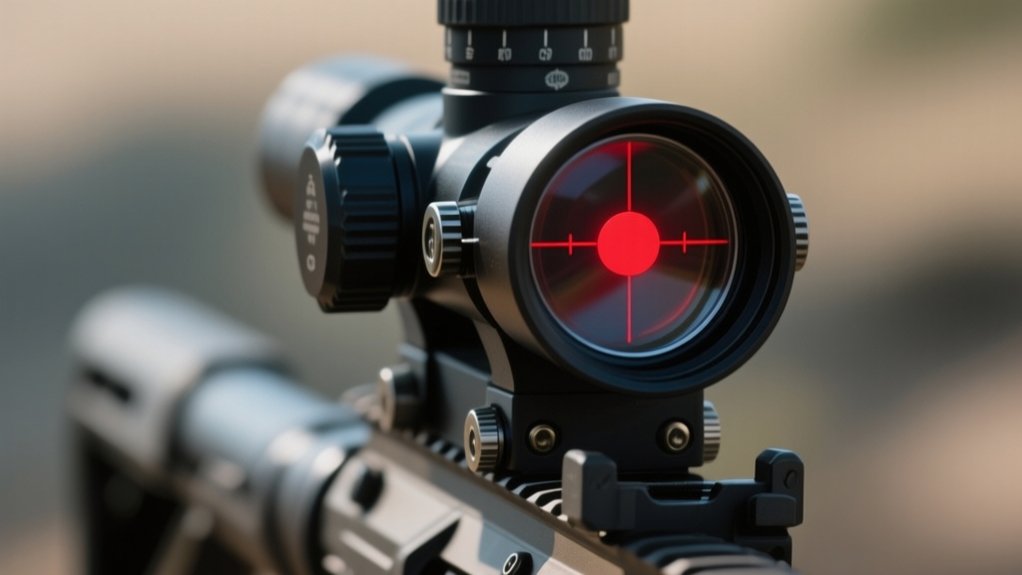
How Does A Reflex Sight Work?
A reflex sight works by projecting a bright, illuminated red dot onto a transparent glass lens, letting you aim quickly without lining up traditional sights. The dot stays steady on your target regardless of eye position thanks to parallax compensation. It’s powered by batteries that light up the reticle, and you can adjust brightness to suit different lighting. Lightweight and compact, it helps you acquire targets faster with both eyes open. Keep going to uncover how these features boost your accuracy and usability.
Key Takeaways
- Reflex sights project an illuminated red dot reticle onto a transparent lens for quick target aiming without magnification.
- The reticle is powered by LEDs or fiber optics, providing a bright, adjustable aiming point visible in various lighting conditions.
- The lens reflects the reticle while allowing a clear view of the target, enabling both eyes open shooting and wide situational awareness.
- Parallax-free design ensures the reticle remains aligned with the target regardless of eye position, improving aiming accuracy.
- Rigid housing and calibration screws maintain reticle stability and precise alignment with the firearm’s point of impact.
What Is a Reflex Sight and How Does It Differ From a Scope?
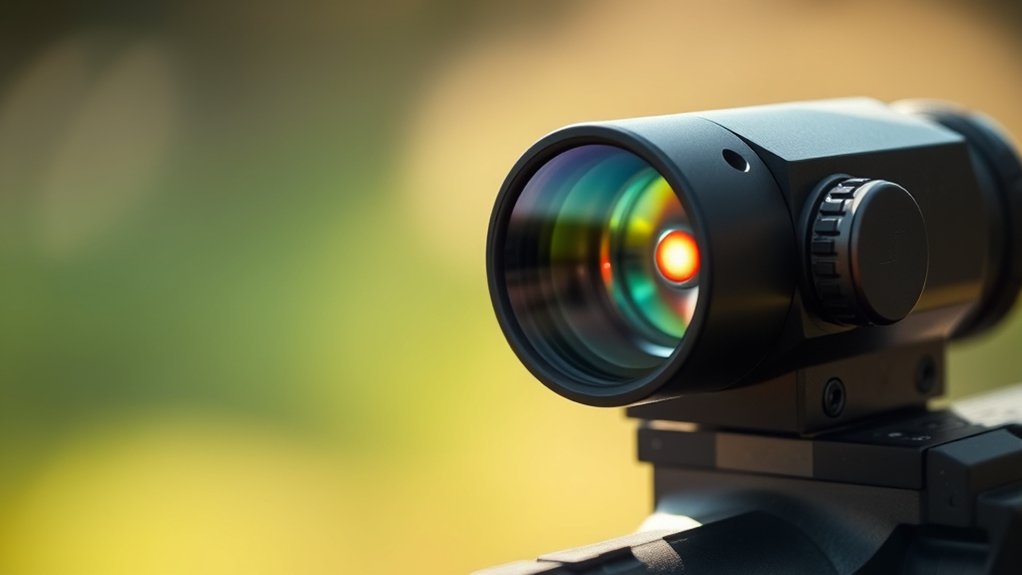
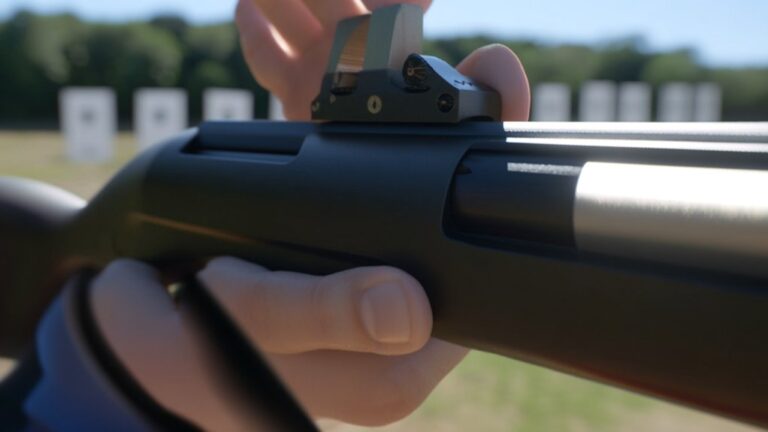
A reflex sight is a type of non-magnifying optical device designed to help you quickly acquire targets by projecting a red dot or reticle onto a lens.
Unlike traditional scopes, which use magnification to zoom in on distant objects, reflex sights keep your field of view wide and natural. This allows you to maintain situational awareness while aiming.
Reflex sights maintain a wide, natural field of view, enhancing situational awareness during aiming.
You’ll find reflex sights are lighter and more compact, making them ideal for fast-moving situations or close-range shooting.
Since they don’t magnify, you won’t get the tunnel vision effect scopes sometimes cause.
Reflex sights also let you keep both eyes open, giving you better depth perception and faster target shift compared to the one-eye focus required by scopes.
How Does a Reflex Sight’s Reticle Work?
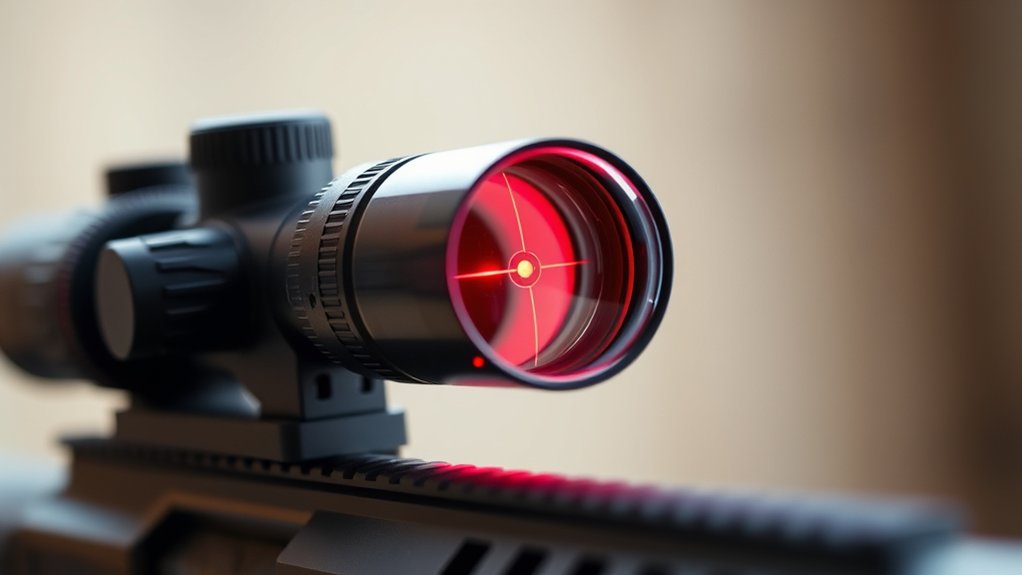
You’ll notice the reticle in a reflex sight is always illuminated, thanks to a tiny LED or fiber optic system.
It stays perfectly aligned with your target because the sight uses a parallax-free design.
This means you can trust the reticle’s position to be accurate, no matter how you move your eye.
Reticle Illumination Mechanism
Understanding how a reflex sight’s reticle illuminates helps you appreciate its quick target acquisition. The reticle’s illumination depends on a small LED that projects light onto the sight’s lens, creating a bright aiming point without shining directly into your eyes. This setup lets you keep both eyes open for maximum situational awareness.
Here’s how the illumination mechanism works:
- LED emits light in a specific wavelength.
- A semi-reflective lens reflects this light toward your eye.
- The reticle pattern appears clearly against various backgrounds.
- Brightness adjusts automatically or manually for different lighting conditions.
This mechanism ensures you get a sharp, visible reticle that’s easy to spot in any environment, speeding up your aim and improving accuracy.
Parallax-Free Design Principle
Since reflex sights are designed to let you aim quickly, their parallax-free feature guarantees the reticle stays aligned with your target no matter how you move your eye.
This works because the reticle is projected onto a lens that reflects it directly back to you, keeping the aiming point consistent regardless of your head position. Unlike traditional scopes, you don’t have to perfectly center your eye behind the sight to maintain accuracy.
This design reduces aiming errors caused by slight shifts in your viewpoint, making quick target acquisition easier. So, when you glance through a reflex sight, you’ll notice the reticle remains steady on the target, helping you react faster and shoot more accurately without worrying about parallax distortion.
Reticle Positioning Accuracy
Although reflex sights seem simple, their reticle positioning relies on precise optical engineering to guarantee accuracy. When you look through the sight, the reticle appears fixed on your target because of careful alignment between the LED projector and the sight’s lens.
This assures your point of aim matches the bullet’s impact point perfectly. Here’s how the accuracy is maintained:
- The LED emits a stable, pinpoint light source.
- The partially reflective lens projects the reticle without distortion.
- The sight’s housing holds components rigidly to prevent shifts.
- Calibration screws let you fine-tune the reticle’s position precisely.
How LEDs Make Reflex Sights Work
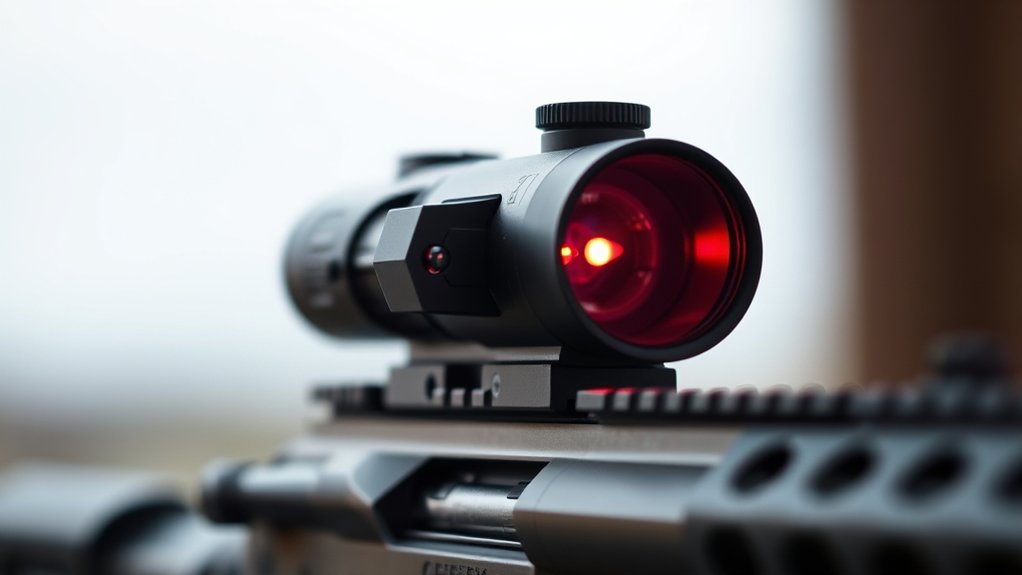
When you activate a reflex sight, LEDs generate the bright, sharp reticle you see through the lens. These tiny light sources sit inside the sight housing and emit a focused beam of light.
The LED’s wavelength and brightness are carefully chosen to guarantee the reticle stands out clearly against any background. Because LEDs consume very little power, they allow your reflex sight to run efficiently for long periods.
Additionally, the LED’s light is projected onto a specially coated optical surface inside the sight, creating that distinct, illuminated aiming point. This setup ensures the reticle remains crisp and easy to see, even in low-light conditions or bright daylight, helping you acquire targets quickly and accurately.
Why Reflex Sights Use Transparent Glass
Why does a reflex sight use transparent glass instead of a solid lens or plastic? It’s all about clarity and efficiency. Transparent glass allows you to see your target clearly while reflecting the LED reticle without distortion. Unlike solid lenses or plastic, glass keeps the image sharp and bright. Here’s why it works so well:
- Glass maintains optical clarity, ensuring you don’t miss details.
- It reflects the LED reticle accurately without blurring.
- Glass resists scratches and warping better than plastic.
- It allows ambient light to pass through, keeping your field of view natural.
How Parallax Compensation Boosts Reflex Sight Accuracy
The clear glass in reflex sights not only guarantees you see your target sharply but also plays a key role in parallax compensation.
Parallax occurs when the reticle appears to shift relative to the target as you move your eye off-center. With parallax compensation, the sight’s optical design aligns the reticle so it stays on target regardless of your eye position.
This means you don’t need to perfectly center your eye behind the sight to maintain accuracy. As a result, you can acquire targets faster and shoot with more confidence, even in dynamic situations.
What Powers Reflex Sights? Battery Types Explained
Although reflex sights offer quick target acquisition and precision, they rely on a power source to illuminate the reticle. Most reflex sights use batteries, but the type you choose impacts performance and runtime.
Here are four common battery types powering reflex sights:
- CR2032 Coin Cell – Compact and widely used, offers moderate life and easy replacement.
- AA Batteries – Larger, providing longer usage but adding bulk to the sight.
- AAA Batteries – Smaller than AA, balancing size and power duration.
- Rechargeable Lithium-Ion – Offers extended runtime and environmental benefits but requires charging access.
Choosing the right battery depends on your usage patterns, sight design, and whether you prioritize runtime or size. Always carry spares to avoid losing reticle illumination at critical moments.
How to Adjust Reflex Sight Brightness and Settings
You’ll find that most reflex sights let you control brightness through buttons or a dial. Adjusting these settings properly guarantees your reticle stays visible in different lighting conditions.
Let’s look at some tips to help you fine-tune your sight for the best performance.
Brightness Control Methods
Since lighting conditions can change quickly, adjusting the brightness of your reflex sight is essential for maintaining a clear and accurate sight picture. You’ll find several brightness control methods to suit different situations and preferences. Most reflex sights include:
- Manual Dial or Wheel – Rotate to increase or decrease brightness in small, precise steps.
- Button Controls – Press up or down buttons to cycle through preset brightness levels.
- Automatic Brightness Adjustment – Sensors detect ambient light and adjust brightness automatically.
- Remote or App-Based Controls – Some advanced models let you change brightness via a connected device.
Setting Adjustment Tips
When adjusting your reflex sight’s brightness and settings, start by finding a comfortable environment with consistent lighting. This helps you see how the reticle appears in real conditions.
Begin by powering on the sight and setting brightness to a mid-level. From there, adjust incrementally—too bright can cause glare; too dim makes the reticle hard to see. Use the sight’s buttons or dials to tweak brightness and reticle size if available.
Don’t forget to check your eye relief and ensure the reticle aligns with your natural line of sight.
Finally, test your adjustments in various lighting scenarios to confirm optimal visibility. Regularly revisiting these settings ensures your reflex sight stays effective whenever you need it.
Popular Mounts and Compatibility for Reflex Sights
Although reflex sights offer quick target acquisition, their effectiveness depends heavily on proper mounting. Choosing the right mount guarantees your sight stays secure and aligned, giving you consistent performance.
You’ll find several popular mounts designed for different firearms and setups:
- Picatinny Rail Mount – Common on rifles, providing a sturdy, standardized base.
- Weaver Rail Mount – Slightly narrower than Picatinny, compatible with many handguns.
- Dovetail Mount – Often used on pistols and some airguns, offering a slim profile.
- Integrated Mount – Built into some reflex sights for specific models, reducing bulk.
Make sure your firearm’s rail matches the reflex sight mount type to avoid compatibility issues and maintain accuracy.
How Reflex Sights Help You Acquire Targets Faster
Because reflex sights eliminate the need to align front and rear sights, you can focus directly on your target, speeding up your reaction time. Instead of shifting your focus between multiple points, your eyes stay on the target while the illuminated reticle remains superimposed. This means you don’t have to pause or adjust your aim as much, allowing for quicker target acquisition.
Reflex sights also offer a wide field of view, so you maintain better situational awareness. You can keep both eyes open, which helps you spot and engage targets faster. Plus, the bright reticle contrasts sharply against most backgrounds, making it easier to pick up your aiming point instantly.
All these factors combined give you a significant edge in speed and accuracy.
Limitations You Should Know About Reflex Sights
Even with their many advantages, reflex sights come with limitations you should consider before relying on them completely. Understanding these can help you make smarter decisions in the field.
- Battery Dependency – Reflex sights rely on batteries, so if yours dies unexpectedly, you lose the illuminated reticle.
- Glare and Reflection – Bright sunlight can cause glare on the lens, making it harder to see the reticle clearly.
- Limited Magnification – Reflex sights usually don’t offer magnification, which limits their effectiveness at long distances.
- Fragility – While durable, reflex sights can be vulnerable to impacts or rough handling, potentially misaligning the reticle.
Knowing these helps you prepare and use your reflex sight effectively without surprises.
Basic Maintenance Tips and Troubleshooting for Reflex Sights
To keep your reflex sight performing well, you’ll want to regularly clean the lens with proper care. You should also know how to spot and fix common issues like reticle dimming or alignment problems.
Let’s go over some simple maintenance tips and troubleshooting steps to help you out.
Cleaning And Lens Care
How often should you clean your reflex sight to keep it performing at its best? Ideally, you should clean it after every use or whenever you notice dirt or smudges on the lens. Keeping the lens clear ensures your sight remains sharp and accurate.
When cleaning, avoid harsh chemicals that can damage coatings. Instead, follow these steps:
- Use a soft brush or compressed air to remove loose debris.
- Gently wipe the lens with a microfiber cloth to prevent scratches.
- Apply lens cleaner designed for optics sparingly if needed.
- Check the sight housing and buttons for dirt and wipe them down.
Regular care like this maintains clarity and prolongs the life of your reflex sight.
Common Issues And Fixes
A common challenge when using reflex sights is dealing with occasional malfunctions or performance drops. If your sight’s reticle flickers or dims, check the battery first—replace it if needed. Dirt or smudges on the lens can also blur your view, so clean it gently with a microfiber cloth.
If the sight won’t turn on, inspect the battery contacts for corrosion and clean them carefully. Sometimes, your sight might lose zero after recoil; make sure the mount is tight and secure.
Avoid exposing the sight to extreme temperatures or moisture, which can affect electronics. Regularly inspect your reflex sight for damage or loose parts to catch issues early.
Following these basic tips will keep your reflex sight reliable in the field.
Frequently Asked Questions
Can Reflex Sights Be Used in Low-Light or Nighttime Conditions?
Yes, you can use reflex sights in low-light or nighttime conditions since many have adjustable brightness settings or illuminated reticles, helping you maintain clear target acquisition even when lighting is poor or visibility is limited.
Are Reflex Sights Waterproof or Weather-Resistant?
Think of your reflex sight like a trusty raincoat—it’s often weather-resistant, protecting against rain and dust, but not always fully waterproof. You’ll want to check the specs to make sure it holds up in the conditions you face.
What Is the Average Lifespan of a Reflex Sight?
You can expect a reflex sight to last around 5 to 10 years, depending on usage and care. Batteries usually need replacing every 1 to 2 years, so maintaining them keeps your sight reliable longer.
Can Reflex Sights Be Used on Firearms Other Than Rifles?
Of course, you wouldn’t want to limit a reflex sight to just rifles—it’s not like pistols and shotguns could ever benefit from quick target acquisition. You can definitely use them on handguns, shotguns, and even some submachine guns.
How Do Reflex Sights Compare Cost-Wise to Other Sighting Options?
Reflex sights usually cost more than basic iron sights but less than high-end scopes. You’ll find them affordable and offering great value for quick target acquisition, especially compared to complex optical or laser sights.
Conclusion
Now that you know how a reflex sight works, you’ll see how it can transform your aiming game. With its clever use of LEDs, transparent glass, and parallax compensation, it helps you lock onto targets faster than the speed of light. Just remember its limits and keep up with basic maintenance, and your reflex sight will be your trusty companion in the field – precise, reliable, and ready when you are.