What Is Parallax on a Rifle Scope?
Parallax on a rifle scope is the apparent shift of the reticle when you move your eye behind the scope, causing aiming errors and inconsistent shot placement. This happens because the reticle and target aren’t on the same optical plane, especially noticeable at longer distances. Properly adjusting parallax and maintaining good eye position keeps your reticle steady on target, improving accuracy. Understanding how parallax interacts with eye relief and scope features can help you shoot more precisely.
What Parallax Means on a Rifle Scope
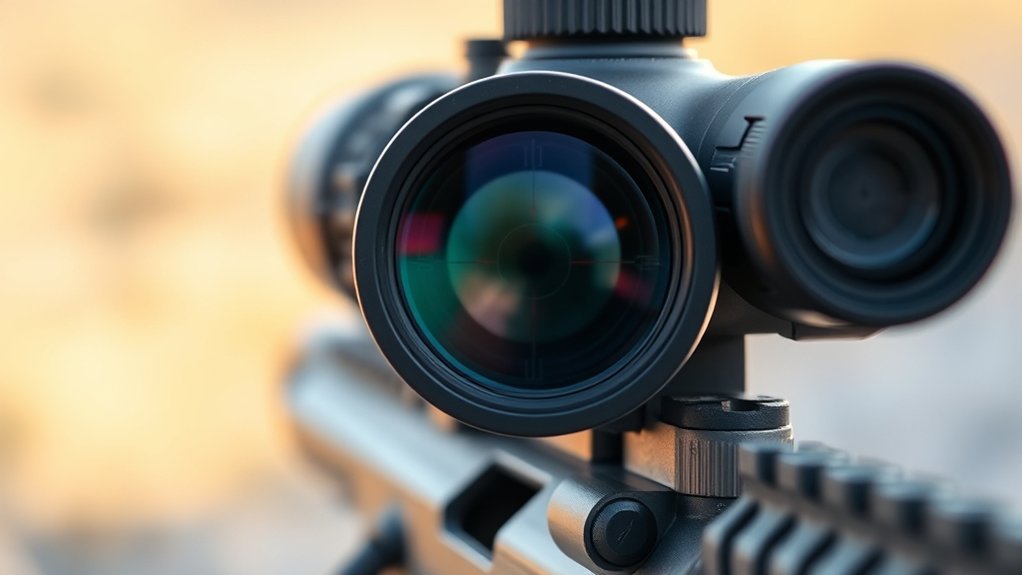
Although you mightn’t always notice it, parallax on a rifle scope affects how your eye aligns with the reticle and target. Parallax occurs when the reticle and the target image aren’t focused on the same optical plane, causing the reticle to shift slightly when you move your head.
This means if your eye isn’t perfectly centered behind the scope, the reticle can appear to move against the target. Most scopes have a parallax adjustment, allowing you to align the reticle and target image properly at a specific distance.
When set correctly, it guarantees that the reticle stays fixed on the target, no matter how your eye moves. Understanding parallax helps you use your scope more effectively and comfortably.
How Parallax Affects Your Rifle Scope Accuracy
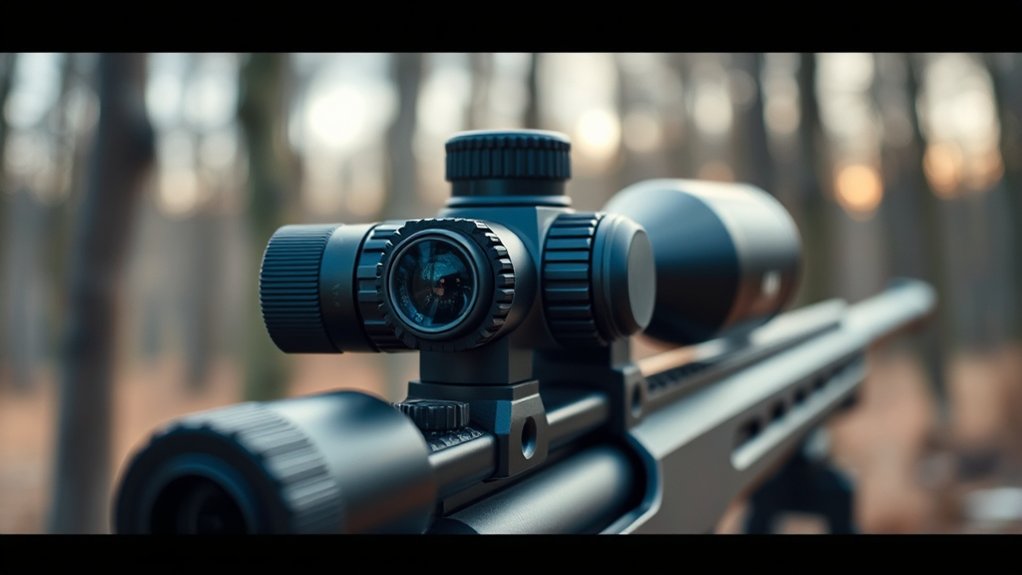
When you don’t properly adjust for parallax, your rifle scope’s accuracy can suffer greatly. Parallax causes the reticle to shift relative to the target if your eye isn’t perfectly aligned with the scope. This misalignment leads to aiming errors and missed shots, especially when you move your head slightly. Understanding how parallax affects your shot can help you correct it for better precision.
| Parallax Effect | Impact on Accuracy |
|---|---|
| Reticle shift | Misaligned aim point |
| Eye movement | Inconsistent shot group |
| Incorrect focus | Blurred target image |
Why Parallax Is More Noticeable at Longer Distances
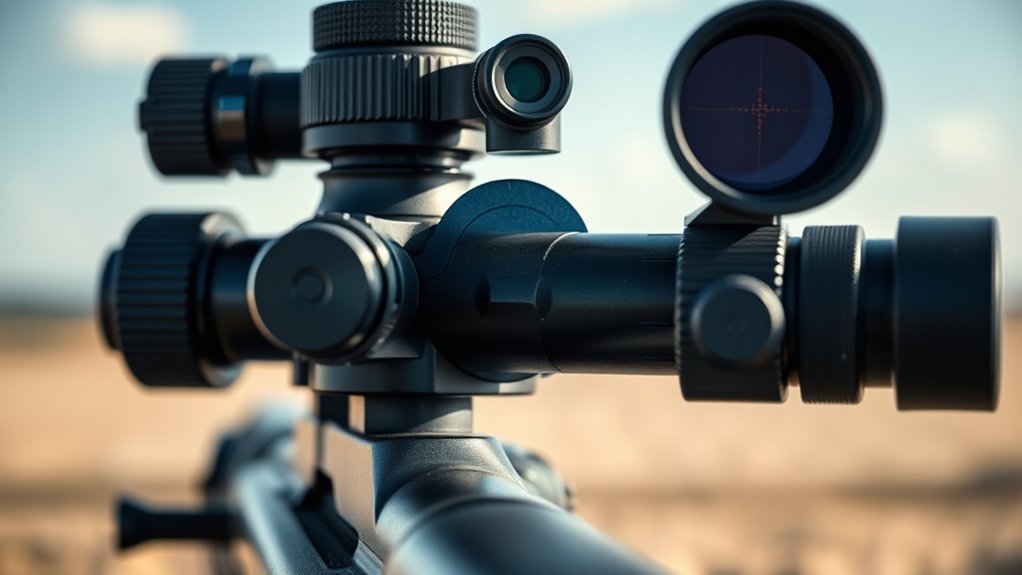
Since parallax causes the reticle to shift relative to your target, its effects become more noticeable at longer distances where even small misalignments can translate into significant aiming errors.
When you shoot at close range, a slight reticle shift might only move your point of impact by a tiny amount, barely affecting accuracy. However, as distance increases, that same shift covers a larger area on the target, making your shots less precise.
You’ll notice that even if you hold steady, the reticle seems to jump around more, which can cause you to miss or hit off-center.
Understanding this helps you stay aware of parallax issues during long-range shooting, ensuring you adjust your aim or scope settings to maintain accuracy.
Differences Between Fixed and Adjustable Parallax Scopes
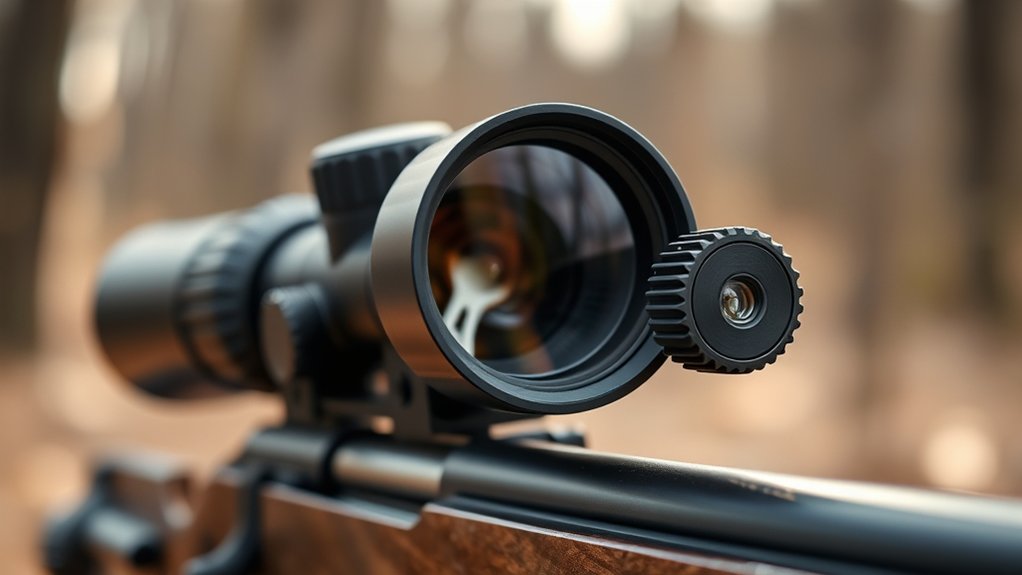
You’ll find that fixed and adjustable parallax scopes handle parallax correction quite differently, which can impact your shooting experience.
Fixed parallax scopes are set to a specific distance, usually around 100 yards. This means you don’t have to adjust anything, making them simpler and often more durable. However, if you’re shooting at distances other than the set range, you might notice parallax errors.
Adjustable parallax scopes let you fine-tune the focus to match your target’s distance. This flexibility helps you eliminate parallax at varying ranges, improving accuracy. They often feature a side knob or an adjustable objective lens.
Though adjustable scopes require more attention and setup, they provide better precision when shooting at different distances. Your choice depends on your shooting style and typical range.
How to Spot Parallax Problems in Your Scope
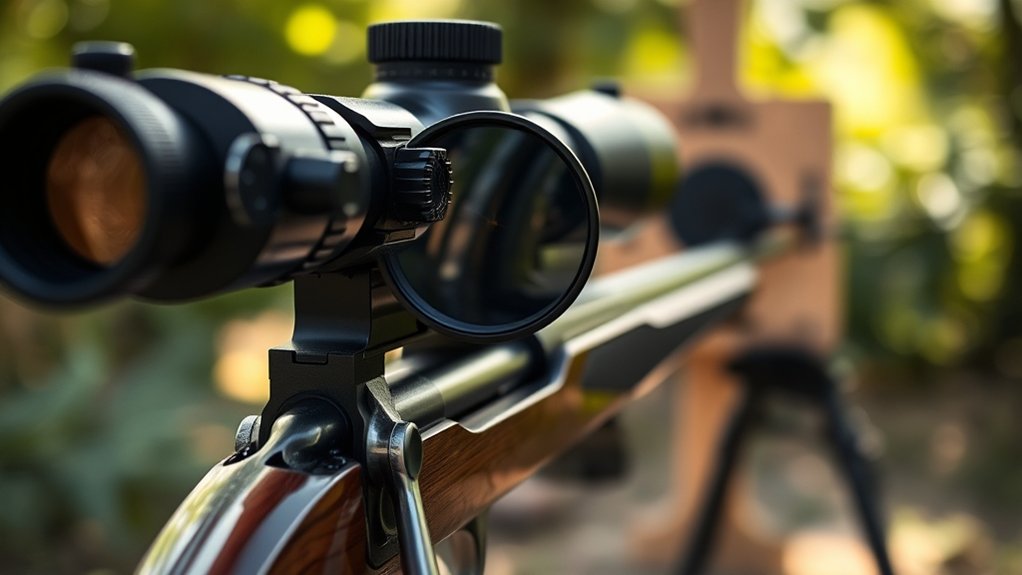
You’ll notice parallax problems when the image shifts as you move your eye behind the scope.
Pay attention to any focus inconsistencies that make the target look blurry or unclear.
Also, watch for reticle movement that doesn’t line up with your target when you adjust your position.
Signs of Image Shift
When you notice the reticle seems to shift as you move your eye behind the scope, it’s a clear sign of parallax issues. This image shift means the reticle and target aren’t aligned on the same focal plane. You might see the crosshairs move relative to the target if you slightly change your head position.
This effect is especially noticeable at longer distances or with higher magnification. Another sign is difficulty keeping the target and reticle perfectly aligned without constantly adjusting your eye position.
If your shots aren’t consistent despite a steady hold and proper technique, image shift might be the culprit. Recognizing these signs early helps you adjust your scope or shooting setup to maintain accuracy.
Detecting Focus Inconsistencies
Although parallax issues can be subtle, detecting focus inconsistencies in your rifle scope is crucial for maintaining accuracy. To spot these problems, start by looking through your scope at a target. Slowly shift your eye side to side and up and down without moving the rifle.
If the target or reticle appears blurry or changes focus during this motion, your scope’s focus may be off. Another test is adjusting the parallax knob or side focus until the target image sharpens and stays clear at different eye positions.
If you notice the image softens or shifts out of alignment, it signals a parallax problem. Catching these focus inconsistencies early helps guarantee your shots stay on target and your scope performs reliably.
Identifying Reticle Movement
Detecting focus inconsistencies sets the stage for recognizing another key sign of parallax problems: reticle movement. When you shift your eye slightly while aiming, the reticle should stay fixed on your target.
If it moves or appears to drift, that’s a clear indicator your scope is out of parallax adjustment. To spot this, look through your scope and move your head left, right, up, and down without adjusting the turrets.
Watch if the reticle shifts relative to the target. Any noticeable movement means the image and reticle aren’t on the same focal plane.
Fixing this usually involves adjusting the parallax setting or the focus until the reticle stays perfectly still, ensuring precise shot placement.
Adjusting Parallax: A Step-by-Step Guide
Because parallax can distort your aim, you’ll want to adjust your rifle scope carefully to guarantee a clear, precise sight picture.
Start by setting your scope’s magnification to the desired level. Then, look through the scope at your target and slowly turn the parallax adjustment knob or ring.
As you adjust, keep your eye perfectly centered behind the scope and watch for any reticle movement against the target. Continue turning the knob until the reticle stays fixed on the target, even if you slightly move your head. This means the parallax error is minimized.
Finally, confirm by shifting your eye position; if the reticle remains steady, your parallax is properly adjusted for the target distance.
Now, you’re ready to shoot with improved accuracy.
Common Mistakes to Avoid When Setting Parallax
When setting parallax on your rifle scope, even small errors can throw off your shot. One common mistake is adjusting parallax without first ensuring your target is in clear focus. If the image isn’t sharp, your parallax adjustment won’t be accurate.
Another error is neglecting to match the parallax setting to your target’s distance—guessing or skipping this step leads to blurry or shifted reticles. Don’t forget to keep both eyes open while adjusting; closing one can distort your perception and cause misalignment.
Finally, avoid rushing the process. Take your time to fine-tune the adjustment carefully, and double-check the reticle alignment through slight head movements. These simple precautions help you maintain precision and consistency in every shot.
When Should You Adjust Parallax on Your Rifle Scope?
Adjusting parallax on your rifle scope becomes essential whenever you change your shooting distance or switch targets at varying ranges.
When you move from a close target to one farther away, parallax settings need tweaking to maintain a clear, accurate sight picture. If you skip this step, you risk aiming errors caused by the reticle shifting relative to the target.
Also, anytime you notice the reticle seems to move when you slightly shift your eye position, it’s a sign parallax isn’t properly adjusted for that distance.
Precision shooting, especially at longer ranges, demands you fine-tune parallax to reduce aiming discrepancies. Make it a habit to check and adjust parallax as you change distances to ensure consistent accuracy with every shot.
How Parallax and Eye Relief Together Affect Shooting Accuracy
You need to understand how parallax and eye relief work together to keep your shots accurate. Parallax errors can shift your point of aim, while proper eye relief guarantees a clear, consistent sight picture.
Mastering both helps you shoot confidently and precisely every time.
Parallax Impact On Accuracy
Because parallax shifts the reticle’s apparent position relative to the target, it can quickly throw off your shot if your eye isn’t perfectly aligned with the scope. Even a slight misalignment changes where the reticle appears, causing you to miss your mark.
When you move your head, the reticle seems to drift, making it harder to keep consistent aim. This effect grows stronger at longer distances or with scopes that lack parallax adjustment.
To maintain accuracy, you need to position your eye so the reticle stays fixed on the target regardless of movement. Otherwise, parallax error will introduce subtle but critical aiming mistakes that reduce your precision.
Understanding and managing parallax helps you shoot confidently and hit your target more reliably.
Eye Relief Importance
While parallax affects how the reticle lines up with your target, eye relief determines how comfortably and consistently you can position your eye behind the scope. If your eye relief is too short, you risk scope bite or inconsistent sight picture, which reduces accuracy. Together, proper parallax adjustment and consistent eye relief guarantee your reticle stays aligned and your shots stay on target.
| Factor | Effect on Accuracy | Your Action |
|---|---|---|
| Parallax Setting | Eliminates reticle shift | Adjust to target distance |
| Eye Relief | Ensures clear sight picture | Maintain consistent eye position |
| Inconsistency | Causes aim errors | Practice steady cheek weld |
Mastering both gives you a reliable, repeatable shot every time.
Key Features to Look for When Choosing a Scope With Parallax Control
When selecting a scope with parallax control, understanding which features matter most can sharpen your shooting accuracy.
First, look for adjustable parallax settings that match your typical shooting distances—whether fixed or side focus, versatility is key.
Clear, crisp optics help you spot targets without straining your eyes.
Check for smooth, precise parallax adjustment knobs that won’t slip under recoil.
Consider the scope’s build quality; it should withstand harsh conditions without losing zero.
Also, guarantee the scope offers consistent eye relief, so you maintain a comfortable, repeatable shooting position.
Finally, choose a model with reliable reticle clarity and minimal distortion, as this helps maintain precise aiming.
Prioritizing these features ensures your parallax control enhances rather than hinders your shooting performance.
Tips for Maintaining Parallax Accuracy Over Time
Choosing a scope with reliable parallax control lays the foundation for accurate shooting, but maintaining that accuracy over time requires regular care and attention.
First, always keep the lenses clean using a soft microfiber cloth and lens cleaner designed for optics. Avoid touching the glass with your fingers to prevent smudges that can affect clarity.
Next, regularly check the parallax adjustment mechanism for smooth operation; if it feels stiff or loose, have it serviced.
Store your rifle and scope in a dry, dust-free environment to prevent corrosion.
After heavy use or exposure to harsh conditions, recalibrate the parallax settings to ensure continued precision.
Frequently Asked Questions
Can Parallax Adjustment Improve Low-Light Shooting Performance?
Yes, adjusting parallax can improve your low-light shooting by ensuring the reticle stays aligned with the target, reducing aiming errors. You’ll get clearer focus and better accuracy, especially when visibility is limited.
Does Parallax Affect Scopes Used on Moving Targets?
You’ll find that over 60% of shooters notice target shift due to parallax when tracking moving targets. It definitely affects scopes, so you’ll want to adjust parallax to maintain accuracy on the move.
Are There Specific Rifles That Benefit Most From Parallax Adjustment?
You’ll benefit most from parallax adjustment on precision rifles, like long-range bolt-actions or varmint rifles. It helps you keep the reticle clear and accurate, especially when shooting at varying distances or moving targets.
How Does Parallax Relate to Different Reticle Types?
Parallax affects reticle types differently; duplex reticles are less sensitive, while mil-dot or BDC reticles require careful parallax adjustment for accuracy. You’ll want to adjust parallax to keep the reticle aligned with your target precisely.
Can Parallax Issues Be Fixed Without Professional Gunsmith Help?
Yes, you can fix parallax issues yourself by adjusting the scope’s parallax knob or focusing the reticle at the proper distance. Just take your time and practice to guarantee clear, accurate targeting without needing a gunsmith.
Conclusion
So, next time your shot mysteriously veers off target, don’t just blame your “bad aim.” Parallax is that sneaky little gremlin messing with your focus, especially at longer distances. If you’re still ignoring adjustable parallax scopes, you might as well be aiming with a potato. Want real accuracy? Learn to spot and adjust it. Otherwise, enjoy playing the guessing game of “Where Did My Bullet Go?”—it’s thrilling, isn’t it?