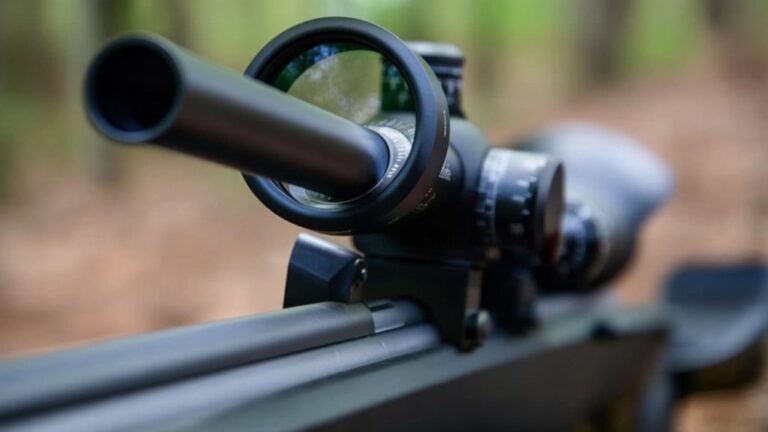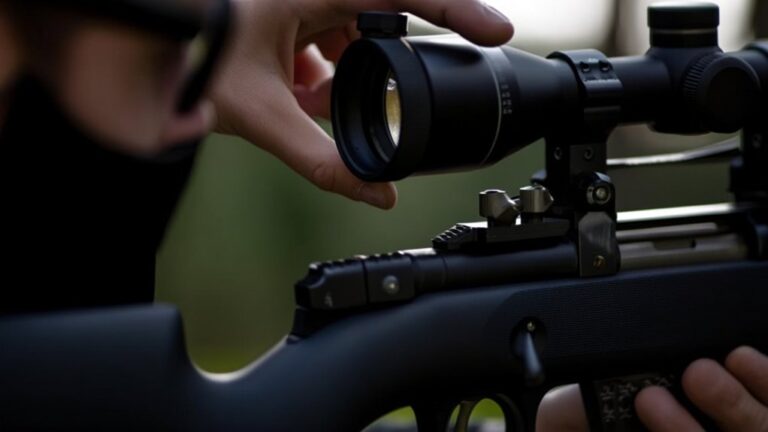
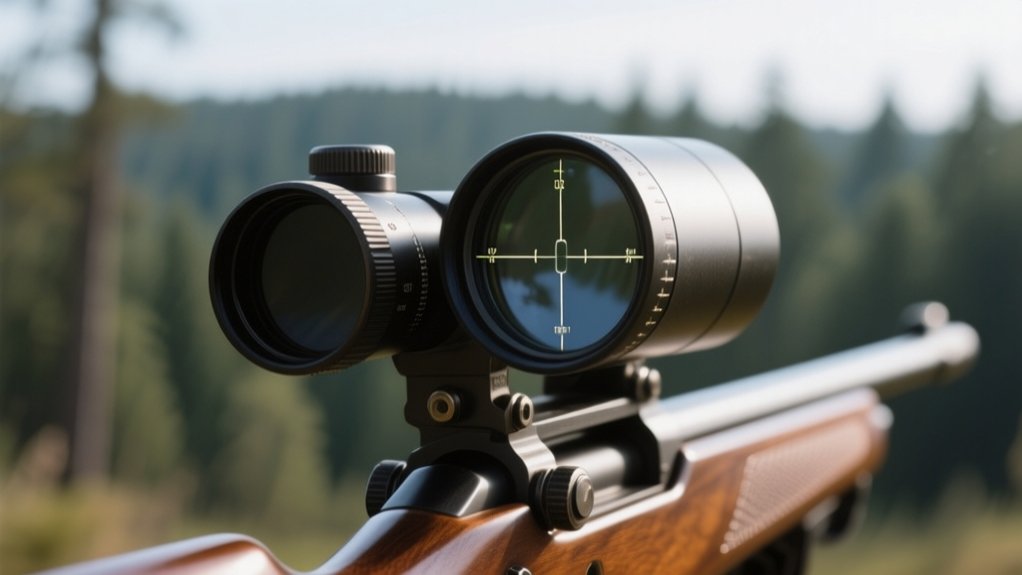
What Is First Focal Plane in a Rifle Scope?
A First Focal Plane (FFP) rifle scope has a reticle that changes size with your zoom, staying proportional to the target. This means your holdover marks and range estimations remain accurate at any magnification. You’ll get consistent precision for long-range shots or quick adjustments in tactical situations. While FFP scopes might cost more or look cluttered at low zoom, they offer versatility you can rely on. Learn how this impacts your shooting performance and scope choice.
What Is a First Focal Plane (FFP) Scope?
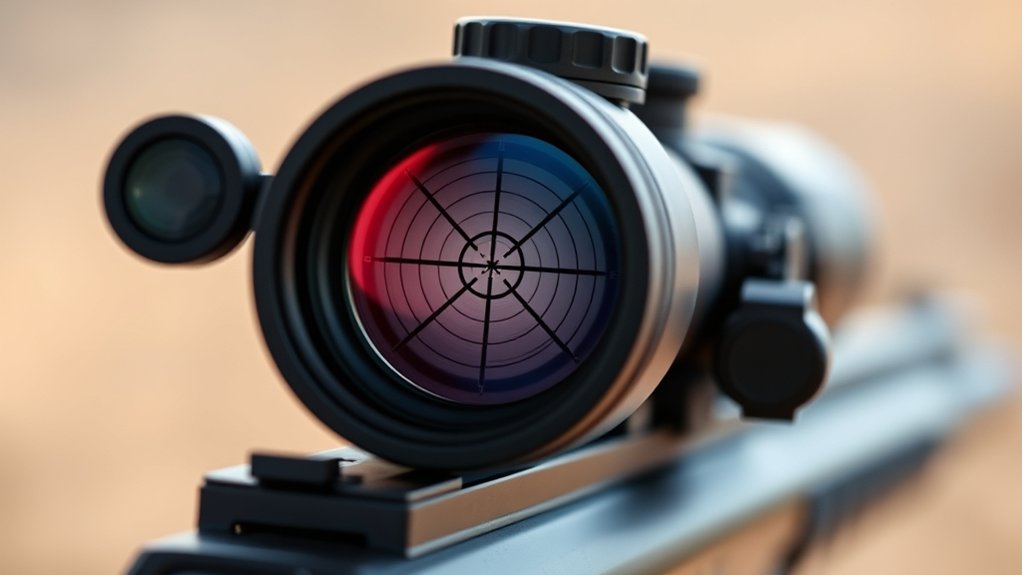
What makes a first focal plane (FFP) scope different from other scopes? When you use an FFP scope, the reticle adjusts size as you change magnification. This means the reticle remains proportional to the target and the range markings stay accurate at any zoom level.
Unlike second focal plane scopes, where the reticle size stays fixed and can cause range estimation errors when zoomed, FFP scopes keep your holdover and windage marks reliable throughout your magnification range. If you rely on precise ranging or ballistic corrections, this consistency gives you a big advantage.
You’ll find FFP scopes especially useful for long-range shooting, tactical applications, or hunting where quick, accurate adjustments matter. They help you maintain confidence in your shot without recalculating at different zooms.
How Does a First Focal Plane Scope Work?
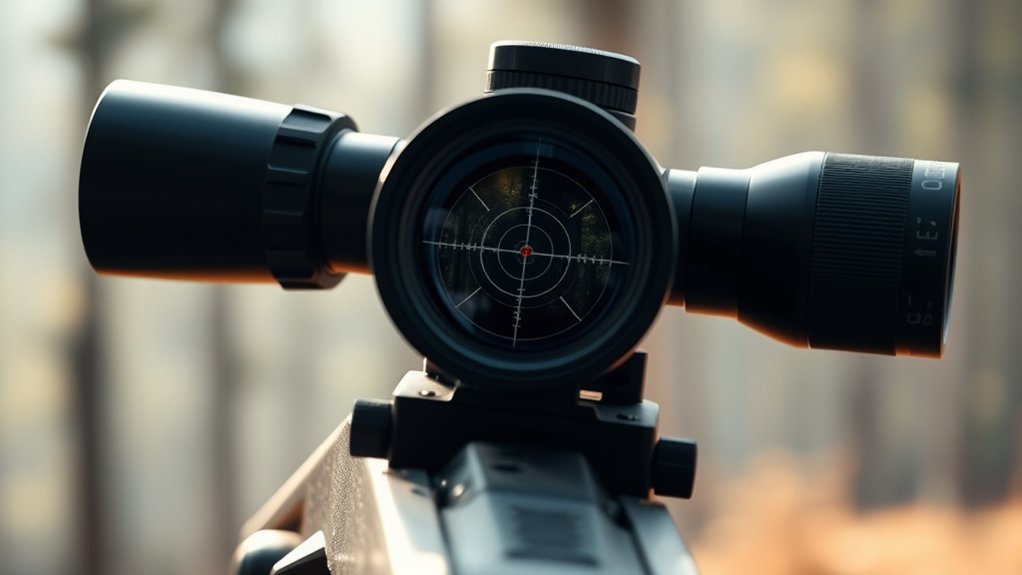
Understanding how a first focal plane scope works helps you appreciate why the reticle changes size with magnification. In an FFP scope, the reticle is etched onto the front lens group, so it scales proportionally when you zoom in or out. This means the reticle stays accurate for range estimation and holdovers at any magnification.
Here’s how it works in practice:
- When you increase magnification, both the target and reticle grow larger together.
- The reticle’s subtensions (spacing) remain consistent with the target size.
- This allows you to use the reticle for precise measurements without adjusting your calculations.
- As a result, you get reliable aiming points at all zoom levels, improving accuracy and speed.
FFP scopes give you a dynamic reticle that adapts with your view, enhancing precision.
FFP vs. SFP: What Are the Key Differences?
When choosing between FFP and SFP scopes, you’ll notice the reticle’s position directly affects how it behaves with magnification changes.
You’ll also want to take into account how each type performs in real-world shooting scenarios.
Let’s explore these differences to help you decide which fits your needs best.
Reticle Positioning Impact
Although both first focal plane (FFP) and second focal plane (SFP) scopes serve the same basic purpose, the position of the reticle inside the scope dramatically affects how you use the reticle at different magnifications.
With an FFP scope, the reticle scales with your zoom, maintaining consistent measurements. In contrast, an SFP scope keeps the reticle size fixed, which can impact accuracy when estimating range or holdover at varying zoom levels.
Here’s how reticle positioning impacts your experience:
- FFP reticles adjust size, aiding range estimation at any magnification.
- SFP reticles remain constant, simplifying target acquisition at one set zoom.
- FFP suits dynamic shooting where quick adjustments are key.
- SFP works well if you prefer zeroing at a specific magnification.
Magnification Effect Differences
The way your reticle changes—or doesn’t—as you zoom in or out directly affects how you interpret what you see through the scope.
With a First Focal Plane (FFP) scope, the reticle scales proportionally with magnification. This means your holdovers and range estimations remain accurate at any zoom level because the reticle’s subtensions adjust with the target size.
In contrast, a Second Focal Plane (SFP) scope keeps the reticle size fixed regardless of magnification. While this can make the reticle appear clearer at lower powers, it means your holdovers are only accurate at one specific magnification, usually the highest.
Understanding this difference helps you decide which scope suits your shooting style, especially if precise range estimation and holdover use are priorities.
Practical Use Scenarios
How do you decide between a First Focal Plane (FFP) and a Second Focal Plane (SFP) scope in real-world shooting? It depends on your needs and shooting style.
FFP scopes keep reticle measurements accurate at all magnifications, which is great for long-range shooting and tactical situations.
On the other hand, SFP scopes provide a clearer reticle at lower magnifications, ideal for hunting and target shooting at known distances.
Consider these scenarios:
- Precision long-range shooting—FFP shines with consistent holdovers.
- Hunting in dense woods—SFP offers a less cluttered view.
- Tactical or law enforcement use—FFP helps with quick range estimation.
- Casual target shooting—SFP gives simplicity and ease of use.
Choose what fits your shooting environment best.
How Do Reticle Sizes Change in FFP Scopes?
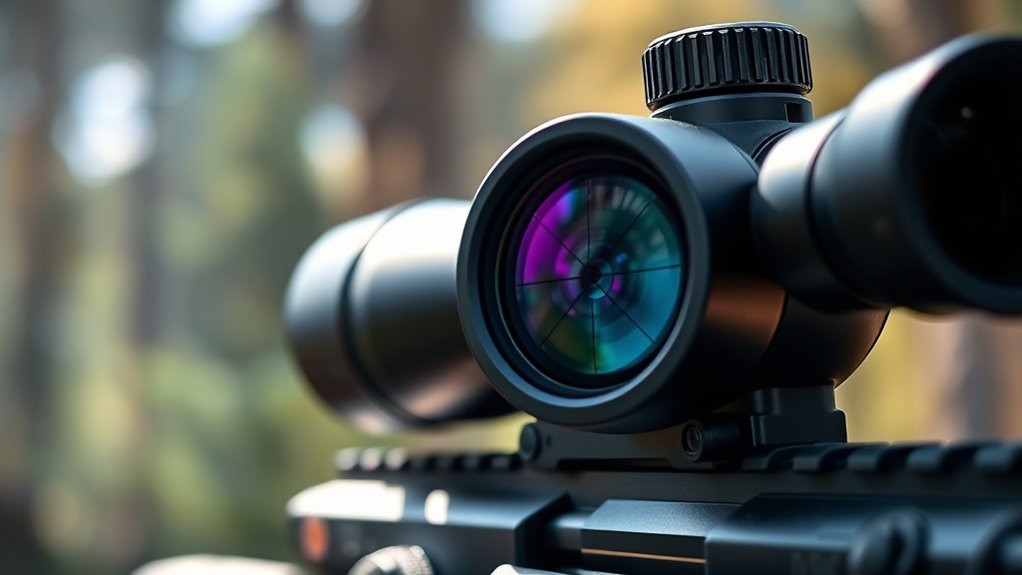
When you adjust the magnification on a First Focal Plane (FFP) scope, the reticle size changes proportionally with the zoom level. This means the reticle appears larger as you zoom in and smaller as you zoom out, maintaining consistent subtensions for accurate holdovers and range estimations at any magnification.
| Magnification Level | Reticle Size Appearance | Practical Effect |
|---|---|---|
| 1x | Smallest | Wide field of view |
| 3x | Medium | Balanced precision |
| 6x | Larger | Enhanced target detail |
| 9x | Larger still | Precision aiming at range |
| 12x | Largest | Maximum reticle detail |
You’ll find this scaling keeps your aiming points reliable regardless of zoom changes.
Common Reticle Types in First Focal Plane Scopes
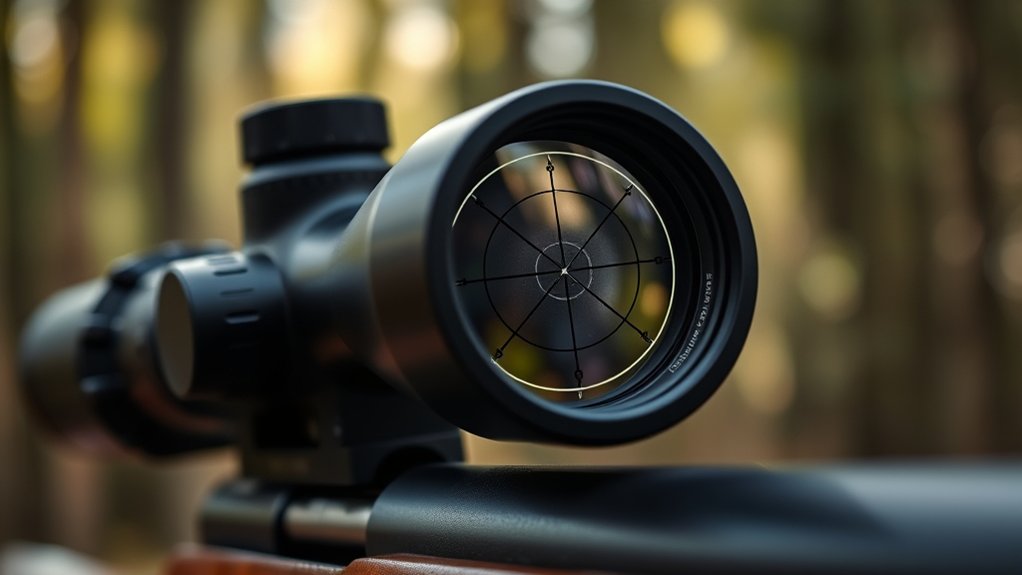
You’ll find that Mil-Dot reticles are popular in first focal plane scopes for precise range estimation.
BDC reticles, on the other hand, help you quickly adjust for bullet drop at various distances.
Let’s explore how each type can improve your shooting accuracy.
Mil-Dot Reticle Features
Although many reticle designs exist for first focal plane scopes, the Mil-Dot reticle stands out for its versatility and precision. When you use a Mil-Dot reticle, you get a series of evenly spaced dots that help you estimate range, holdover, and windage adjustments without guessing. This makes it a favorite among tactical shooters and hunters alike.
Here’s what makes the Mil-Dot reticle useful:
- Range Estimation – Measure targets quickly using known object sizes.
- Holdover Points – Compensate for bullet drop without adjusting turrets.
- Windage Correction – Adjust for wind by using horizontal dots.
- Consistent Scaling – Since it’s in the first focal plane, dots stay accurate at any zoom.
With these features, you’ll improve your shot accuracy and speed under various conditions.
BDC Reticle Advantages
The Mil-Dot reticle offers precise measurement tools, but the BDC (Bullet Drop Compensation) reticle takes a different approach by simplifying holdover adjustments for shooters. With a BDC reticle in a first focal plane scope, you can quickly compensate for bullet drop at various distances without fiddling with turrets. This makes it ideal for fast-paced shooting or hunting scenarios where time is critical.
| Advantage | Explanation |
|---|---|
| Quick adjustments | Holdovers match bullet drop at set distances |
| User-friendly | Intuitive marks make range estimation easier |
| Speed | Faster target acquisition at varying ranges |
| Less guesswork | Reduces need to calculate bullet drop manually |
| Ideal for hunting | Efficient in dynamic, real-world conditions |
BDC reticles boost your shooting efficiency by streamlining range compensation.
What Are the Advantages of Using an FFP Scope?
When you choose a first focal plane (FFP) scope, you get the advantage of a reticle that adjusts its size in direct proportion to the zoom level. This means your aiming points remain accurate at any magnification, which is a huge benefit for precision shooting.
Here are the key advantages you’ll appreciate:
- Consistent holdovers and windage corrections across all zoom levels.
- Easier range estimation since reticle subtensions stay true regardless of magnification.
- Improved target acquisition when zooming in or out without losing reticle clarity.
- Enhanced versatility, allowing you to engage targets at varying distances confidently.
What Are the Drawbacks of First Focal Plane Scopes?
While first focal plane scopes offer many benefits, they come with some drawbacks you should consider before making a purchase. One major downside is their higher cost compared to second focal plane scopes. You’ll often pay more upfront for the advanced reticle technology.
Also, the reticle can become cluttered or harder to see at low magnifications because it scales with your zoom level. This might distract you in certain shooting scenarios.
Additionally, some FFP scopes tend to be bulkier or heavier due to their complex design, which can affect your overall setup.
Finally, if you rarely adjust magnification, the constant reticle scaling may feel unnecessary, making a simpler scope more practical.
Weigh these factors carefully to decide if an FFP scope suits your needs.
When Should You Choose a First Focal Plane Scope?
You should choose a first focal plane scope when you need reliable holdovers at any magnification, especially for long-range precision shooting.
These scopes are ideal for tactical situations and hunting where quick adjustments and accuracy matter.
Understanding when to use one can improve your shooting performance considerably.
Long-Range Precision Benefits
Why does precision at long range matter so much for shooters? Because even a tiny miscalculation can cause you to miss the target entirely.
A first focal plane (FFP) scope keeps the reticle size proportional at all magnifications, letting you make accurate holdovers and windage adjustments as you zoom in or out. This consistency is essential for long-distance shots.
Here’s why you should consider an FFP scope for long-range shooting:
- Reticle subtensions stay accurate at any zoom level.
- You can quickly estimate range and bullet drop without guesswork.
- Adjusting for wind and elevation becomes more intuitive.
- It saves time when taking rapid follow-up shots at varying distances.
Choosing an FFP scope enhances your confidence and precision downrange.
Tactical And Hunting Use
Long-range precision is just one advantage of first focal plane scopes. You’ll find them especially useful in tactical situations where quick, accurate adjustments matter.
Since the reticle scales with your zoom, you can estimate range and holdovers without recalculating at different magnifications. This makes FFP scopes ideal for law enforcement, military, or competitive shooting where speed and accuracy are critical.
For hunting, they’re a smart choice if you often shoot at varying distances or need to make fast shots on moving game. The consistent reticle markings help you adjust for bullet drop and wind without second-guessing.
However, if you mostly shoot at close range or prefer a simpler setup, a second focal plane scope might suit you better.
Choose an FFP scope when versatility and rapid precision count.
How Do FFP Scopes Help With Range Estimation and Ballistics?
How exactly do First Focal Plane (FFP) scopes enhance your ability to estimate range and improve ballistics? With an FFP scope, the reticle scales consistently with your target regardless of magnification. This means your holdovers and range estimations remain accurate at any zoom level, giving you real-time ballistic data. Here’s how they help:
- Consistent Reticle Sizing: Your reticle subtensions stay true at all magnifications, letting you measure targets precisely.
- Accurate Range Estimation: Use the reticle’s markings to calculate distance without adjusting for scope zoom.
- Reliable Holdover Points: You can quickly compensate for bullet drop and windage using fixed reticle references.
- Improved Shot Placement: The dynamic reticle aids in making faster, more accurate shots under varying conditions.
FFP scopes keep ballistic calculations straightforward and dependable.
Key Factors to Consider When Choosing an FFP Scope
When selecting an FFP scope, you need to focus on several critical factors to guarantee it matches your shooting style and needs.
First, consider the magnification range—choose one that suits your typical engagement distances.
Next, check the reticle design; it should offer clear, precise holdovers without clutter.
Durability matters, so opt for scopes with robust construction and weather resistance.
Also, factor in the scope’s adjustment turrets—they should be easy to use and offer reliable, repeatable clicks.
Weight and size are important too, especially if you carry your rifle for extended periods.
Finally, ensure the scope’s glass quality provides a bright, clear image in various light conditions.
Balancing these elements helps you pick an FFP scope that elevates your shooting accuracy and confidence.
Frequently Asked Questions
Can FFP Scopes Be Used Effectively in Low-Light Conditions?
Yes, you can use FFP scopes effectively in low-light conditions since their reticle stays proportional to magnification, helping you aim precisely. Just make sure your scope has illuminated reticles or good light transmission for better visibility.
How Durable Are First Focal Plane Scopes in Harsh Environments?
You’ll find first focal plane scopes quite durable in harsh environments since many are built with rugged materials and sealed for waterproof and fog-proof performance, ensuring they hold up well under tough conditions and rough handling.
Are FFP Scopes Compatible With Night Vision Devices?
Don’t worry about compatibility—FFP scopes work well with night vision devices. You’ll appreciate their reticle clarity and consistent sizing, helping you track targets precisely in low light without losing focus or detail during your night missions.
What Maintenance Is Required for First Focal Plane Scopes?
You should regularly clean the lenses with a microfiber cloth, check for loose screws, and keep the scope dry to prevent fogging or corrosion. Also, store it in a protective case when not in use to maintain performance.
Do FFP Scopes Affect the Weight of the Rifle Significantly?
FFP scopes don’t considerably affect your rifle’s weight since their design is similar to other scopes. You might notice a slight difference, but it’s usually minimal and won’t impact your handling or shooting comfort much.
Conclusion
So, you want precision and quick range estimation? Sure, FFP scopes change your reticle size as you zoom—because who doesn’t love a moving target in their sight picture? But hey, if you enjoy guessing distances with a static reticle, stick to SFP. Otherwise, choosing an FFP might just make you feel like a sniper, even if you’re only shooting at squirrels. Either way, it’s all about what fits your shooting style and needs.