How Do Holographic Sights Work?
Holographic sights use laser technology to project a floating, 3D reticle onto a transparent display you look through, letting you aim with both eyes open. The reticle stays perfectly aligned no matter your head position, minimizing parallax errors for fast, intuitive targeting. Laser light creates a stable reticle image that appears to hover over your target. While they offer quick acquisition and ruggedness, there are trade-offs in battery life and visibility. Explore further to understand what sets holographic sights apart.
Key Takeaways
- Holographic sights project a 3D reticle using laser diodes and holographic optical elements for precise targeting.
- The reticle appears to float in front of the user, maintaining alignment regardless of head or eye position.
- Laser light interference patterns recorded on holographic film create the stable, parallax-free reticle image.
- The reticle is illuminated and reconstructed in the line of sight, enhancing visibility under various lighting conditions.
- Users benefit from quick target acquisition and aiming with both eyes open, improving situational awareness.
What Are Holographic Sights and How Do They Differ?
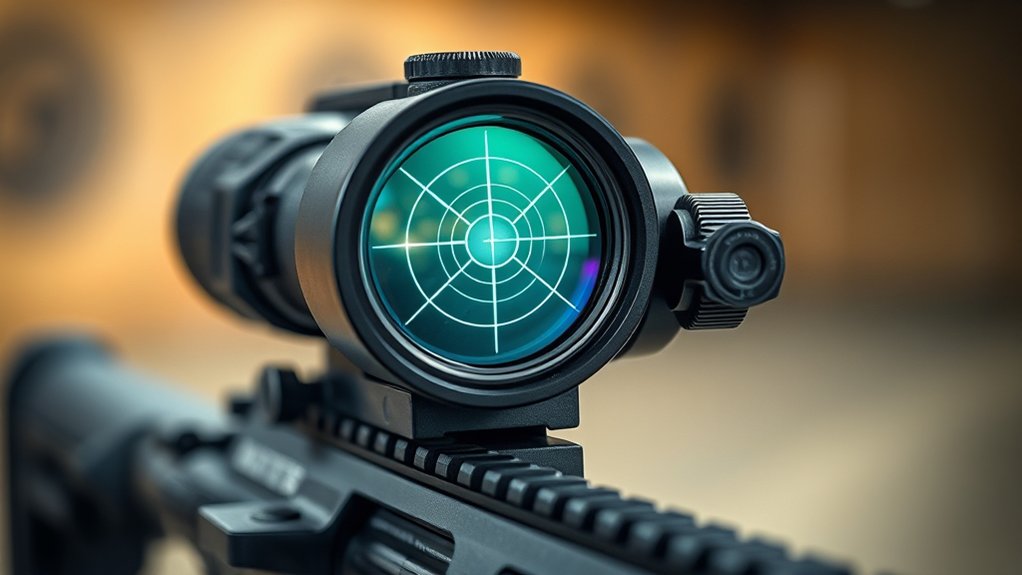
Although you might’ve heard of various aiming devices, holographic sights stand out because they use laser technology to project a reticle onto a transparent display. Unlike traditional red dot sights that shine an LED dot on a lens, holographic sights create a three-dimensional reticle that appears to float in front of you.
This means you can keep both eyes open while aiming, improving your situational awareness and target acquisition speed. Holographic sights also tend to be less affected by parallax errors, so your point of aim stays consistent even if your head moves slightly.
They’re popular among military and law enforcement professionals because of their durability and precision. When you use one, you’ll notice how quickly and clearly you can line up your shot.
How Holography Creates the Reticle in Holographic Sights
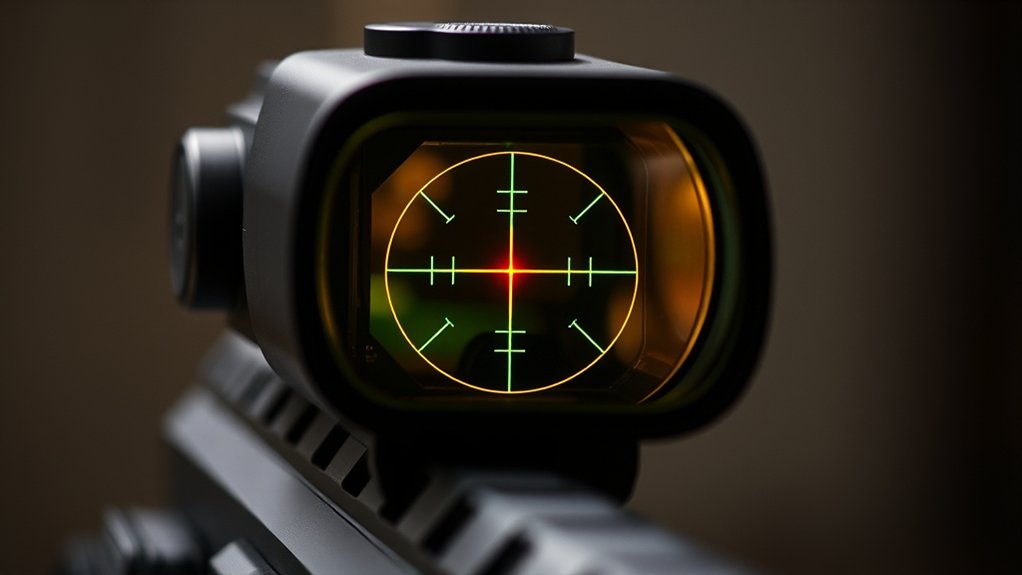
When you look through a holographic sight, the reticle you see isn’t simply a painted or projected dot; it’s created using holography, a technique that records and reconstructs light patterns to produce a three-dimensional image.
The process starts by shining a laser onto a specially designed reticle pattern, which reflects light and interferes with a reference beam. This interference pattern is recorded on a holographic film inside the sight.
When you later view the sight, this recorded pattern reconstructs the light waves, allowing you to see the reticle floating in space. Because it’s a true hologram, the reticle maintains its shape and position regardless of your eye’s angle, giving you a precise aiming point without parallax issues.
How Laser Light Makes the Reticle Appear
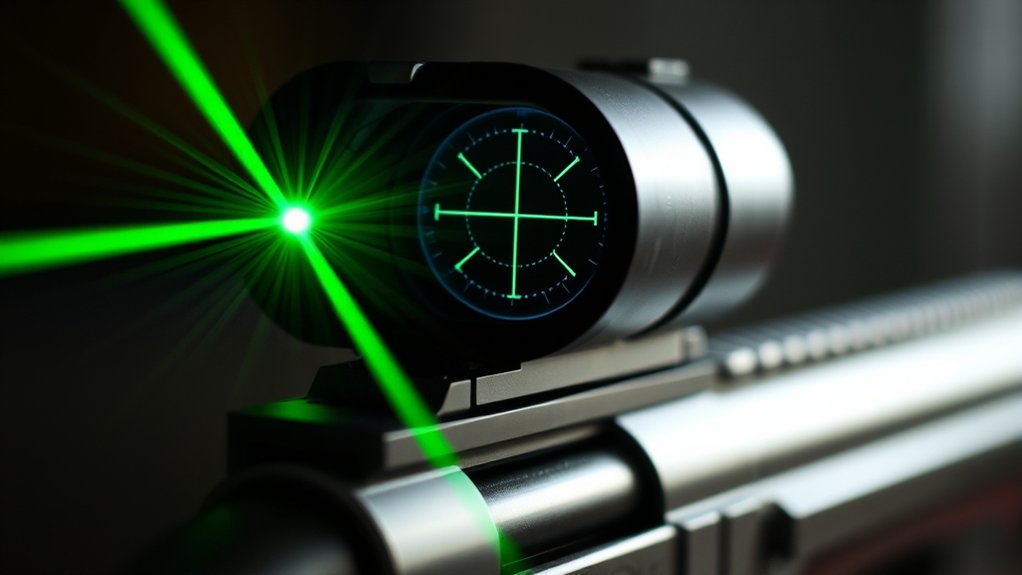
You’ll see the reticle because the laser light projects it onto the holographic film inside the sight.
How clearly it appears depends on factors like laser intensity and ambient lighting.
Let’s explore how this laser projection mechanism controls what you see.
Laser Projection Mechanism
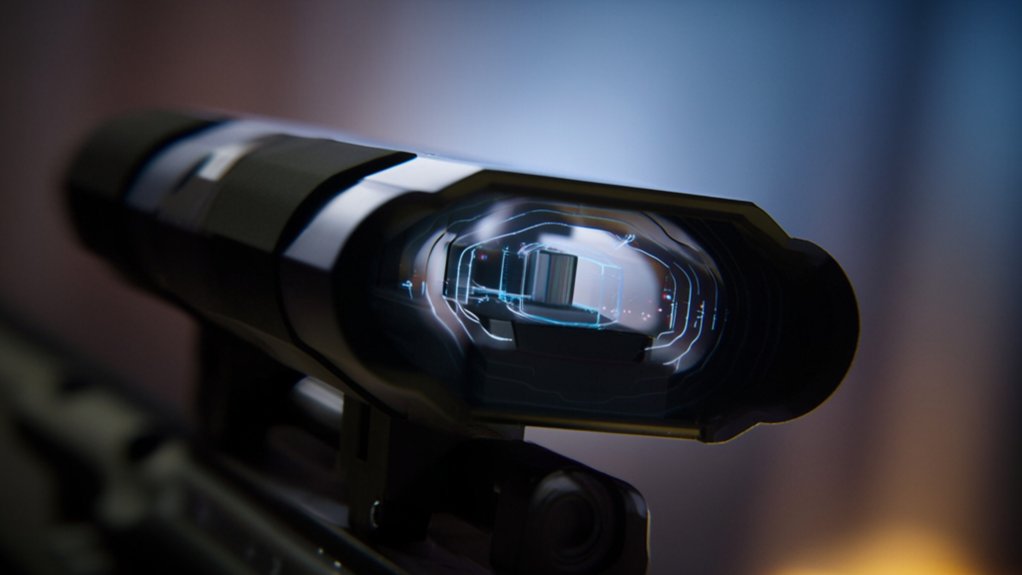
How exactly does a holographic sight project the reticle you see? It starts with a laser diode that emits a coherent beam of light. This laser beam is directed onto a holographic optical element (HOE), a specially designed glass plate containing the reticle’s hologram.
When the laser hits the HOE, it reconstructs the reticle image by diffracting the light in a precise pattern. This diffracted light travels through the sight’s viewing window, making the reticle appear to float in your field of view.
Because the reticle is created by interference patterns in the laser light, it remains sharp and clear at various distances without parallax errors. This laser projection mechanism lets you quickly acquire targets with enhanced accuracy and speed.
Reticle Visibility Factors
Although the laser projection creates the reticle, several factors influence how clearly you see it. Your ability to spot the reticle depends on lighting conditions, the reticle’s brightness setting, the quality of the holographic window, and even the environment’s background contrast. Understanding these helps you adjust your sight for maximum clarity.
| Factor | How It Affects Reticle Visibility |
|---|---|
| Ambient Light | Too bright or dim light can wash out or obscure it |
| Brightness Setting | Higher brightness enhances visibility in sunlight |
| Window Quality | Clean, scratch-free glass ensures a sharp image |
| Background Contrast | High contrast makes the reticle stand out better |
How the Reticle Is Projected in Holographic Sights
Because holographic sights rely on advanced optics, they project the reticle differently than traditional scopes. Instead of using lenses to magnify, they use a laser to create a holographic image of the reticle right in your line of sight. Here’s how it works:
- A laser diode emits a beam that hits a holographic optical element (HOE).
- The HOE reconstructs the reticle image as a hologram.
- This hologram appears to float at a set distance, making it easier to focus on.
- The reticle is illuminated without physical parts blocking your view.
- Your eye sees the holographic reticle superimposed on the target, allowing quick target acquisition.
This method guarantees the reticle remains clear and precise, no matter your environment or lighting conditions.
Does Head Position Affect Reticle Alignment?
When you move your head while aiming through a holographic sight, the reticle stays aligned with your target regardless of your position. This is because the reticle is projected onto a holographic film that appears fixed in space. Unlike traditional sights, your eye position doesn’t shift the reticle’s point of aim.
Here’s a quick comparison of how head position affects different sight types:
| Sight Type | Reticle Movement with Head Shift | Impact on Accuracy |
|---|---|---|
| Holographic Sight | None | Consistent |
| Red Dot Sight | Slight | Minor |
| Iron Sights | Significant | Major |
With holographic sights, you get reliable reticle alignment no matter how you move your head, making quick target acquisition easier and more accurate.
Why Holographic Sights Work With Both Eyes Open
Since holographic sights project the reticle onto a transparent holographic film, you can keep both eyes open while aiming without losing focus on your target. This design lets you maintain full situational awareness and depth perception, unlike traditional sights that require closing one eye.
Holographic sights let you aim with both eyes open, keeping focus and full situational awareness.
When you use both eyes, your brain naturally merges the reticle from the sight with the real-world view, making aiming quicker and more intuitive.
Here’s why this works so well:
- The reticle appears at a consistent focal distance.
- The transparent film doesn’t block your field of view.
- Your brain blends the holographic image with your surroundings.
- You retain peripheral vision for better awareness.
- Rapid target acquisition improves under stress.
This combination helps you shoot accurately without compromising vision.
Key Components Inside a Holographic Sight
To understand how a holographic sight creates its reticle, you’ll need to look at its key components. The laser diode generates the light, while reflective optical elements shape and direct that light inside the sight.
Let’s explore how these parts work together to give you a clear aiming point.
Laser Diode Functionality
Although you mightn’t see it, the laser diode inside a holographic sight plays an essential role by generating the coherent light needed to create the reticle image. This tiny component emits a focused beam of light that interacts with the holographic film to project the aiming point you see.
Here’s what the laser diode does for you:
- Produces a precise, coherent light source
- Enables a bright, clear reticle visible in various lighting
- Operates efficiently with low power consumption
- Provides quick startup for instant aiming readiness
- Maintains stability to avoid image distortion
Without the laser diode, your holographic sight wouldn’t deliver the sharp, reliable aiming point essential for accurate shooting.
Reflective Optical Elements
When you look through a holographic sight, reflective optical elements play a crucial role in directing the laser light to form the reticle image clearly on the viewing window. These elements consist of carefully angled mirrors and beam splitters that guide the laser beam emitted by the diode toward the holographic film embedded in the sight.
By reflecting and focusing the light precisely, they guarantee the reticle appears sharp and stable regardless of your eye position. This design minimizes parallax and maximizes brightness, even in varying light conditions.
Without these reflective components, the hologram wouldn’t align properly, making it difficult to acquire targets quickly. So, the reflective optical elements are indispensable for transforming laser light into a crisp, easily visible aiming point on the holographic sight’s glass.
Battery Life and Performance Impact
Since holographic sights rely on electronic components to project their reticle, their battery life directly affects how long you can use them in the field without interruptions. Knowing how battery performance impacts your sight helps you plan better and avoid unexpected downtime.
Here are key factors to take into account:
- Battery type: Lithium batteries usually last longer than alkaline.
- Brightness settings: Higher brightness drains power faster.
- Usage duration: Continuous use shortens battery life.
- Temperature: Extreme cold or heat can reduce battery efficiency.
- Power-saving features: Auto shut-off and adjustable reticle intensity conserve energy.
Comparing Holographic Sights to Red Dot and Iron Sights
When you compare holographic sights to red dot and iron sights, accuracy and speed in target acquisition stand out as key differences.
You’ll also want to contemplate durability and how battery life affects each option’s reliability.
Understanding these factors helps you choose the best sight for your needs.
Accuracy and Target Acquisition
How quickly can you acquire your target with different sight types?
Holographic sights give you a clear, precise aiming point that stays aligned even if your eye position shifts. Compared to red dot and iron sights, they often provide faster target acquisition and better accuracy in dynamic situations.
Here’s how they stack up:
- Holographic sights: Quick target focus with a sharp reticle.
- Red dot sights: Fast but can suffer from parallax errors.
- Iron sights: Reliable but require perfect eye alignment and practice.
- Holographic vs. red dot: Holographics maintain reticle clarity at various angles.
- Holographic vs. iron sights: Easier to use under stress and low light.
With holographic sights, you can react and shoot more efficiently.
Durability and Battery Life
Although holographic sights offer impressive performance, their durability and battery life differ remarkably from red dot and iron sights. You’ll find holographic sights depend on electronics, requiring batteries that usually last between 8 to 50 hours. Red dot sights often outlast holographics with battery lives stretching from 20 to over 50,000 hours. Iron sights, being purely mechanical, never need batteries and are incredibly rugged. When considering durability, holographic sights can handle rough use but are more vulnerable to damage than iron sights, which are nearly indestructible. Here’s a quick comparison:
| Sighting Type | Battery Life | Durability |
|---|---|---|
| Holographic | 8–50 hours | Moderate (electronic) |
| Red Dot | 20–50,000+ hours | High (electronic) |
| Iron Sights | None | Extremely high (mechanical) |
Advantages of Holographic Sights for Military and Civilian Use
Holographic sights offer clear advantages for both military personnel and civilians by enhancing target acquisition speed and accuracy. When you use these sights, you benefit from technology designed to improve your shooting experience in various scenarios.
You’ll find that holographic sights:
- Provide a clear, illuminated reticle visible in low light and bright conditions
- Allow quick target engagement with both eyes open, improving situational awareness
- Minimize parallax error, so your point of aim stays accurate regardless of eye position
- Feature rugged, durable construction that withstands harsh environments
- Require less training time due to intuitive aiming systems
Whether you’re in combat or at the range, these sights help you react faster and shoot more precisely, making them valuable tools for your firearm setup.
Limitations of Holographic Sights
While these sights bring many benefits, it’s important to recognize their limitations to make informed decisions for your shooting needs.
Recognizing the limitations of these sights helps you make smarter choices for your shooting needs.
Holographic sights can be more expensive than traditional red dot sights, which mightn’t fit every budget. They also consume more battery power, so you’ll need to keep spare batteries handy during extended use.
In harsh environments, intense sunlight or extreme weather conditions can affect the sight’s visibility, making it harder to see the reticle clearly.
Additionally, holographic sights tend to be bulkier and heavier, which could impact your weapon’s balance.
Finally, while they’re great for quick target acquisition, they mightn’t offer the precision needed for long-range shooting, so consider your typical shooting scenarios before choosing one.
Frequently Asked Questions
Can Holographic Sights Be Used in Low-Light or Nighttime Conditions?
Yes, you can use holographic sights in low-light or nighttime conditions because they have illuminated reticles that stay visible without external light. Just adjust the brightness to avoid glare and maintain clear aiming.
How Durable Are Holographic Sights Under Extreme Weather Conditions?
You know what they say, “When the going gets tough, the tough get going.” Holographic sights are built tough, so you can trust them to endure extreme weather without failing, keeping your aim steady no matter the conditions.
Are Holographic Sights Compatible With Night Vision Devices?
Yes, holographic sights are compatible with night vision devices. You can easily use them together since these sights emit a low-light reticle that won’t interfere with your night vision equipment, ensuring clear targeting in the dark.
What Maintenance Is Required to Keep Holographic Sights Functioning Properly?
You’ll want to regularly clean the lens with a soft cloth, check and replace batteries as needed, keep the sight dry, and avoid dropping it. Proper storage helps prevent damage and guarantees reliable performance.
Can Holographic Sights Be Calibrated for Different Weapon Types?
Yes, you can calibrate holographic sights for different weapon types by adjusting windage and elevation settings. This guarantees accuracy regardless of recoil or barrel length, letting you quickly adapt the sight to various firearms.
Conclusion
You might think holographic sights are too complex or fragile for practical use, but they’re actually designed to be rugged and reliable. They give you a fast, clear reticle that stays aligned no matter your head position, unlike traditional sights. Whether you’re in the military or a civilian shooter, holographic sights offer precision and speed that can really improve your aim. Give them a try—you might be surprised how much they elevate your shooting experience.