How To Sight In A Leupold Scope?
To sight in your Leupold scope, first mount it securely with proper rings and bases, ensuring it’s level and aligned. Choose a zero distance—commonly 100 yards—and set a stable target. Bore sight to align the reticle before firing. Then, take three-shot groups, adjusting windage and elevation turrets carefully until your shots consistently hit the target. Maintain solid shooting technique and confirm your zero at various distances. Following these steps, you’ll refine your accuracy and confidence.
Key Takeaways
- Mount the Leupold scope securely with proper rings and bases, ensuring correct eye relief and level alignment.
- Bore sight the scope to align the reticle with the barrel before firing live rounds.
- Shoot three-shot groups at your chosen zero distance, then adjust windage and elevation turrets based on shot placement.
- Make small, incremental adjustments and confirm zero with consistent tight groups at the target distance.
- Regularly maintain and clean the scope lenses and mounts to preserve zero and ensure long-term accuracy.
Why Properly Sighting a Leupold Scope Improves Accuracy
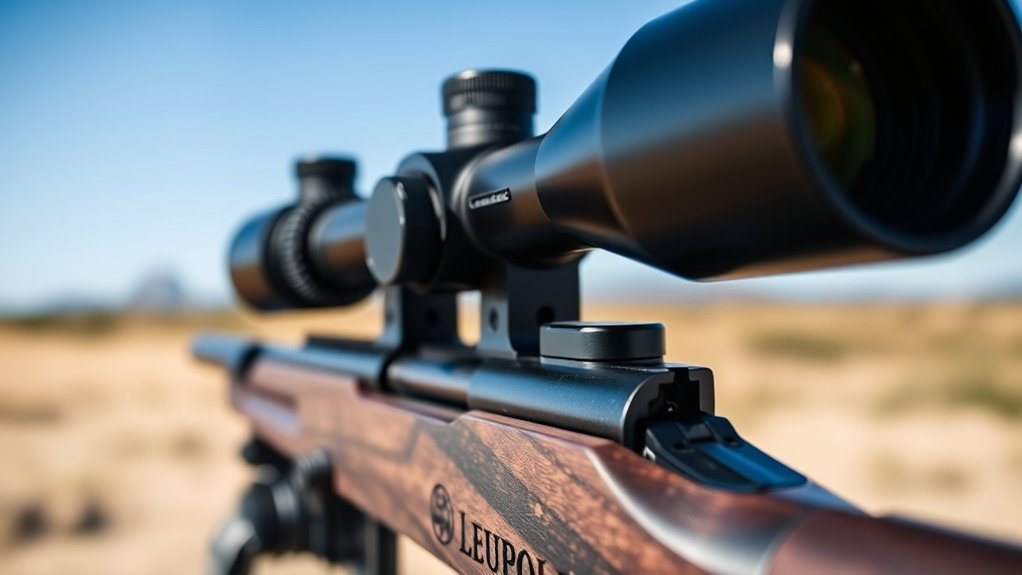
When you properly sight in your Leupold scope, you guarantee your shots hit exactly where you aim. This process aligns the scope’s reticle with the bullet’s point of impact, eliminating guesswork.
Without proper sighting, your shots may consistently veer off target, wasting ammo and compromising effectiveness. By ensuring your scope matches your rifle’s unique ballistics, you improve precision and confidence in every shot.
Proper sighting aligns your scope with your rifle’s ballistics, boosting accuracy and shot confidence every time.
Proper sighting also helps you adjust for variables like distance and wind, making your shooting more adaptable. Ultimately, a well-sighted scope turns your Leupold into a reliable tool, letting you focus on your target rather than compensating for errors.
It’s the foundation of accuracy, whether you’re hunting or target shooting.
Tools Needed to Sight In Your Leupold Scope
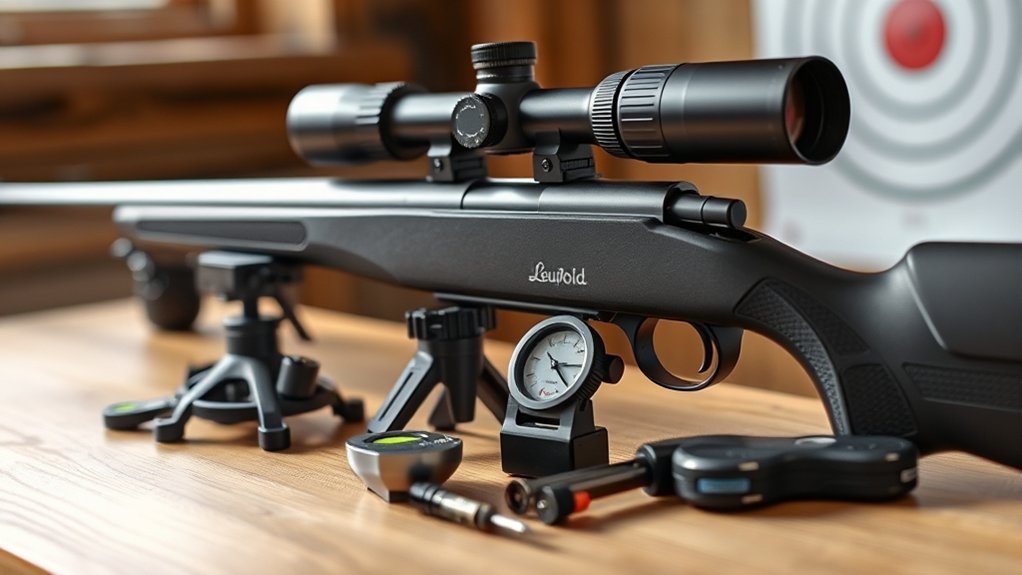
To sight in your Leupold scope accurately, you’ll need a few essential tools like a stable rest, targets, and a reliable spotting scope.
Having the right accessories can make the process smoother and more precise.
Let’s look at the key equipment that’ll help you get the job done right.
Essential Equipment Checklist
Although sighting in your Leupold scope might seem straightforward, having the right tools on hand makes the process smoother and more accurate. Start with a stable rifle rest or shooting bench to keep your firearm steady.
Bring quality targets—preferably paper or steel—that offer clear aiming points. Don’t forget a reliable spotting scope or binoculars to observe your shots without moving from your position.
A rangefinder helps confirm the exact distance to your target, ensuring precise adjustments. Also, pack a screwdriver or Allen wrench for making scope adjustments, plus extra batteries if your scope has illuminated reticles.
Finally, bring cleaning supplies to maintain your barrel’s consistency throughout the session. With these essentials, you’ll set yourself up for a successful sight-in every time.
Recommended Accessories Overview
Since accurate adjustments depend on precise tools, you’ll want to gather a few key accessories before sighting in your Leupold scope.
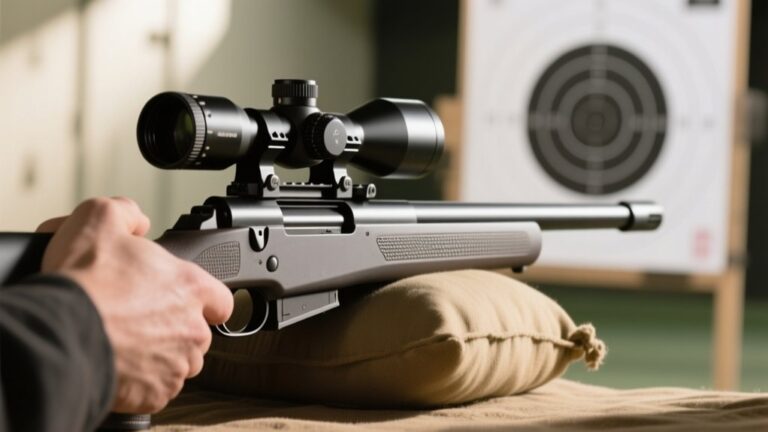
Start with a sturdy shooting rest or sandbags to stabilize your rifle, minimizing movement for consistent shots.
A reliable rangefinder helps you measure exact distances to your target, which is essential for zeroing in accurately.
Don’t forget a quality bore sighter—it saves time by aligning your scope roughly before live firing.
A target with clear, visible markings lets you track bullet impact easily.
Finally, bring a small screwdriver or scope adjustment tool specific to your Leupold model for fine-tuning your windage and elevation.
Having these accessories at hand guarantees a smoother, more precise sighting-in process.
Mounting Your Leupold Scope the Right Way
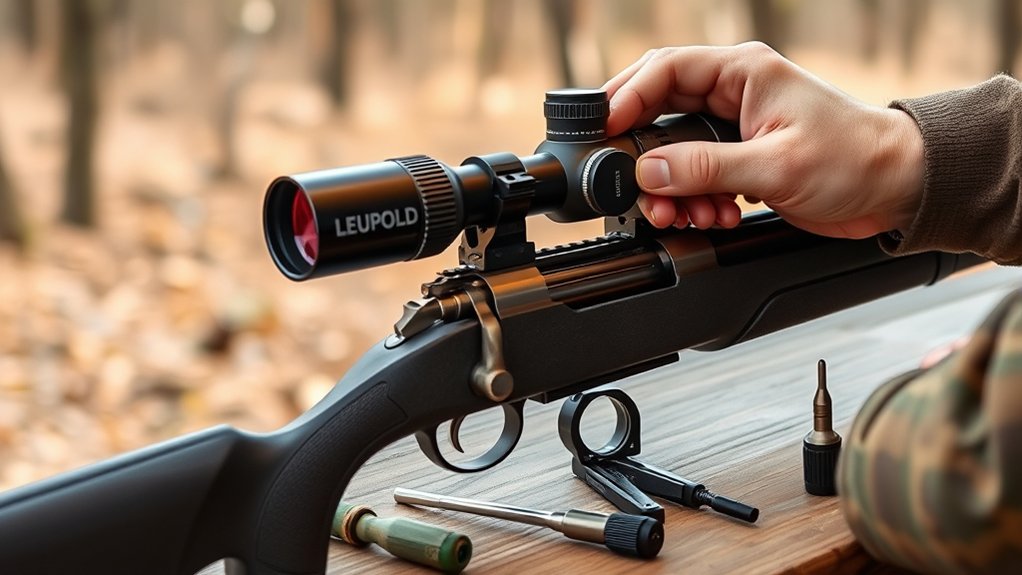
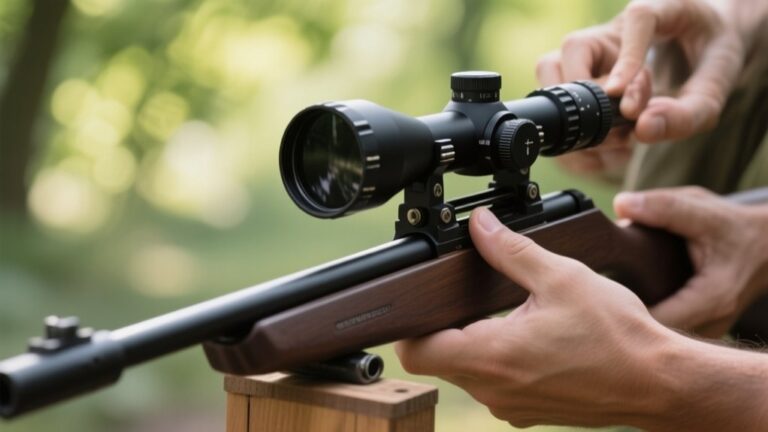
Before you start sighting in your Leupold scope, you need to mount it securely and correctly. Begin by selecting the right rings and bases designed for your rifle and scope model. Attach the bases firmly to your rifle, ensuring no movement.
Next, place the scope in the rings and adjust it for proper eye relief—this means you want a clear, full sight picture without moving your head excessively. Tighten the rings evenly, alternating between screws to avoid uneven pressure, which can damage the scope or affect accuracy.
Double-check the scope’s alignment; it should be level both vertically and horizontally. Taking your time during mounting helps prevent frustration later and guarantees your scope performs at its best when you start sighting it in.
Choosing the Right Distance to Zero Your Scope
When you start zeroing your Leupold scope, picking the right distance is essential for accuracy in the field. Most shooters zero at 100 yards because it balances bullet drop and trajectory for many hunting or target shooting scenarios.
However, your ideal distance depends on your typical shooting range and the caliber you use. If you mostly shoot at shorter distances, zeroing at 50 yards might make more sense. For long-range shooting, consider zeroing at 200 yards or more.
Setting Up Your Target for Accurate Sight-In
Now that you’ve chosen the right distance to zero your scope, it’s essential to set up your target correctly. Make sure your target is stable and clearly visible to get precise adjustments.
A steady setup helps you avoid errors and speeds up the sight-in process.
Choosing The Right Distance
How far should you set your target for the most accurate sight-in? It depends on your shooting purpose.
For general hunting, start at 100 yards—that’s the standard distance to zero your Leupold scope. This distance balances bullet drop and trajectory, letting you make precise shots within typical hunting ranges.
If you’re sighting in for long-range shooting, you might extend the target distance to 200 yards or beyond, but only after confirming your scope’s adjustments at closer ranges.
For varmint or small game, zeroing at 50 yards might be more practical, speeding up the sight-in process.
Always consider the typical distances you’ll shoot to choose the right target distance, ensuring your scope’s settings match real-world conditions perfectly.
Ensuring Stable Target Setup
Setting your target at the right distance is just the start; guaranteeing it stays stable throughout your sight-in session is equally important. You want your target firmly anchored to prevent movement caused by wind or recoil. Use a sturdy target stand or secure the target to a solid backstop like a wooden frame or sandbags.
If you’re shooting outdoors, choose a location sheltered from strong winds to minimize sway. Double-check the target’s position before every shot to maintain consistent aim points. Avoid lightweight paper targets alone, as they flutter easily. Instead, consider backing them with cardboard or foam to keep them flat.
A stable target setup ensures your adjustments are accurate, helping you zero your Leupold scope effectively without guessing or repeated corrections.
Using Your Reticle to Get Perfect Alignment
Before you start adjusting your scope, you’ll want to verify your reticle is perfectly aligned with the target. Look through your Leupold scope and position the crosshairs directly over the center of your target. If the reticle appears tilted or off-center, it can cause inaccurate shots.
To check alignment, focus on the reticle itself—ensure the vertical and horizontal lines are square with the rifle’s barrel and the target’s orientation. You can also use a bubble level on your rifle or scope mount to confirm there’s no canting.
Taking the time to get this alignment right means every adjustment you make afterward will be accurate, helping you achieve precise shot placement without guessing or unnecessary corrections.
Making Initial Adjustments on Your Leupold Scope
Now that your reticle is aligned, it’s time to make initial adjustments on your Leupold scope. You’ll start by setting your zero distance.
Then, fine-tune windage and elevation to match your shooting conditions. Using bore sighting tools can speed up this process and improve accuracy before you take your first shot.
Setting Zero Distance
Although zeroing your Leupold scope might seem straightforward, getting it right requires careful attention to detail. Start by choosing your zero distance—commonly 100 yards for rifles—but consider your typical shooting range.
Set up a stable shooting rest and position your target at the chosen distance. Before firing, verify your rifle is securely mounted and the scope’s reticle is properly aligned.
When you take your initial shots, focus on grouping rather than perfect accuracy. This helps identify where adjustments are necessary without rushing.
Remember, setting your zero distance establishes the foundation for all further fine-tuning. Take your time, confirm your setup is consistent, and don’t move the target during this stage.
Once you’ve nailed this, you’re ready to adjust windage and elevation.
Adjusting Windage And Elevation
Once you’ve established a solid zero distance and confirmed your shots group consistently, it’s time to fine-tune your scope by adjusting windage and elevation.
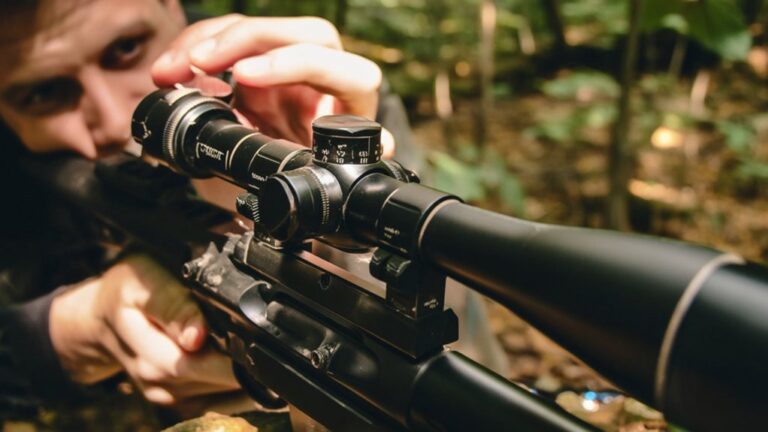
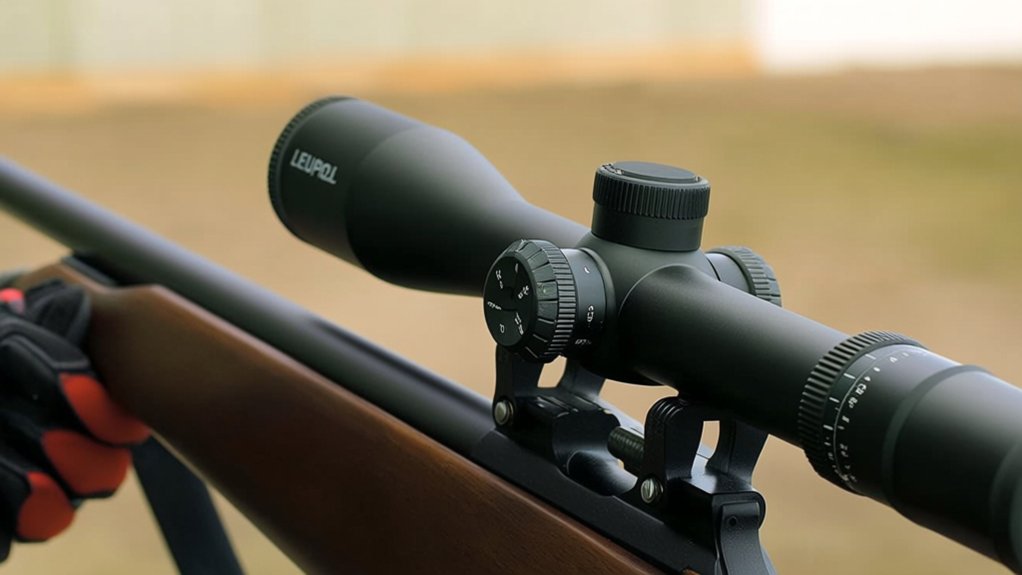
Begin by firing a three-shot group at your target and note where the group lands relative to the bullseye. Use the elevation turret to move the point of impact up or down, and the windage turret to shift it left or right.
Each click typically corresponds to ¼ MOA (about ¼ inch at 100 yards), so adjust accordingly based on your grouping. Make small, deliberate adjustments, then fire another group to evaluate changes.
Repeat this process until your bullet impacts exactly where you aim. Remember, patience and precision during this step guarantee your Leupold scope performs accurately in the field.
Using Bore Sighting Tools
How do you guarantee your Leupold scope’s reticle aligns closely with your barrel before live firing? Using bore sighting tools is the answer.
Start by securely mounting your rifle in a stable rest. Insert a bore sight tool into the barrel, which projects a laser or aligns a visible marker down the bore.
Look through your scope and adjust the windage and elevation knobs until the reticle centers on the projected laser dot or bore alignment mark.
This process gets you on paper quickly and saves ammo. Once aligned, you’ll find zeroing at the range much faster and more precise.
Fine-Tuning Windage and Elevation on Your Leupold Scope
When you start fine-tuning windage and elevation on your Leupold scope, you’ll make precise adjustments to guarantee your shots hit exactly where you aim.
Begin by firing a group of shots at a target from your usual shooting distance. Note where the group lands relative to the bullseye.
Start by shooting a group at your regular distance and observe its placement on the target.
To correct horizontal deviation, adjust the windage turret—turn it right to move the point of impact right, or left to move it left.
For vertical shifts, use the elevation turret—turn it up to raise the impact point or down to lower it.
Make small, incremental turns and shoot another group to observe changes.
Repeat this process until your shots consistently cluster on the target, ensuring your scope is finely tuned for accuracy.
Confirming Your Leupold Scope Is Properly Zeroed
Now that you’ve adjusted your windage and elevation, it’s time to verify your scope’s zeroing accuracy.
You’ll want to test at various distances to guarantee consistent precision.
If needed, make further adjustments to your windage and elevation until your shots consistently hit the target.
Verify Zeroing Accuracy
Although you’ve made your initial adjustments, you’ll want to verify zeroing accuracy to guarantee your Leupold scope hits precisely where you aim.
Start by setting up a stable shooting position at your desired zeroing distance. Next, fire a three-shot group aiming at the exact center of your target.
After shooting, carefully examine your group’s placement on the target to see if the bullets cluster where you intended. Finally, note any deviation from the bullseye and confirm the group size is tight enough for your needs.
If your shots consistently land near the point of aim, your scope is properly zeroed. This verification step ensures confidence in your shooting accuracy before you head out into the field.
Adjust Windage And Elevation
Since precise adjustments are key to hitting your target consistently, you’ll need to fine-tune the windage and elevation settings on your Leupold scope.
Start by identifying the direction your shots are grouping off-target. Use the windage turret to move the point of impact left or right, and the elevation turret to shift it up or down.
Each click usually moves the impact a specific fraction of an inch or MOA, so consult your scope’s manual for exact values.
Make small modifications, then fire a few more rounds to see the effect.
Repeat this process until your shots cluster tightly on your aiming point.
This method guarantees your scope is zeroed accurately, giving you confidence in your shot placement every time you pull the trigger.
Test At Various Distances
How do you guarantee your Leupold scope stays accurate beyond the initial zeroing distance? Testing at various distances is essential to confirm your adjustments hold true in real-world scenarios. Here’s how to do it effectively:
- Start Close: Begin at 25 yards to ensure your point of impact matches your aim, confirming your baseline zero.
- Move to Mid-Range: Shoot at 50 and 100 yards, adjusting for any consistent deviation you notice. This helps you understand bullet drop and wind influence.
- Try Long Range: Test at 200 yards or more to verify your scope’s reliability for extended shots, making fine tweaks if necessary.
Adjusting for Different Ammunition Types
Why does your choice of ammunition matter when sighting in a Leupold scope? Different ammo types have unique ballistics, including velocity, bullet weight, and trajectory, which directly affect your point of impact.
Ammunition choice impacts ballistics like velocity and trajectory, influencing your point of impact when sighting in a Leupold scope.
When you switch ammo, your previous zero may no longer be accurate. Always sight in with the exact ammunition you plan to use regularly.
Start by firing a group with your chosen ammo, then adjust windage and elevation turrets on your Leupold scope to align the reticle with your bullet impacts.
If you change ammo types later, repeat this process to maintain precision.
Ignoring ammo differences can lead to missed shots and frustration, so take the time to adjust your scope accordingly for each ammunition variant you use.
Sight-In Techniques for Longer Distances
When you move out to longer distances, sighting in your Leupold scope requires extra attention to factors like bullet drop, wind drift, and even atmospheric conditions.
Start by zeroing your scope at a moderate range, like 100 yards, to establish a baseline.
Then, follow these steps:
- Calculate bullet drop: Use ballistic charts or apps to know how much to adjust your elevation turret for the distance.
- Compensate for wind: Observe wind direction and speed, then dial in the appropriate windage adjustments.
- Account for environmental factors: Temperature, humidity, and altitude can affect bullet trajectory, so fine-tune your settings accordingly.
Troubleshooting Common Sight-In Problems
If your shots aren’t grouping where you expect, don’t get discouraged—many common sight-in problems have straightforward solutions.
First, check your mounting; a loose or improperly aligned scope can throw off accuracy. Tighten all screws and ensure the scope sits level.
Ensure your scope is securely mounted and perfectly level to maintain shooting accuracy.
Next, confirm you’re using the right ammunition and that it’s consistent. Inconsistent ammo affects grouping and point of impact.
Also, verify your target distance matches your adjustments—mistakes here cause confusion.
Don’t overlook parallax errors; adjust the parallax setting to match your range for a sharp reticle.
Finally, review your shooting position and technique; inconsistent hold or trigger pull often shifts shots.
Maintaining Your Leupold Scope for Longevity
Although Leupold scopes are built tough, you’ll want to perform regular maintenance to keep yours functioning smoothly and accurately over time. Proper care guarantees your scope won’t lose zero or suffer damage that impacts performance. Follow these steps:
- Clean the lenses carefully – Use a microfiber cloth and lens cleaner designed for optics to avoid scratches or residue buildup.
- Check and tighten all mounts and screws – Loose hardware can shift your scope, so make sure everything stays secure after every outing.
- Store your scope properly – Keep it in a padded case when not in use, away from moisture and extreme temperatures to prevent corrosion and fogging.
Using Your Leupold Scope to Shoot Consistently
To shoot consistently with your Leupold scope, you need to develop a reliable routine that combines proper positioning, steady breathing, and controlled trigger pulls. Start by ensuring your shooting stance is stable and comfortable. Focus on your breathing—inhale deeply, exhale halfway, then hold steady before squeezing the trigger slowly. Practice this routine regularly to build muscle memory.
Here’s a quick reference for consistency:
| Element | Tip | Outcome |
|---|---|---|
| Positioning | Keep a firm, balanced stance | Minimizes movement |
| Breathing | Control breath cycle | Reduces scope sway |
| Trigger Pull | Squeeze, don’t jerk | Prevents shot disruption |
Stick to these fundamentals and your accuracy with the Leupold scope will improve markedly.
Frequently Asked Questions
What Is the Warranty Coverage for Leupold Scopes?
Leupold scopes come with a lifetime warranty, covering any defects in materials or workmanship. You don’t have to worry about repairs or replacements—they’ll take care of it, no questions asked, for as long as you own it.
Can I Use a Leupold Scope for Night Hunting?
You can’t turn night into day with a regular torch, and similarly, Leupold scopes alone won’t work for night hunting. You’ll need night vision or thermal attachments to see clearly in the dark wilderness.
How Do I Clean the Lenses Without Damaging the Scope?
You should blow off dust with a soft brush, then gently wipe lenses using a microfiber cloth and lens cleaner designed for optics. Avoid harsh chemicals or rough materials to prevent scratches and maintain your scope’s clarity.
Are Leupold Scopes Compatible With All Rifle Models?
Leupold scopes aren’t compatible with every rifle, but they fit most popular models. You’ll want to check your rifle’s mounting system and the scope’s base to guarantee a proper fit before buying or installing.
What Is the Difference Between Various Leupold Scope Reticle Types?
Leupold reticles differ mainly in design and functionality; you’ll find duplex reticles for simplicity, mil-dot for range estimation, and BDC for bullet drop compensation. Each suits different shooting styles and distances, so pick based on your needs.
Conclusion
Sighting in your Leupold scope is like tuning a fine musical instrument—it guarantees every shot hits the mark with precision and confidence. By carefully mounting, zeroing at the right distance, and maintaining your scope, you set yourself up for consistent success in the field. Remember, patience and practice are your best allies. Keep your scope in top shape, and it’ll reward you with accuracy that sings every time you pull the trigger.