How to Use MOA on a Rifle Scope for Precise Shooting
To use MOA on your rifle scope for precise shooting, first understand that 1 MOA equals about 1 inch of adjustment at 100 yards. Each click on your scope usually moves the point of impact by ¼ MOA, so calculate how many clicks you need to correct your shot. Adjust turrets accordingly and zero your scope by measuring your group’s deviation from the target. Mastering these steps will sharpen your accuracy, and there’s more to explore about fine-tuning your adjustments for varied conditions.
What MOA Means and Why It Matters
Although it might seem technical at first, understanding MOA is vital if you want to improve your shooting accuracy. MOA stands for Minute of Angle, a unit used to describe the adjustment increments on your rifle scope.
When you turn the turret, you’re moving the reticle by a fraction of a degree, which translates to a specific distance on your target depending on how far you are. Knowing this helps you make precise corrections for bullet drop or wind drift.
If you grasp what MOA represents, you’ll confidently dial in your scope adjustments and hit your target more consistently. Without this knowledge, you’re fundamentally guessing, which can cost you both time and accuracy in the field or at the range.
What MOA As an Angular Measurement Means
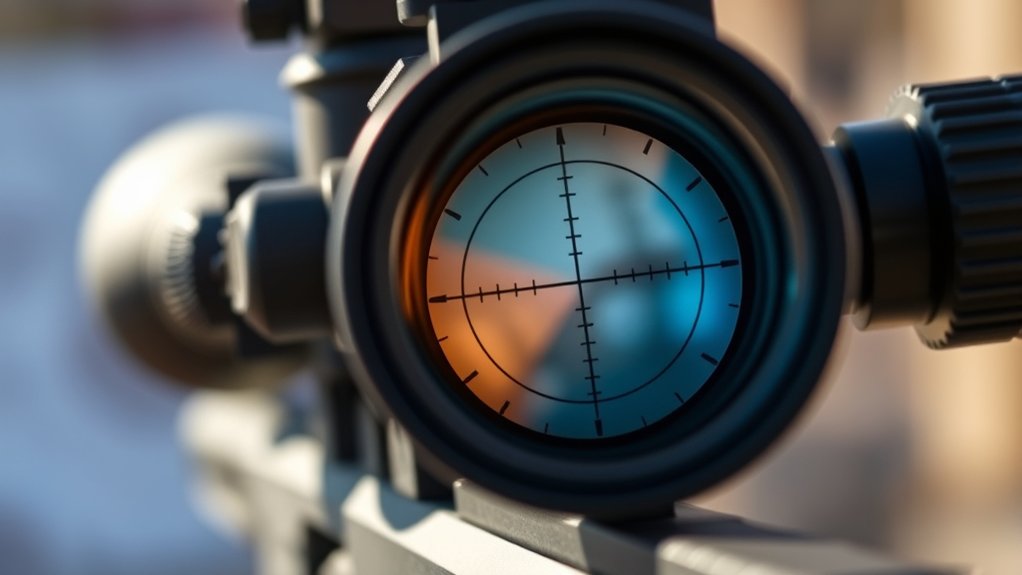
How exactly does MOA function as an angular measurement in practical terms? MOA, or Minute of Angle, represents 1/60th of a degree, measuring angles rather than distances.
When you look through your scope, MOA helps you understand how much your bullet’s point of impact shifts at various distances.
At 100 yards, 1 MOA roughly equals 1.047 inches, so if you adjust your aim by 1 MOA, your bullet lands about an inch away from the original point.
This angular measurement stays consistent regardless of range, which means the linear size changes with distance.
How to Use MOA for Rifle Scope Adjustments
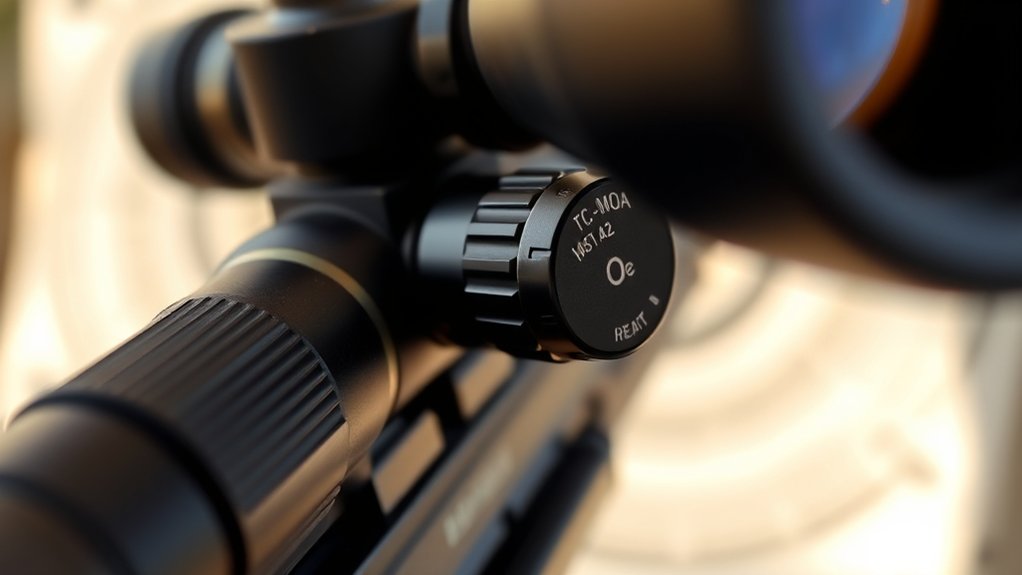
Where do you start when adjusting your rifle scope using MOA? First, understand that each click on your scope typically equals 1/4 MOA, which moves the point of impact about 0.25 inches at 100 yards.
To make precise adjustments, follow these steps:
- Determine how far off your shot landed from the target in inches.
- Calculate the number of clicks needed by dividing the distance by 0.25 inches per click.
- Adjust the turret in the direction you want the bullet to move (up/down or left/right).
How to Set Your Scope’s Zero Using MOA
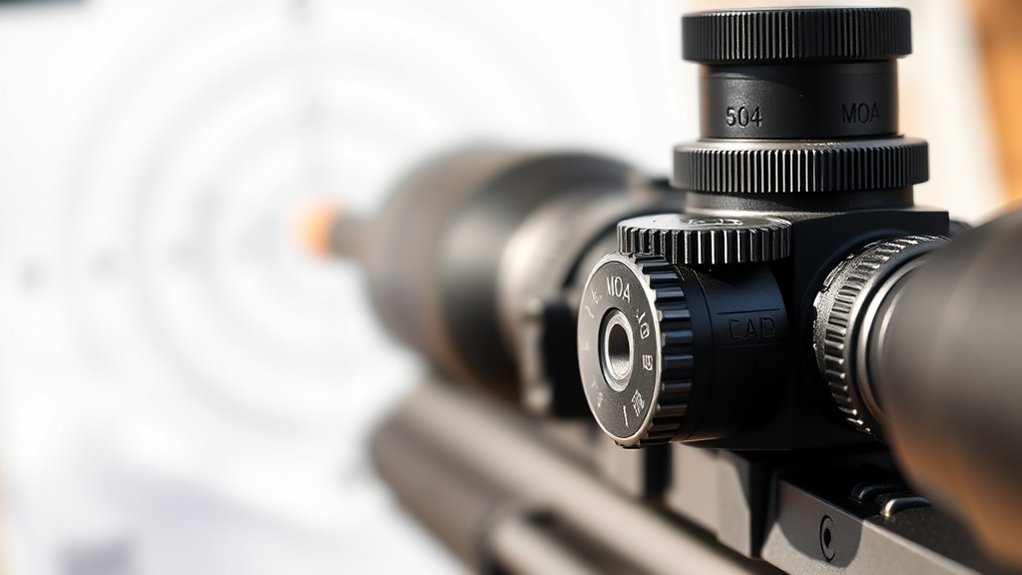
Setting your scope’s zero using MOA is essential for accurate shooting at your preferred distance. Begin by securely mounting your rifle on a stable rest and placing a target at the distance you want to zero, commonly 100 yards.
Fire a three-shot group and observe where the bullets hit relative to the bullseye. Measure the distance between the group’s center and the bullseye in inches.
Convert this measurement to MOA—remember, 1 MOA equals 1.047 inches at 100 yards.
Use this MOA value to adjust your scope’s elevation and windage turrets accordingly, moving the reticle in the opposite direction of the group’s deviation.
After adjustments, fire another group to confirm your zero. Repeat as needed until your shots consistently hit the bullseye at your chosen range.
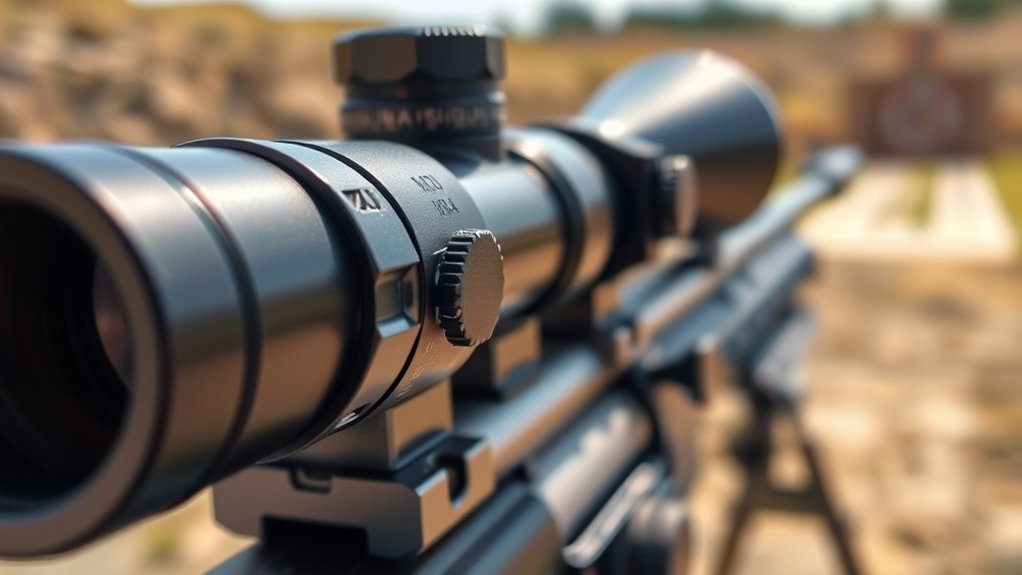
How to Read and Turn Your Scope’s MOA Turrets
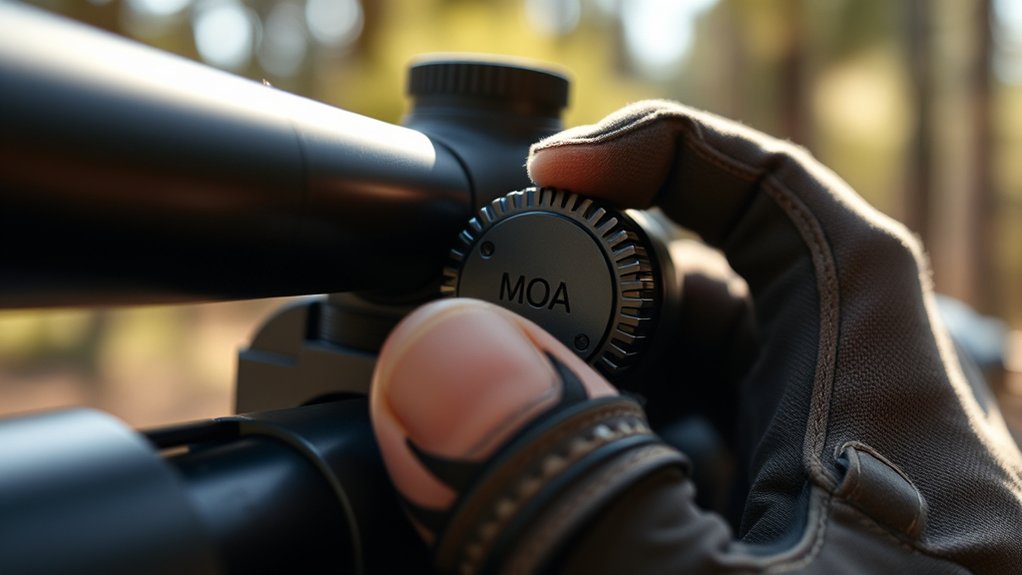
After zeroing your scope using MOA, understanding how to read and adjust your scope’s MOA turrets will help you make precise corrections on the fly.
Each turret click typically represents ¼ MOA, which moves the point of impact roughly ¼ inch at 100 yards.
To read your turrets:
- Check the numbers and hash marks to see how many MOA adjustments you’ve dialed.
- Turn the elevation turret clockwise to move the point of impact down, counterclockwise to move it up.
- Rotate the windage turret clockwise to shift impact right, counterclockwise to shift left.
How to Calculate MOA at Different Distances
To calculate MOA at different distances, you first need to understand that one MOA roughly equals 1 inch at 100 yards.
As the distance changes, the size of the adjustment shifts proportionally, so you’ll multiply or divide accordingly.
Knowing this lets you make precise MOA adjustments for accurate shooting at any range.
MOA Definition Basics
Understanding MOA (Minute of Angle) is essential when adjusting your rifle scope for accurate shooting at various distances. MOA measures angular deviation, allowing you to translate adjustments into real-world impact changes on your target.
One MOA equals 1/60th of a degree, which roughly corresponds to 1.047 inches at 100 yards. This standard helps you make precise corrections consistently.
To calculate MOA at different distances, keep these basics in mind:
- 1 MOA ≈ 1.047 inches at 100 yards
- At 200 yards, 1 MOA covers about 2.094 inches
- At 300 yards, 1 MOA equals roughly 3.141 inches
Knowing these values helps you quickly estimate how much to adjust your scope turrets for varying ranges. This fundamental understanding keeps your shots accurate and your adjustments efficient.
Distance Impact On MOA
How does distance affect your MOA adjustments on a rifle scope? As you shoot farther, the bullet’s drop increases, meaning your MOA value changes with distance. MOA represents angular measurement, so one MOA covers a bigger area as distance grows. Understanding this helps you make precise shots.
Here’s a quick reference to see how MOA translates to inches at various distances:
| Distance (yards) | 1 MOA (inches) |
|---|---|
| 100 | 1.047 |
| 200 | 2.094 |
| 300 | 3.141 |
| 400 | 4.188 |
Knowing these values helps you estimate how much your point of impact shifts, so you can adjust your scope accordingly for accurate shooting at any range.
Calculating MOA Adjustments
Since MOA changes with distance, you’ll need a clear method to calculate your adjustments for each shot.
First, understand that 1 MOA equals roughly 1.047 inches at 100 yards, but you can simplify it to 1 inch for easier math.
To adjust your scope precisely, follow these steps:
- Measure the distance to your target.
- Calculate the bullet’s deviation in inches at that distance.
- Divide that deviation by the inches per MOA value (adjusted for distance).
For example, if your bullet hits 3 inches low at 200 yards, divide 3 by 2.094 (1.047 inches × 2) to get about 1.43 MOA adjustment upward.
This method helps you dial in your scope accurately, improving your shot placement every time.
How to Adjust for Bullet Drop Using MOA
When you notice your shots consistently hitting below the target at longer distances, it’s time to adjust for bullet drop using MOA.
Begin by determining the distance to your target and the bullet’s trajectory data, usually available in your ballistics chart.
Find the bullet drop in inches or centimeters for that distance, then convert it to MOA by dividing the drop by 1.047 (since 1 MOA ≈ 1.047 inches at 100 yards).
Next, use your rifle scope’s elevation turret to dial up the corresponding MOA adjustment.
For example, if your bullet drops 5 inches at 200 yards, that equals roughly 2.4 MOA.
Turn the turret down by 2.4 MOA to raise your point of impact.
This method guarantees precise compensation without guessing.
How to Compensate for Wind With MOA Adjustments
To compensate for wind using MOA adjustments, you first need to estimate the wind speed and its direction accurately.
Then, you’ll adjust both elevation and windage on your scope to counteract the bullet’s drift.
Getting these settings right guarantees your shot stays on target despite the wind.
Estimating Wind Speed
Although estimating wind speed can seem challenging at first, you can quickly learn to gauge it by observing environmental cues like moving foliage or dust patterns. These indicators give you practical insights into how much the wind might affect your bullet’s trajectory.
To make a solid estimate, consider these signs:
- Light breeze: leaves barely move, grass sways gently
- Moderate wind: small branches move, dust and loose debris lift
- Strong wind: large branches sway, flags flap vigorously
Adjusting Elevation and Windage
Since wind can push your bullet off course, you’ll need to adjust your rifle scope’s elevation and windage settings using MOA increments to keep your shot accurate.
Begin by estimating wind speed and direction, then use this info to determine how many MOA clicks to dial. For example, a 10 mph crosswind might require a 2 MOA windage adjustment. Turn the windage turret left or right accordingly.
Elevation adjustments compensate for bullet drop, so dial up or down based on distance and ballistic data.
Always remember one MOA equals roughly 1 inch at 100 yards, making it easier to translate your corrections into precise turret clicks.
Practice these adjustments in real conditions to build confidence and improve your long-range shooting accuracy.
When to Use MOA vs. MILs for Scope Adjustments
When deciding between MOA and MILs for scope adjustments, you’ll want to contemplate the type of shooting you do and your personal preference.
MOA (Minute of Angle) is often favored in hunting and target shooting within moderate distances because it breaks down adjustments into familiar 1-inch increments at 100 yards.
MILs (milliradians), on the other hand, are popular among military and long-range shooters due to their metric-based system, which can simplify range estimations and ballistic calculations.
Consider these points when choosing:
- Use MOA if you prefer inches and yards for quick, intuitive adjustments.
- Choose MILs for metric measurements and advanced ballistic computations.
- Factor in what your scope and reticle support to avoid confusion in the field.
Pick the system that aligns best with your shooting style and gear.
Practical Tips for Dialing MOA on Your Rifle Scope
Mastering the art of dialing MOA on your rifle scope requires understanding how each click translates into movement on your target. Each click typically adjusts your point of impact by 1/4 MOA, moving the bullet approximately 0.25 inches at 100 yards. Always make adjustments based on your shooting distance and note that the effect scales linearly with range. Keep a shooting log to track adjustments for various distances, and practice dialing in under different conditions.
| Distance (yards) | Clicks per MOA | Impact Shift per Click (inches) |
|---|---|---|
| 100 | 4 | 0.25 |
| 200 | 4 | 0.5 |
| 300 | 4 | 0.75 |
| 400 | 4 | 1.0 |
| 500 | 4 | 1.25 |
Common Mistakes to Avoid When Using MOA
Although MOA adjustments seem straightforward, many shooters fall into common pitfalls that can throw off their accuracy. To make the most of your scope’s MOA system, avoid these mistakes:
- Neglecting to Zero First: Skipping the initial zeroing step means your MOA adjustments won’t be accurate relative to your point of impact.
- Confusing Click Values: Don’t assume every scope click equals 1/4 MOA. Check your scope’s specs to avoid incorrect adjustments.
- Overcorrecting Adjustments: Making large, frequent changes instead of small, precise tweaks can lead you off target quickly.
How MOA Improves Grouping and Accuracy
Because MOA allows you to make precise adjustments to your rifle scope, you can tighten your shot grouping and improve overall accuracy.
By understanding that one MOA equals roughly 1 inch at 100 yards, you can dial in your scope to correct for slight deviations in your aim. This means you can consistently hit closer to your target’s center, reducing the spread between shots.
When you adjust your scope using MOA increments, you’re effectively compensating for factors like wind or elevation changes, keeping your shots aligned. This control helps you develop consistent shooting habits, which directly enhances grouping.
Ultimately, using MOA correctly guarantees every shot counts, making your shooting more reliable and precise without guessing or over-adjusting.
Advanced MOA Tips for Long-Range Shooting
Once you’ve grasped how MOA helps tighten your shot grouping at typical distances, you can apply more advanced techniques for long-range shooting.
At extended ranges, even minor adjustments matter, so you need to fine-tune your scope precisely. Start by zeroing your scope at a known distance and use MOA clicks to compensate for bullet drop and wind drift.
Keep in mind:
- Calculate holdovers using ballistic charts or apps, then dial MOA adjustments accordingly.
- Make wind corrections by estimating wind speed and direction, adjusting MOA to counteract drift.
- Practice shooting at various distances to understand how environmental factors affect your MOA settings.
Frequently Asked Questions
Can MOA Adjustments Vary Between Different Rifle Calibers?
Yes, MOA adjustments can vary between calibers because each bullet’s trajectory and velocity differ. You’ll need to account for these differences when zeroing your scope to guarantee precise shots at various distances.
How Does Temperature Affect MOA Adjustments?
Did you know bullets can shift up to 1.5 MOA with a 20°F temperature change? You’ll need to adjust your MOA settings since temperature affects air density and bullet trajectory, keeping your shots precise regardless of weather.
Are MOA Adjustments Compatible With All Rifle Scope Brands?
MOA adjustments are generally compatible with most rifle scope brands since they follow a standard measurement system. You just need to make sure your scope’s turret clicks correspond to MOA increments for precise and consistent adjustments.
Can MOA Be Used for Moving Target Shooting?
Yes, you can use MOA for moving target shooting by adjusting your aim to lead the target. You’ll estimate the target’s speed and distance, then dial in the appropriate MOA holdover to improve accuracy.
How Often Should I Recalibrate My Scope’s MOA Settings?
You should recalibrate your scope’s MOA settings every time you change ammunition, after significant impacts or bumps, and periodically during regular use to guarantee accuracy. Consistent checks keep your shots precise and reliable.
Conclusion
Mastering MOA on your rifle scope can boost your shooting accuracy considerably. Did you know that just a 1 MOA adjustment changes your bullet impact by about 1 inch at 100 yards? Understanding and using MOA lets you make precise corrections, improving your grouping and confidence in every shot. Keep practicing these techniques, and you’ll see your long-range shooting skills sharpen, turning every target into a clear hit.